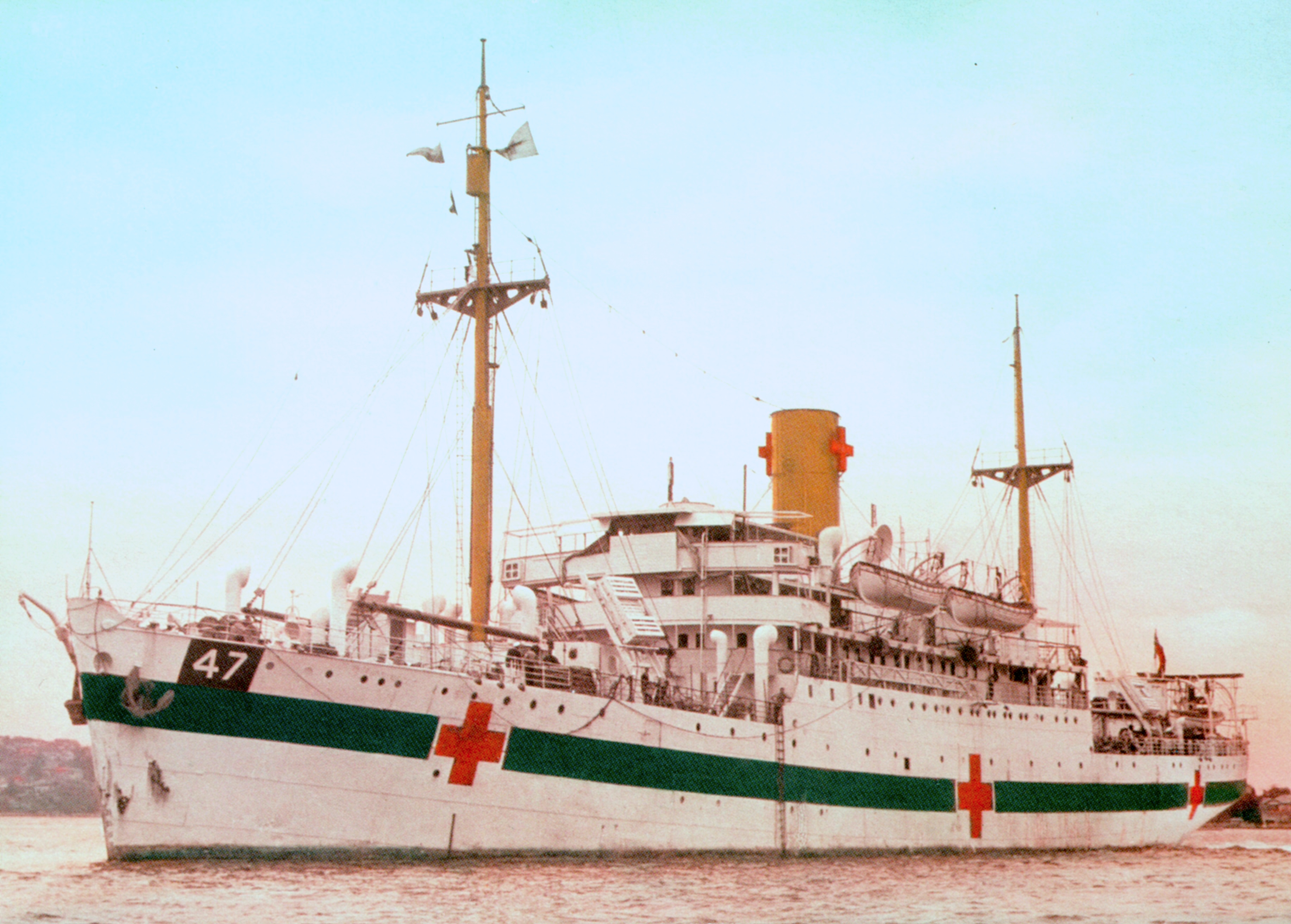
Centaur was named for the creature in the old stories, half man and half horse. She was a Blue Funnel motor ship of the Ocean Steamship Company, built to take the place of Charon on the run from Fremantle up the Western Australian coast and on through Java to Singapore. Scotts of Greenock laid her down on 16 November 1923, launched her on 5 June 1924, and finished her on 29 August 1924. She was registered at Liverpool and worked out of Fremantle. She measured 3,222 tons and 96 meters, with a flat strengthened bottom so she could sit on the mud when the northwest tides ran out. Twin screws and Burmeister & Wain diesels drove her. She carried passengers, cargo in four holds, and cattle.
From the end of 1924 she worked that coast, Geraldton, Carnarvon, Onslow, and the ports to the north, then the Bali Strait, Surabaya, Semarang, Batavia, and Singapore. The calls changed from voyage to voyage. In November 1938 the Japanese whale-chaser Kyo Maru II broke down on the way home from the Antarctic and was drifting onto the Houtman Abrolhos. Centaur took her in tow and brought her into Geraldton.
In 1939 a 4-inch gun and two machine guns went aboard, with paravanes and degaussing gear against mines. She stayed on her own run. On 26 November 1941, a week after Sydney and the German raider Kormoran destroyed each other off Western Australia, an aircraft sent her to a lifeboat of Kormoran men. Theodor Detmers was among them. Her master would not leave them in the boat, and he would not fill the ship with them. Nine wounded men came aboard. He towed the rest toward Carnarvon. The boat swamped, and two of Centaur's own boats finished the tow. The Germans went into a hold, with more of their men and an army guard, and she took them down to Fremantle. After Japan entered the war the run stopped at Broome. In October 1942 she was sent across to carry cargo between Queensland and New Guinea.
The hospital ships already serving Australia, Manunda, Wanganella, and the Dutch Oranje, could not work the shallow New Guinea harbors. On 4 January 1943 the British Ministry of Shipping put Centaur at Australia's disposal. The conversion began on 9 January. The guns came off. The degaussing gear stayed. On 1 March she commissioned as the 2/3rd Australian Hospital Ship, Red Cross ship 47. The hull was white, with a green band and red crosses, and the number 47 was on the bow. At night the marks were lit. She could take 252 patients. In the first week of February the Red Cross had her description, and Japan was told on 5 February. She began work on 12 March. The run from Melbourne to Sydney produced a long list of defects from the master, the chief engineer, and the chief medical officer. After the repairs she carried wounded from Townsville to Brisbane, then took medical staff up to Port Moresby and brought Australian and American wounded, and a few Japanese prisoners, back.
She was in Sydney on 8 May and sailed on 12 May for Cairns, and from there for New Guinea. There were no patients aboard. With her went the merchant crew, the Torres Strait pilot Richard Salt, twelve nurses, the army medical staff of the ship, and 192 men of the 2/12th Field Ambulance. Three hundred and thirty-two people in all. Master George Alexander Murray, of Nedlands in Western Australia, had her. He and the chief medical officer refused the rifles the ambulance drivers wanted to bring until word came that the Hague rules allowed those weapons for order and for the defense of the wounded. The rest of the cargo was searched.
About 4:10 on the morning of 14 May, east-northeast of Point Lookout on North Stradbroke Island, a torpedo hit the port oil tank. The fuel caught. Fire ran from the bridge aft. She rolled to port and went down by the bow in less than three minutes. The boats were never launched. Two broke free as she sank. Sixty-four people lived. Murray did not. Twelve nurses had been aboard, and Sister Ellen Savage was the only one of them saved. She was given the George Medal for the hours on the wreckage. Of eighteen doctors, Lieutenant Colonel Leslie Outridge was the only one saved. Second Officer Gordon Rippon, the senior man left of the crew, put the ship about twenty-four miles east-northeast of Point Lookout. The survivors were in the water for about thirty-six hours. Ships and aircraft went by and did not see them. On the afternoon of 15 May an Anson of No. 71 Squadron found them. The destroyer Mugford, which had left Brisbane that morning to take the freighter Sussex on her way, picked up all sixty-four. Helm searched through the next day. Lithgow and four motor torpedo boats searched until 21 May. They found no one else.
No one on board saw the submarine at the moment she was hit. The cook, Francis Martin, adrift on a hatch, later saw one on the surface, and the shape was a Kaidai Type 7. Three boats of that type were off the coast, I-177, I-178, and I-180. I-177's signal that morning claimed a 15,000-ton freighter, not a hospital ship. Her captain, Hajime Nakagawa, lived through the war and would not admit the sinking. He was not tried for it. Japan denied the attack in December 1943. The place and that signal are what put it on I-177. The wreck was found on 20 December 2009, near 27°17′ S, 153°59′ E, in about 2,000 meters of water, within a mile of the position Rippon had worked out.