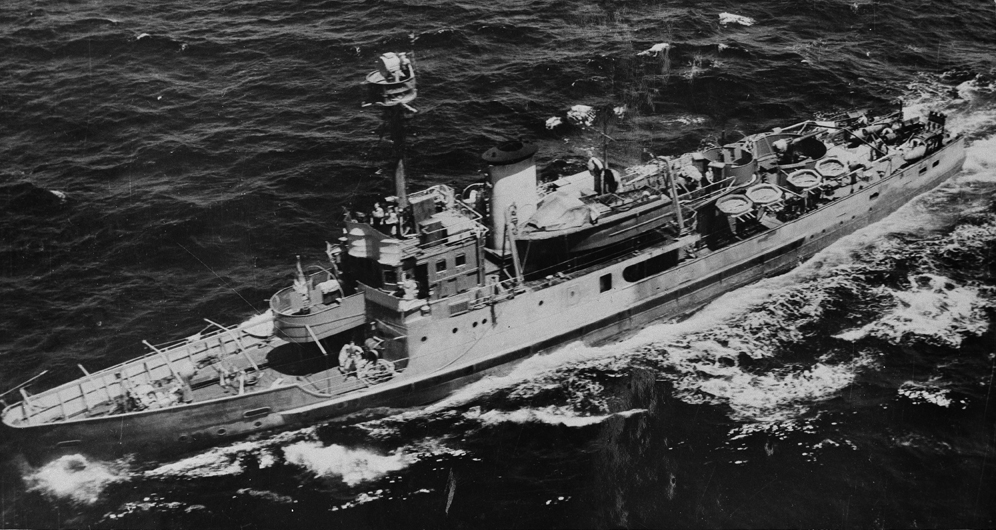
Abraham Crijnssen was named for a Dutch commander of the seventeenth century. Werf Gusto at Schiedam laid her down on 21 March 1936 and launched her on 22 September 1936. The Royal Netherlands Navy commissioned her on 26 May 1937. She was a Jan van Amstel-class minesweeper, about 460 tons and 56 meters long, good for about 15 knots, with a crew of about 45. The class was built for the Netherlands East Indies.
Bernardus Poortman had her from 2 September 1939. Johannes Abraham Agelink van Rentergem relieved him on 20 March 1941, and Anthonie van Miert took her on 3 October. By then she was at Surabaya.
Java was falling. On the evening of 6 March 1942, about half past nine, van Miert took her out of Surabaya with the tanks full. Three sisters had been meant to sail with her. Pieter de Bitter did not sail. By day Crijnssen lay in against the coast. She was painted and covered with nets, branches, and leaves, so that from the air she would pass for a small island, and the cover was renewed when the leaves died. On the morning of 7 March she saw Eland Dubois and Jan van Amstel near Gili Raja, still without that cover, and van Miert anchored farther east. After dark he went on, through Alas Strait and out into the Indian Ocean. She reached Geraldton on 15 March and Fremantle on 20 March. She was the last ship to get out of Java.
On 20 April she left Fremantle escorting the Dutch submarines K IX and K XII toward Sydney. Van Miert still had her. She was turned over to the Royal Australian Navy on 26 August. The Australians commissioned her on 28 September as an anti-submarine escort, under Arthur Irwin Chapman, a reserve lieutenant. He later wrote that he came aboard with a White Ensign under one arm and two framed pictures under the other, one of the King and one of Rita Hayworth, and that Queen Wilhelmina stayed in the wardroom. She worked the convoy routes along the Australian coast.
On 26 January 1943, escorting a Sydney-bound convoy through Bass Strait with the corvette Bundaberg, she got an asdic contact that behaved like a submarine, about 700 yards on the port beam. She dropped two charges set to 50 feet before she had much way on. The blast tore fittings off her own after end. Chapman wrote that the crockery went, light switches came off, and small pipes cracked. Queen Wilhelmina came down off the bulkhead. No wreckage was found. Nothing there is credited as a sinking. She spent about a week in dock at Sydney.
The Netherlands took her back on 5 May 1943. Joseph Remy Louis Lebeau had her until 8 July 1944, Klaas Gerrit Tiel until 20 March 1945, and then Sies Dobbenga. She stayed in Australian waters. On 30 May 1945 she exercised off Sydney with the submarine Vox. On 7 June she left Sydney for Darwin towing K IX, by then used as an oil lighter. The tow parted and K IX went ashore. Crijnssen was not sunk.
She left the East Indies in August 1951 and went home. She was taken out of service in 1961 and lent to the sea cadets. In 1995 she was given to the naval museum at Den Helder. She is there still, fitted out again as a wartime minesweeper.