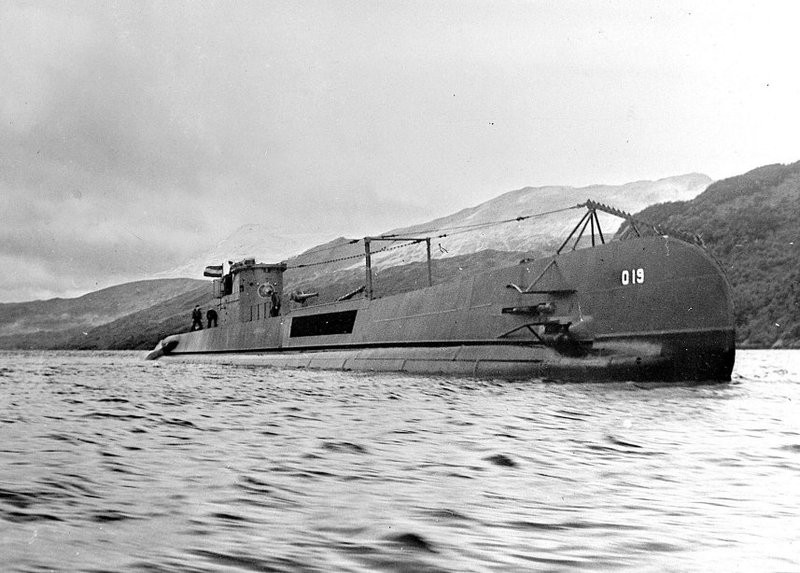
O 19 was an O 19-class minelaying submarine of the Royal Netherlands Navy, and one of the first boats fitted with a working snorkel, the Dutch snort, so her diesels could run while she was submerged. Wilton-Fijenoord laid her down at Rotterdam on 15 June 1936 as K XIX, under the old colonial K numbering. The Navy renamed her O 19 when it dropped the distinction between home and East Indies submarines. She was launched on 22 September 1938 and commissioned on 3 July 1939. Lieutenant Commander Karel van Dongen had her. She sailed for the Dutch East Indies by way of Suez on 25 July and arrived on 13 September 1939.
The design followed the Polish Orzeł class, also built in the Netherlands, and it made O 19 and her sister O 20 the first Dutch minelayers. She was about 1,100 tons surfaced and about 1,560 submerged, and 265 feet long. Two Sulzer diesels, about 5,300 horsepower, and electric motors gave her about 19.5 knots on the surface and about 9 knots submerged. The range was about 10,000 nautical miles at 12 knots. She carried eight 21-inch tubes, four in the bow and four in the stern, roughly 14 torpedoes, and 40 mines in 20 vertical Normand-Fenaux tubes in the saddle tanks. On deck she had an 88 mm Bofors gun and two retractable 40 mm Bofors guns. The snort was a breathing mast that let the diesels charge the batteries at periscope depth.
When Germany invaded the Netherlands on 10 May 1940, O 19 was already in the East Indies. The next years were patrol, convoy attack, and minelaying around the archipelago, the Gulf of Siam, the Strait of Malacca, and the waters off Sumatra and Java. F. J. A. Knoops had her from May to December 1941. H. F. Bach Kolling had her from late 1941 until October 1943. Armand van Karnebeek had her from October 1943 until December 1944. J. F. Drijfhout van Hooff had her from December 1944 until she was lost. The months are what the record gives. The days of those reliefs are not.
The credited attacks are these. On 10 January 1942 she torpedoed the Japanese troop transport Akita Maru, about 3,800 tons, in the Gulf of Siam. Some accounts call that a heavy damaging and not a confirmed sinking. On 15 January 1942 she is credited with Tairyu Maru, also written Taieryu Maru, about 4,900 tons. On 10 September 1944 she sank Korei Maru, 599 tons. On 16 November 1944 she sank the coaster Kaishin Maru No. 2, about 150 tons. On 9 January 1945 she sank the auxiliary gunboat Shinko Maru No. 1, 935 tons. On 10 April 1945 she sank the tanker Hosei Maru, 676 tons. She also sank small craft by gunfire and laid minefields, including one in Bantam Bay in January 1945. Her sister O 20 was lost on 19 December 1941 off Kota Bharu, Malaya, after an attack by the Japanese destroyer Uranami.
On 25 June 1945 she left Fremantle for Subic Bay with stores and dummy mines, stopped at Onslow, and passed Lombok Strait northbound on 2 July. Before dawn on 8 July she was running on the surface at about 16 knots, ballast tanks blown dry to make speed, and she struck Ladd Reef in the South China Sea, about 8°40′ N, 111°40′ E. The reef is a low coral scimitar only inches under the surface. She drove up onto it. Both screws hit coral, and the vertical mine chutes in the ballast tanks caught on outcrops, so she could not be shifted.
Cod, already bound for Subic Bay with a medical case, was ordered to the scene and arrived that night. Towing attempts on 9 and 10 July failed. Japanese ships and aircraft were still in the area, and the order came to abandon the boat. All 55 Dutch crew went aboard Cod. Demolition charges, two stern torpedoes from Cod, and 16 hits from Cod's 5-inch gun destroyed O-19. It is the only international submarine-to-submarine rescue on record. Cod flew the O 19 flag beside the United States ensign on the way to safety. The Dutch crew later threw a thank-you party for Cod's men in Fremantle.