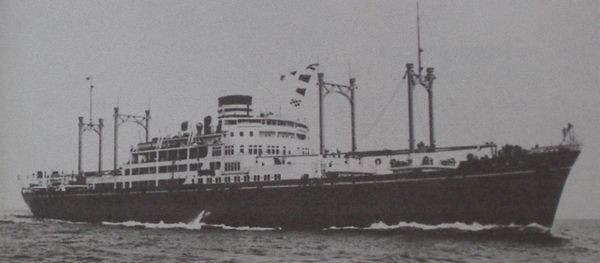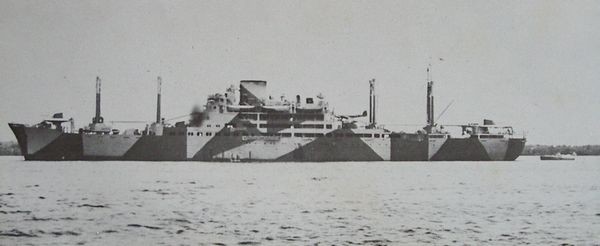
Aikoku Maru was laid down on 29 December 1938 at the Tama yard as a passenger-cargo ship for Osaka Shosen, for the South America and round-the-world service. She was launched on 25 April 1940 and completed on 31 August 1941. The Navy requisitioned her the next day. On 5 September she was registered at Kure. Rear Admiral-retired Masao Okamura, Etajima class 38, took command, and at the same time took joint command of Kiyosumi Maru. At Tamano she was fitted with four 152 mm guns, two 76 mm anti-aircraft guns, machine guns, and two torpedo tubes, and she carried a Kawanishi E7K2 floatplane.
With Hokoku Maru she was assigned to the 24th Cruiser Squadron, the raiding unit. In December 1941 and January 1942 the two ships worked the South Pacific. Hokoku Maru shelled the American freighter Vincent north of Pitcairn, and a torpedo finished Vincent. Aikoku Maru's floatplane strafed and bombed the freighter Malama, whose crew scuttled her. Both raiders picked up the people. In the spring the pair were attached to the Sixth Fleet as submarine supply ships, with fuel and torpedoes for the boats sent toward East Africa.
On 25 August 1942, at Penang, Commander Tamotsu Oishi relieved Okamura. Oishi was promoted captain on 1 November. On 11 November Aikoku Maru came up on the fight in which the Dutch tanker Ondina and the Indian minesweeper Bengal had blown up Hokoku Maru. Aikoku Maru hit Bengal, then put six shells into Ondina and fired two torpedoes, both of which missed. Ondina's crew abandoned her. Oishi's ship picked up Hokoku Maru's survivors and left.
Captain-retired Shojiro Mizusaki, class 38, former commanding officer of Suzuya, took her at Kure on 5 April 1943. Captain-retired Yoshizo Nakamaruo, class 36, former executive officer of the submarine tender Jingei, relieved him on 20 October 1943. By February 1944 she was a transport in the lagoon, loaded with men and ammunition.
She was anchored on the east side of Dublon. At dawn on 17 February, planes from Intrepid hit her. The first bomb struck the officers' wardroom galley and started a fire. Three more bombs hit. About 0830 a Mark 13 torpedo went into No. 1 hold and set off the ordnance there. The blast sheared away the forepart of the ship. She went down in about two minutes at 07-22 N, 151-56 E, taking Captain Nakamaruo, most of the crew, and 945 sailors, passengers, and men of the First Brigade, and also the Avenger that had torpedoed her. Nakamaruo was promoted rear admiral after his death.
A note on sources. The career and the manner of the loss are the tabular record by Bob Hackett and Sander Kingsepp on combinedfleet.com, which is also the source for the commanding officers. The Joint Army-Navy Assessment Committee calls her a converted light cruiser of 10,437 tons and prints 7-22 N, 151-54 E, carrier aircraft, 17 February. Jeffery's tonnage is 10,348. The famous photograph of an ammunition ship exploding over Dublon that morning, Navy number 80-G-215155, does not name her in the Naval History and Heritage Command caption, so it is not used here as her picture.