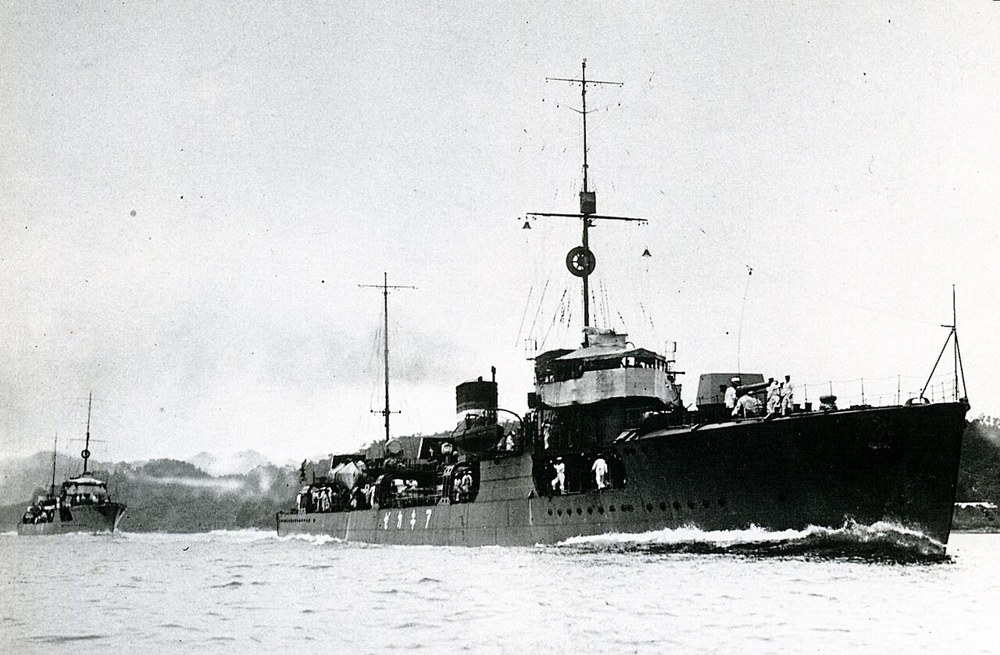
The name means autumn wind. Akikaze was a Minekaze-class destroyer built by Mitsubishi at Nagasaki. She was laid down on 7 June 1920, launched on 14 December 1920 and commissioned on 16 September 1921. She served in Destroyer Division 4 with Hakaze, Tachikaze and Hokaze in the First Torpedo Squadron, and patrolled the central China coast in 1938 and 1939.
At Pearl Harbor she was in Destroyer Division 34 of the 11th Air Fleet at Takao, giving air-sea rescue support to the Philippines invasion and escorting convoys to Davao and Legazpi. From January to April 1942 she was at Davao, escorting ships between Davao and Ambon. From May 1942 she was at Rabaul, escorting transports. On 14 March 1943 she and two other destroyers attacked a submarine, possibly USS Triton, near Kairiru Island. An air raid on 2 August 1943 killed her captain, Lieutenant Commander Tsurukichi Sabe, and 22 others. She made Tokyo Express runs to New Guinea from October 1943 to February 1944, then escorted convoys out of Truk and, from May 1944, Manila.
On 18 March 1943, with Lieutenant Commander Tsurukichi Sabe in command, she was the scene of a war crime. She took aboard the staff of the Catholic mission on Kairiru Island and some people from Wewak, including Bishop Joseph Loerks, 38 missionaries (18 of them nuns) and three children, and then picked up about 20 more at Manus. Wikipedia says her commander received orders from Eighth Fleet headquarters to dispose of all the civilians aboard, and that all of them were killed between Manus and Rabaul. Combinedfleet.com puts the number at about 60. The Australian War Crimes Section handed the case to the American authorities on 18 July 1947, who appear to have taken no further action.
On 24 and 25 October 1944 she led the escort of the Second Supply Force with Ozawa's Northern Force and rescued survivors of the oiler Jinei Maru. On 1 November 1944 Destroyer Division 30 (Yuzuki, Uzuki and Akikaze) left Mako to escort the carrier Junyo and the cruiser Kiso to Brunei. On 3 November USS Pintado torpedoed Akikaze, 160 miles west of Cape Bolinao, and she sank. Lieutenant Commander Yamazaki was killed. She was struck from the Navy List on 10 January 1945.
Commanding officers, from the combinedfleet.com record: Lieutenant Commander Tsurukichi Sabe, from 20 October 1942 (killed in the air raid of 2 August 1943); Lieutenant Commander Nitaro Yamazaki (in command when she was sunk on 3 November 1944; killed).
Sources: Allyn Nevitt's combinedfleet.com Tabular Record of Movement for IJN Akikaze; Wikipedia, Japanese destroyer Akikaze, rewritten here.