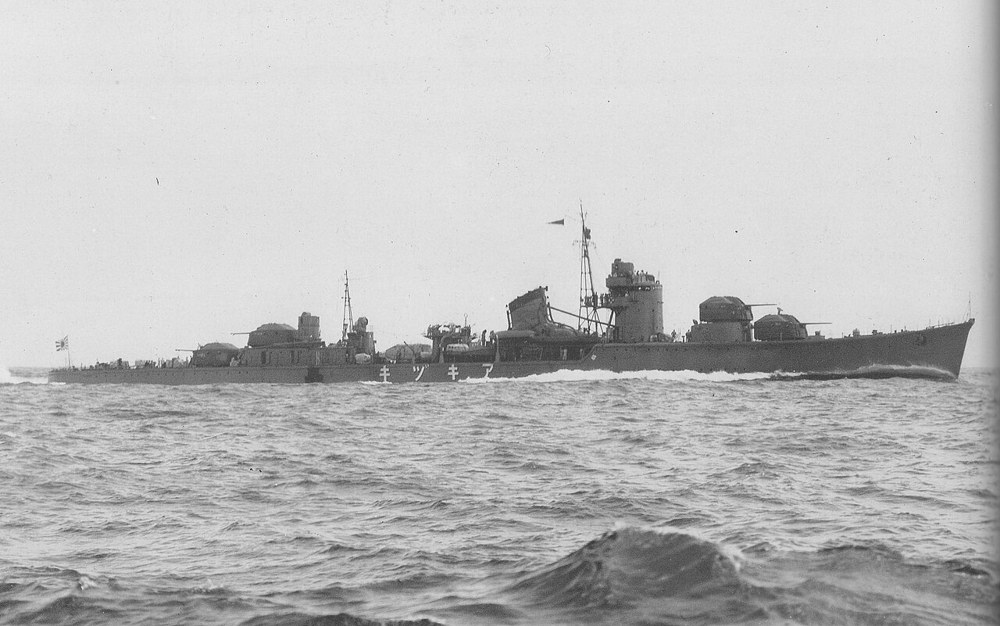
The name means autumn moon. Akizuki was the lead ship of the Akizuki class, destroyers built with a heavy battery of eight 10 cm dual-purpose guns to screen carriers against aircraft. Maizuru Naval Arsenal laid her down on 30 July 1940, launched her on 2 July 1941 and completed her on 11 June 1942.
She joined Nagumo's carrier screen at the Battle of the Eastern Solomons on 24 August 1942 and was not damaged. In the fall she guarded transports running to Guadalcanal. Bombs from American aircraft near-missed her on 25 October 1942 and flooded an engine room; 11 of her crew were killed and 22 injured. She was repaired in Japan from 8 November to 16 December 1942.
On 19 January 1943 USS Nautilus torpedoed her; the hit flooded a boiler room and her starboard engine room. She reached Truk, but her bow began to sag and she was beached at Saipan. Her bridge and forward turrets were removed and a temporary bow fitted. She was repaired at Nagasaki from July to October 1943, and her bow was replaced with the forward hull of her unfinished sister Shimotsuki.
In the Battle of the Philippine Sea she screened Carrier Division 1 and helped pick up survivors from Taiho. On 25 October 1944, with Ozawa's Northern Force off Cape Engano, she screened Zuikaku and Zuiho. Aircraft attacked her at about 0820, and at 0850 an explosion broke her in two. She sank at 0856. Commander Ogata and 150 men were rescued by Maki, and 183 officers and men were lost. Most sources credit the hit to aircraft of Task Force 38. Some credit USS Halibut, and the TROM rules that out on timing.
Commanding officers, from the combinedfleet.com record: Commander Yasuji Koga, 11 June 1942 to 26 July 1943; Commander Tomoe Ogata, from 8 October 1943 (survived her loss on 25 October 1944; he was among the 150 officers and men taken off by Maki).
Sources: Allyn Nevitt's combinedfleet.com Tabular Record of Movement for IJN Akizuki; Wikipedia, Japanese destroyer Akizuki, rewritten here.