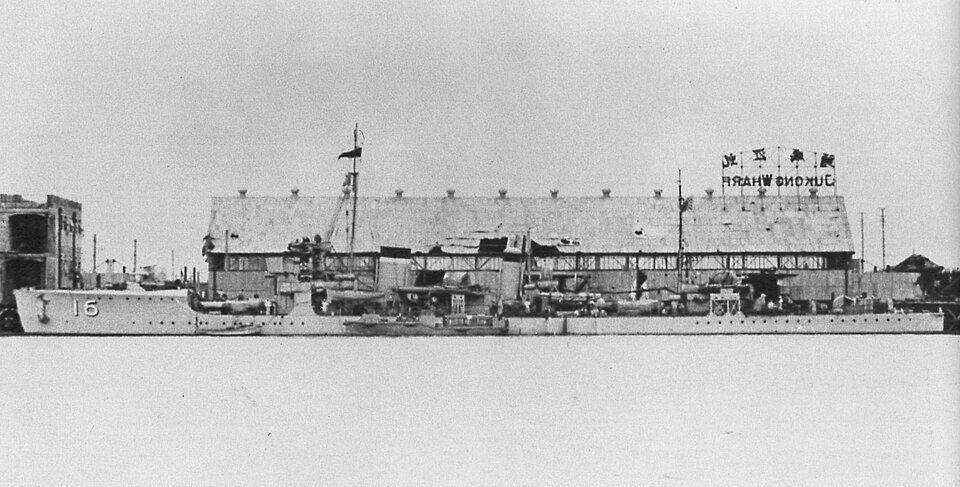
Asagao (朝顔, "morning glory") was a Wakatake-class second-class destroyer, a sister of Karukaya. Ishikawajima built her in Tokyo. She was laid down on 14 March 1922, launched on 4 November 1922, and completed on 10 May 1923 as Dai-10-Gō Kuchikukan, No. 10 Destroyer. On 1 April 1924 she became Dai-10-Gō. On 1 August 1928 she received the name Asagao.
Like the rest of the class she was a small coastal escort: about 900 tons normal, 1,100 full load, 280 feet overall, two shafts and about 21,500 shaft horsepower for a design speed of 35.5 knots. As built she had three 120 mm guns, two twin 533 mm torpedo mounts, light machine guns, and minelaying gear. In the 1941–42 refit one 120 mm gun and one twin torpedo mount came off. In their place she received six 25 mm guns in two triple mounts, 13.2 mm machine guns, four depth-charge throwers with up to 48 charges, and sonar.
She was photographed at Shanghai in 1937, during the early weeks of the Second Sino-Japanese War, with a tall galley funnel aft of the second stack. Lieutenant Kyuji Aoki had her from 24 February 1936 to 15 November 1937, and was promoted lieutenant commander on 1 December 1936 while still in command. Her wartime escort career belongs to other captains.
At the start of the Pacific War she was in Destroyer Division 32 with Fuyō and Karukaya, under the Chinkai Guard District, screening the Tsushima Strait. On 10 April 1942 the division joined the 1st Surface Escort Division of the Southwest Area Fleet. Division 32 was dissolved that December, but Asagao stayed on convoy duty.
In 1943 she touched Moji, Mako, and Takao about half a dozen times each, Manila four times, Palau twice, and Balikpapan once. In late January 1944 she reached Cam Ranh Bay with a convoy from Takao just as the destroyer Amatsukaze was torpedoed and badly damaged in the South China Sea. Asagao towed her to Cape St. Jacques (Vũng Tàu), then by late February was back at Takao on the Manila and Hainan runs.
On 9 July 1944 she drove onto a reef near Hainan in a typhoon and stayed there for three months. On 29 July, still stranded, she was attacked by an estimated 40 aircraft and took only light damage. She was refloated on 15 October 1944, returned to Japan, and was under repair into the end of the year. After a short last spell of escort work out of Takao in the spring of 1945, age and wear kept her in the Inland Sea as a tender for patrol craft and minesweepers. One account also has her lightly damaged by Task Force 38 aircraft west of the Bisan Seto on 28 July 1945.
She was the only ship of the class still afloat at the Japanese surrender. On 22 August 1945, a week after the surrender, she struck a drifting mine in the Kanmon Straits off Shimonoseki. She flooded, was abandoned as unnavigable, and was surrendered in that condition. Struck on 30 November 1945, she was raised, towed ashore, and broken up at Yoshimi in 1948, the last of the Imperial Navy's second-class destroyers.