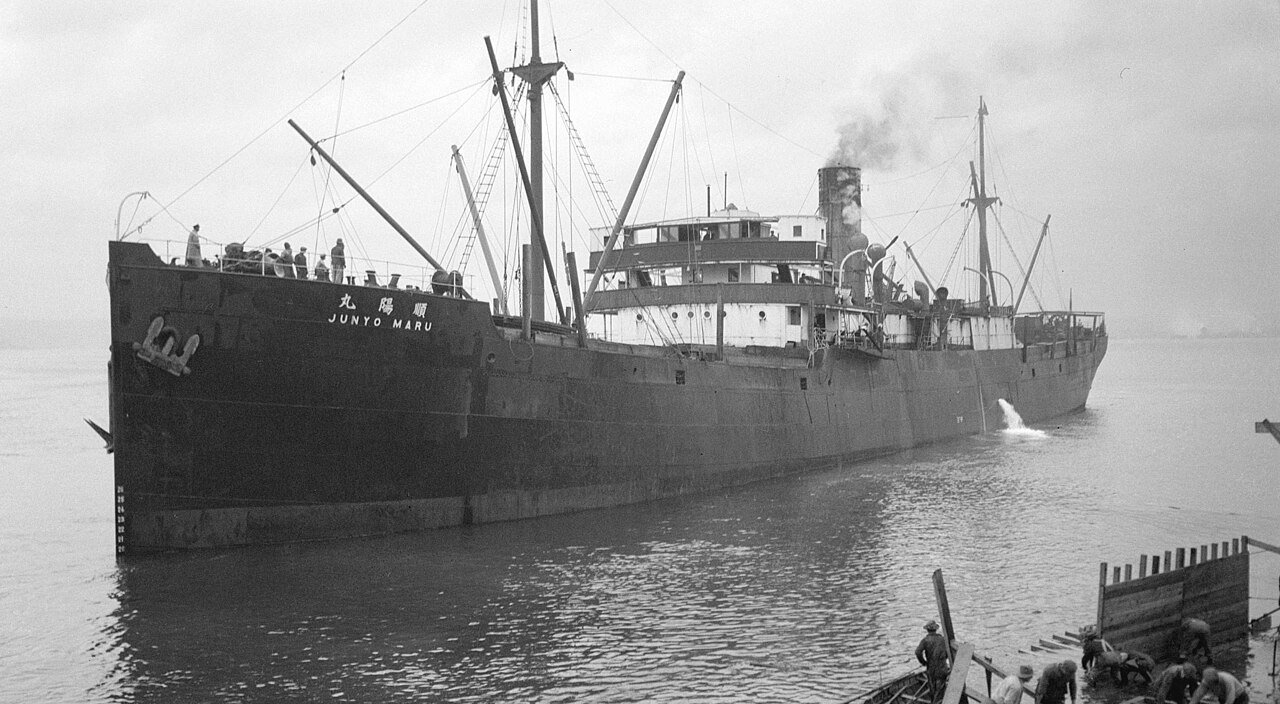
Junyo Maru was a cargo ship. The characters are 順陽丸. She is not the carrier Junyo.
Robert Duncan & Co. launched her at Port Glasgow on 30 October 1913 as Ardgorm, for Lang & Fulton of Greenock. She was completed that December. She was about 5,065 gross tons, 405 feet long and 53 feet in beam, with a triple-expansion engine of 475 nominal horsepower.
In 1917 the Norfolk & North American Steamship Company bought her and renamed her Hartland Point. In 1918 she became Hartmore. In 1921 the Anglo-Oriental Navigation Company renamed her Sureway. She was sold to Japanese owners and renamed Junyo Maru. Lists put that sale in 1926 or 1927. Baba Shoji had her by 1938. In March 1944 the company became Baba Kisen.
The Imperial Japanese Army requisitioned her on 6 October 1943 and fitted her as a transport. Bamboo decks and partitions were built into the holds. The Army list gave her 640 berths, space for 484 horses, and 28 small landing craft. She carried an 8 cm gun and four depth charges. There were two lifeboats and few rafts, almost no latrines, and little drinking water. Allied prisoners later called ships of this kind hell ships.
On 16 September 1944 she left Tanjung Priok, the port of Batavia, for the railway being built across Sumatra from Pekanbaru to Muaro. Two small escorts were with her. She passed through the Sunda Strait, by Krakatoa, and up the west coast of Sumatra toward Padang.
The counts of who was aboard do not agree. A figure often repeated is about 1,377 Dutch, 64 British and Australian, and 8 Americans, with several hundred Ambonese and Manadonese, and about 4,200 Javanese forced laborers. Other lists put the laborers nearer 4,320 and the prisoners near 2,200. Many were already sick. The laborers were packed into the forward holds. The prisoners were aft and on deck.
On the afternoon of 18 September 1944, off the west coast of Sumatra near 2°53′S, 101°11′E, about 225 km south-southeast of Padang, the British submarine Tradewind, Lieutenant Commander S. L. C. Maydon, sighted her. Tradewind had no way to know the cargo was prisoners. At about 1,800 yards she fired four torpedoes. Two hit, one forward and one aft. An escort dropped depth charges and Tradewind went deep. Junyo Maru sank by the stern in about 15 minutes.
Most of the Javanese could not swim and stayed with the ship. Prisoners in the holds were trapped. The escorts picked up Japanese survivors first and came back the next morning for others. The dead are put anywhere from about 5,000 to about 5,620. One count gives about 1,520 of the prisoners and about 4,120 of the laborers. The living are put at about 680, and in another count at about 880. They were taken on to the railway. Of the prisoners from this ship who were sent there, later accounts say only about 100 were still alive at the end of the war.
A memorial ceremony was held over the wreck on 4 June 2000.