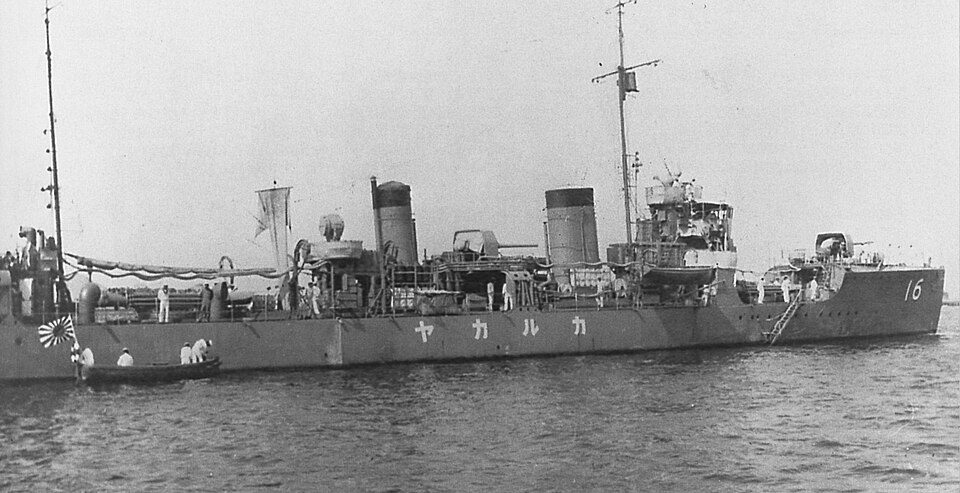
Karukaya (刈萱) was a Wakatake-class second-class destroyer. The name is a grass used in classical Japanese poetry, in keeping with the plant names of the class. The Wakatake class was a cheaper follow-on to the Momi class, under the fiscal 1921 program, meant as a smaller companion to the Minekaze-class fleet destroyers. Thirteen were planned. The Washington Naval Treaty and budget cuts left eight. Fujinagata built her at Osaka. She was laid down on 16 May 1922, launched on 19 March 1923, and commissioned on 20 August 1923 as Dai-18-Gō Kuchikukan, No. 18 Destroyer. On 1 August 1928 the Navy dropped numerical names, and she became Karukaya.
She displaced about 900 tons normal and about 1,100 full load. She was 280 feet overall, with a beam of 26 feet and a draft of only 8 feet. Two shafts, Parsons geared turbines, and three Kampon boilers gave about 21,500 shaft horsepower and a design speed of 35.5 knots. As built she carried three 120 mm guns, two twin 533 mm torpedo mounts, light machine guns, and minelaying and sweeping gear. The shallow draft and the small hull made these boats poor fleet escorts. They were coastal and local-defense ships.
In the winter of 1941–42 she was refitted for antisubmarine work. One 120 mm gun came off. In its place she received six 25 mm Type 96 guns in two triple mounts, plus 13.2 mm machine guns. The minesweeping gear came off so she could carry four depth-charge throwers and up to 48 depth charges, with Type 93 sonar.
Through the 1920s and 1930s she worked Chinese coastal waters, the usual employment for the class. She was photographed there in 1937, during the Second Sino-Japanese War. Zenji Ichimon had her from 15 November 1933 to 11 January 1934. At the start of the Pacific War she was in Destroyer Division 32, under the Chinkai Guard District, screening traffic in the Tsushima Strait. On 10 April 1942 Destroyer Division 32 joined the 1st Surface Escort Division of the Southwest Area Fleet. From then on she was a convoy escort, first the Moji–Taiwan–Philippines run, and later the routes to Singapore, French Indochina, the Netherlands East Indies, and Palau. She completed 54 convoy escorts before she was lost, a record for the class. Of the six Wakatake-class ships still afloat at the start of the war, four were sunk by American submarines and one by air attack. Only Asagao survived, and she was scrapped in 1948.
On 10 May 1944 she was escorting a convoy of about 32 freighters and transports bound for Subic Bay. West of Luzon, in the South China Sea, Cod attacked. Lieutenant Commander James C. Dempsey had Cod. She closed to about 1,200 yards and fired three stern torpedoes at the destroyer. Two hit. The first, under the bridge after about 26 seconds, collapsed the stacks and threw men overboard. The second, near the mainmast, broke the ship in half. She sank quickly. In the same attack Cod put six bow torpedoes into the convoy and sank the cargo ship Shōhei Maru, of 7,256 tons, then was driven down by the remaining escorts and depth-charged. The reported position is about 15°38′ N to 15°47′ N, 119°25′ E to 119°32′ E, roughly 150 nautical miles northwest of Manila. About 73 were dead or missing. She was struck from the Navy list on 10 July 1944.