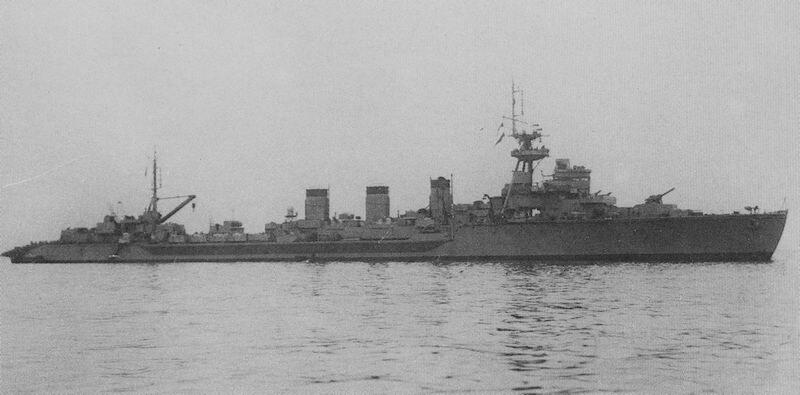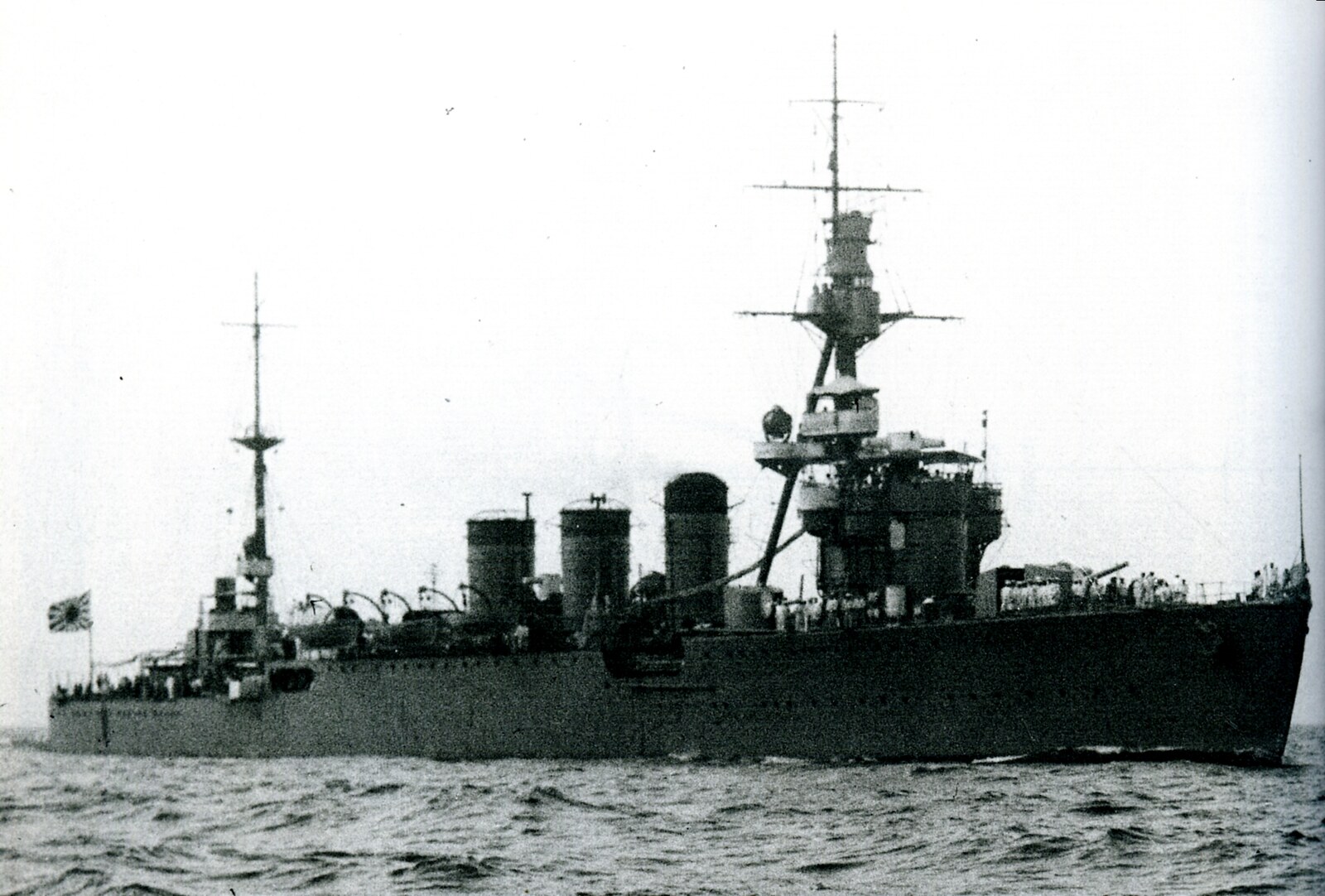
Kitakami was a Kuma-class light cruiser named for the Kitakami River in northern Honshu. The Sasebo Navy Yard laid her down on 1 September 1919, launched her on 3 July 1920 and completed her on 15 April 1921. For twenty years she was an ordinary flotilla cruiser. In 1941 the Navy chose her and her sister Oi for a new role built around the Type 93 oxygen torpedo. The plan was to open a fleet battle with masses of long-range torpedoes fired from beyond gun range. At Sasebo most of her 140-millimeter guns came off, and she was given ten quadruple torpedo mounts, five on each side, forty tubes in all. The work was finished on 30 September 1941. Captain Saiji Norimitsu took command on 28 November.
The fleet battle did not come. In the first months of the war she and Oi stayed in the western Inland Sea as guardships for the battleships. At Midway in June 1942 they sailed with Vice Admiral Shiro Takasu's Aleutian screening force of four battleships and saw no action. Over the summer both ships were converted again, this time into fast transports. Their torpedo mounts were cut to six, and landing barges, more antiaircraft guns and depth-charge rails were added. Captain Nobumichi Tsuruoka took command on 5 September.
From September 1942 she carried troops. She took the 4th Maizuru Special Naval Landing Force from Yokosuka to Truk and men to Rabaul. In January and February 1943 she and Oi carried the Army's 20th and 41st Divisions from Pusan and Tsingtao toward Wewak in New Guinea in Operation C. In May she went to the Netherlands East Indies, where Captain Tomekichi Nomura took command at Surabaya. There she stood guard and carried troops, and on 23 June 1943 she came through the B-24 raid on Makassar with only slight damage. Captain Jo Tanaka relieved Nomura on 21 November.
On 27 January 1944, in the Malacca Strait southwest of Penang, the British submarine HMS Templar hit her aft with two torpedoes. Twelve men were killed and four injured. She could not get under way and was not in danger of sinking. Kinu towed her in, escorted by Shikinami, and she reached Singapore on 31 January. After temporary repairs she went home. At Sasebo from August 1944 she was rebuilt as a carrier for eight kaiten, the manned suicide torpedoes. Her remaining 140-millimeter guns came off. She was given a 20-ton crane taken from Chitose, twin 127-millimeter guns, dozens of 25-millimeter guns and radar. Captain Saburo Kase had taken command in June, Captain Masamoto Shimizu held her as additional duty from August, and Captain Kunizo Kanaoka took over on 1 December.
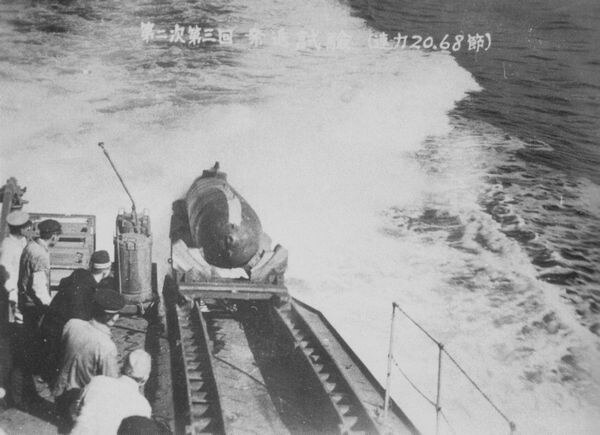
The work was finished on 20 January 1945. She went to Kure and trained kaiten pilots in the Inland Sea, though shortage of fuel kept her in port much of the time. In February 1945 kaiten were launched from her in tests. She never took them into action. In July she was moored at Kurahashi-jima near Kure, and on 24 July carrier aircraft of Task Force 38 damaged her with strafing and near misses and killed 32 of her crew. She was still afloat at the surrender. Kanaoka left on 15 August. After the war she served the repatriation service as a repair ship, first at Kure and then at Kagoshima. She was struck from the Navy List on 30 November 1945 and broken up at Mitsubishi's Nagasaki yard between October 1946 and March 1947.
A note on sources. This history follows the Tabular Record of Movement for Kitakami by Bob Hackett and Sander Kingsepp at combinedfleet.com. The list of captains in the Japanese Wikipedia article on Kitakami agrees with it. The kaiten photographs are wartime Imperial Navy images reproduced in Japanese books. Commons treats them as public domain because they were taken in Japan before 1957. The record notes that older sources place her scrapping at Nanao rather than Nagasaki.