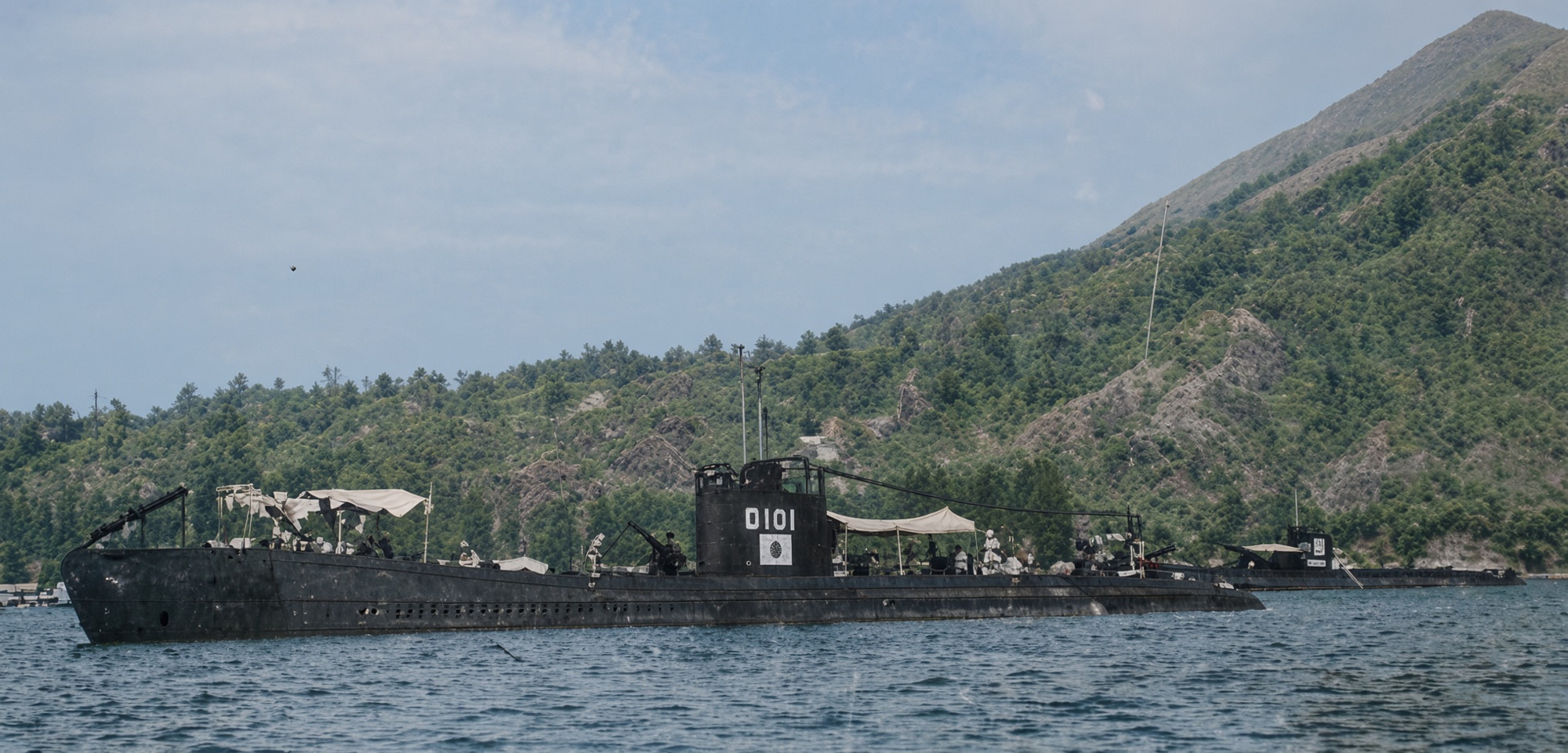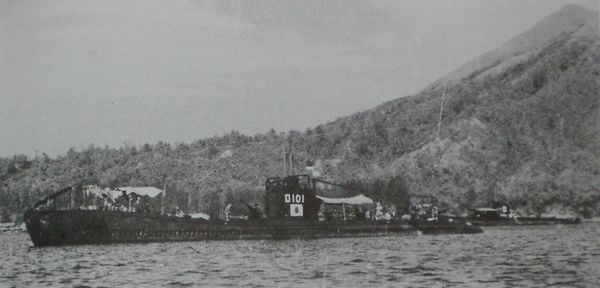
RO-101 was a Ro-100-class coastal submarine. The type was also called KS, the small type, and it was meant to free the large I-boats for fleet work. A boat of the class was about 60.9 meters long and 6 meters in beam, with a draft of about 3.5 meters. The lists put her at about 525 tons standard and about 600 tons in normal load, and about 780 to 795 tons submerged. Two diesels, about 1,000 horsepower, drove two shafts, with about 760 horsepower submerged. She could make about 14 knots on the surface and about 8 submerged. On the surface she could go about 3,500 miles at 12 knots. Submerged, the range was about 60 miles at 3 knots. The test depth was 75 meters. She had four bow tubes and eight torpedoes, and a light anti-aircraft gun, a 25 mm or sometimes a 76 mm. The design crew was about 38. None of the 18 boats of the class survived the war.
She was ordered in the 1941 emergency program as Submarine No. 211, the second boat of the class. Kawasaki at Kobe laid her down on 30 September 1941, launched her on 17 April 1942, and completed her on 31 October 1942. She commissioned that day and joined the Kure Submarine Squadron for work in the Inland Sea. Lieutenant Zenji Orita had her from that day until 4 September 1943. He was promoted lieutenant commander on 1 November 1942. His executive officer was Lieutenant Hiromi Tokugawa.
She left Yokosuka on 18 January 1943 and reached Truk on 25 January. She was then assigned to Submarine Division 13 in Submarine Squadron 7, Eighth Fleet, at Rabaul. She made eight war patrols, almost all of them in the Solomons and off New Guinea.
On 8 February 1943 she left Truk for distant cover east of Port Moresby during the evacuation of Guadalcanal. The patrol is closed at Rabaul on that same date, and nothing was sighted. On 9 February she sailed again with Ro-103, east of Port Moresby, and returned on 28 February. On 22 February the navigator sighted a steamer of about 4,000 tons. Orita took it for a Q-ship and waited for dark. The ship ran for Port Moresby and he lost it.
On 4 March she left Rabaul after the Bismarck Sea. On 7 March, south of Dampier Strait, she picked up the captain of the collier Nojima Maru and 44 soldiers from the boats and landed them at Rabaul the next day. She was then sent to help Ro-103, aground off Kiriwina. Ro-103 got herself off, and RO-101 came back. A sortie on 19 March was cut short by food poisoning. The third patrol, 21 March to 12 April, was a weather and rescue station in the Solomons. On 5 April she was ordered to Cape Esperance for a downed bomber crew. PT boats kept her off, and she was back at Rabaul on 12 April.
On 30 April she left to relieve Ro-102 in the Samarai Bight, southeast of Rabi, and stayed there from 10 to 17 May. Off Cape St. George on the way home she watched a four-engine bomber crash in flames, and two parachutes open. She reached Rabaul on 21 May and was fitted with a radar detector. From 8 June to 3 July she was east of Guadalcanal, then toward Munda and Gatukai. On 30 June, the day of the New Georgia landings, she sighted landing craft off Munda and reported them. Twice she was ordered in against the beachhead from west of Rendova. She could not get through the PT boats and was recalled.
The sixth patrol was the short one into Kula Gulf, 8 to 14 July, against ships off Rice Anchorage. On 12 July, charging on the surface near 8°00′S, 157°19′E, she was picked up on radar by Taylor (DD-468). Taylor closed to about 2,500 feet, lit her, and opened fire. The first hits killed Tokugawa and two lookouts on the bridge. Orita had to drag the bodies clear of the hatch before she could dive. She went out of control to about 460 feet, about 140 meters, and main ballast was blown to stop the dive. That was well under the test depth. Taylor's charges wrecked one periscope. She stayed down about two hours in heat of about 104°F, then surfaced and crept along the northwest coast of Kolombangara. Orita later counted on the order of 127 shell dents, and the other periscope was unusable. That night she heard the Battle of Kolombangara. She was ordered to pick up survivors of the light cruiser Jintsu, and the damage made that impossible. On the afternoon of 13 July, charging west of Shortland, a patrol plane bombed her. The crash dive finished the second periscope. She reached Rabaul on 14 July. Some American accounts give Taylor the sinking of I-25 or of Ro-107 that day. The boat Taylor hit was RO-101, and RO-101 survived. The repairs took about three weeks.
She left again on 7 August for Kolombangara. Early on 18 August, off Horaniu, Orita watched the gun flashes and at about 02:00 fired four torpedoes at the second destroyer in a column in New Georgia Sound, from about 600 yards. All four passed astern. The destroyer was making about 30 knots, faster than he had allowed. She was back at Rabaul on 26 August, and Orita left her.
The officer sent to relieve him, Lieutenant Arima, was killed on 28 August 1943. A PB4Y-1 Liberator shot down the Kawanishi flying boat that was carrying him from Truk to Rabaul. Lieutenant Masakata Fujisawa took RO-101 on 4 September. Orita had gone to I-177. On 10 September Fujisawa took her out of Simpson Harbor for the area southeast of San Cristobal.
On 15 September, at the south end of Indispensable Strait, she attacked a two-ship convoy bound for Espiritu Santo. The escorts were the light minelayer Montgomery and Saufley (DD-465). They sighted a torpedo wake at 10:11. Saufley ran down the track, gained sonar contact at 12:51 at about 3,000 yards, and made five depth-charge attacks over the next three and a half hours. Around 14:43 the submarine surfaced. Saufley opened with her 5-inch guns and machine guns. A Catalina of Patrol Squadron 23, flown by Lieutenant W. J. Geritz, dropped two depth charges. The second hit. The boat went under, a heavy explosion followed, and by 17:35 a diesel slick covered about a square mile, centered near 10°57′S, 163°56′E. The Navy presumed her lost in the Solomons on 11 October and struck her on 1 December. The dead are put at about 50 to 60, Fujisawa among them. There were no survivors. The wreck has not been found. The sinking is shared by Saufley and the Catalina.