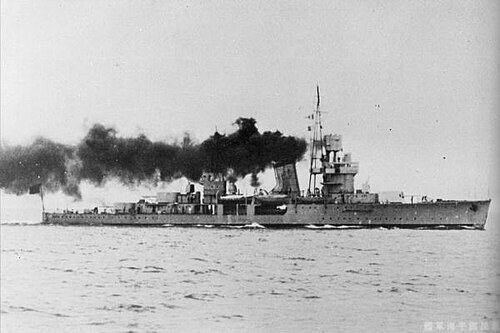
Yasoshima began as the Chinese light cruiser Ping Hai, the second of two small cruisers of Japanese design ordered by the Nationalist government. The first, Ning Hai, was built in Japan. Ping Hai was laid down at the Kiangnan yard in Shanghai on 28 June 1931, with Japanese advisers overseeing the work. The Mukden Incident and the fighting at Shanghai in 1932 delayed her. Japan refused to supply her secondary guns, and China bought antiaircraft guns through Germany instead. She was launched on 28 September 1935, fitted with her armament at Harima's yard at Aioi in Japan, and completed on 18 June 1936. She became flagship of the Chinese navy in April 1937.
When the war with Japan began that summer, Ping Hai, Ning Hai and other ships were sent down the Yangtze to Kiangyin to help defend the river below Nanking. On 22 and 23 September 1937 aircraft from Kaga and from airfields near Shanghai attacked them. Ping Hai was hit by eight bombs and settled in shallow water. Her captain was badly wounded and kept fighting. The Japanese took the wreck on 5 December 1937, raised her in 1938 and towed her to Sasebo, where she was renamed Mishima and served as an accommodation hulk until the end of 1943.
In January 1944, with the convoy war going badly, she was towed to Kure and rebuilt as a kaibokan, an escort ship. She was renamed Yasoshima on 1 June and registered on 10 June 1944. Her Chinese armament was gone, and she was given Japanese dual-purpose and antiaircraft guns and radar. Lieutenant Commander Sonichiro Matsumura of the reserve took command on 15 June. In July and September she escorted convoys from Yokosuka to Chichi Jima and Haha Jima in the Bonins. On 9 September the submarine Bang sank both cargo ships of a convoy she was escorting toward Haha Jima, and on 11 September Finback sank one of the ships she was bringing back to Yokosuka. On 5 September she was rerated a second-class cruiser.
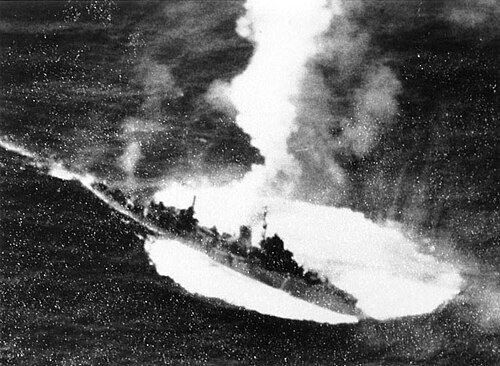
On 25 September 1944 she became flagship of Rear Admiral Akira Sone's new 1st Transport Squadron of fast transports. She was refitted at Sasebo with extra radio gear for the role and left for Manila on 15 November. On 25 November, near Santa Cruz on the west coast of Luzon north of Manila, she was with three small transports when Avengers from Ticonderoga and Langley of Task Group 38.3 attacked. A Mark 13 aerial torpedo from a Ticonderoga plane of Torpedo Squadron 80 hit her in the stern, and she sank. Matsumura and about 100 of her crew survived. She was struck from the Navy List on 10 January 1945.
A note on sources. This history follows the Tabular Record of Movement for Yasojima (also spelled Yasoshima) by Bob Hackett and Sander Kingsepp at combinedfleet.com, and the English Wikipedia article on Ping Hai. The two differ. Wikipedia says she was recommissioned on 25 September 1944 and fought at Leyte Gulf. The record shows her registered in June 1944, made a squadron flagship on 25 September, and in the yard at Sasebo from 15 October to 15 November, which would have kept her out of that battle. The record is followed here, and she is not placed at Leyte Gulf. The record does not say how many of her crew were lost. No list of her captains in Japanese sources was checked, so Matsumura is the only commanding officer named.