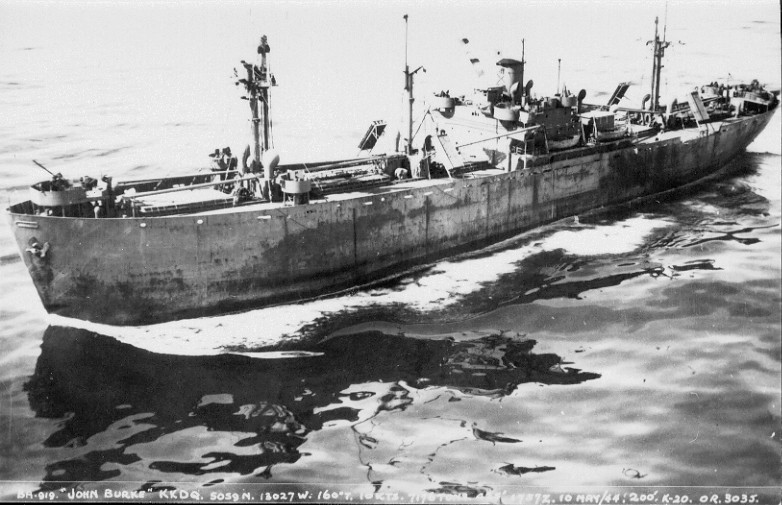
The ship
SS John Burke was an EC2-S-C1 Liberty ship, one of 2,710 of the type. She was named for John Burke, the tenth governor of North Dakota, who died in 1937. She was a cargo ship, not a Navy combatant. The War Shipping Administration owned her. Northland Transportation Company of Seattle operated her.
Kaiser's Oregon Shipbuilding yard in Portland laid her keel on 20 November 1942 and launched her in mid-December. The Maritime Commission took delivery on 23 December, thirty-three days after the keel was laid.
A Liberty was about 441 feet, 7,200 gross tons, and roughly 14,000 tons fully loaded, with a triple-expansion steam engine and a crew of about forty merchant mariners. In a war zone a Navy Armed Guard, here twenty-eight or twenty-nine men, manned the guns.
Her first two years were the ordinary Liberty trade: dry cargo across the Pacific. The last voyage was different. In late 1944 she left Seattle for Guam and loaded munitions for the troops who had landed on Mindoro on 15 December. Mindoro was the airfield step to Luzon. If the resupply convoy did not get through, the beachhead was cut off.
28 December 1944
She sailed in a large convoy, called Uncle Plus 13 in some accounts, and reached Leyte on the night of 27 December. The Mindoro-bound group was Task Group 77.11, under Captain George F. Mentz. On the morning of the 28th the ships were in the Mindanao Sea, south of Cebu and Bohol, bound west. The weather was bad. The escorts were told that fighter cover would not launch until it cleared. They went to general quarters on the dawn report.
Japanese records put the attack at three A6M Zeros of the 201st Air Group, flown from Cebu at 9:50 a.m. under Lieutenant Masami Hoshino, each with a 250-kilogram bomb. Other accounts say six aircraft, and some call the plane that hit her a Val dive bomber. The better-documented version is the three Zeros. They found the convoy through breaks in the cloud.
One Zero, already hit by anti-aircraft fire, kept the dive and crashed between Burke's No. 2 and No. 3 holds. Witnesses saw a short flash, then only smoke. A few seconds later a column of fire came out of the hold, then a white cloud, then the blast. The ammunition cargo detonated as one charge. The ship disintegrated. The shock and the fireball were filmed from a nearby ship.
Everyone aboard was killed: forty merchant mariners and twenty-eight Armed Guard sailors. Some lists count twenty-nine guards. There were no survivors and no identifiable wreck on the surface. Fragments lie in about 1,500 feet of water near 9°01′ N, 123°26′ E, in the strait between Negros, Siquijor, and the Mindanao coast.
The rest of the convoy kept going. It reached Mindoro on the morning of 30 December with the supplies the beachhead needed. Burke was one of three Liberty ships sunk by kamikaze attack, and one of about forty-seven ships of all kinds lost to suicide planes in the war.