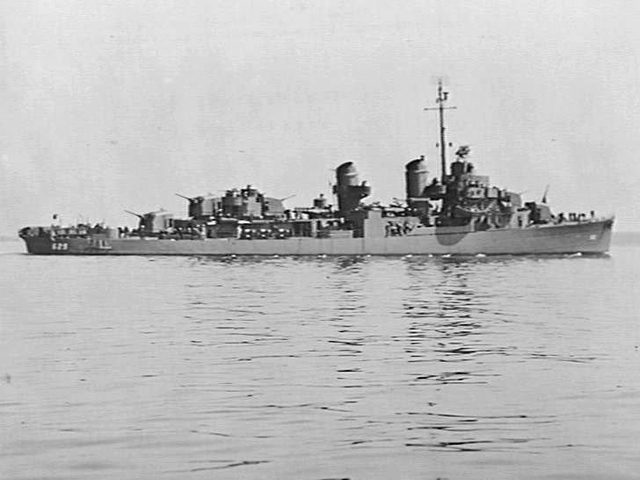
USS Abbot (DD-629) was a Fletcher-class destroyer, the second U.S. Navy ship named for Commodore Joel Abbot. An earlier destroyer, DD-184, had carried the name and passed to the Royal Navy in 1940. Bath Iron Works laid this hull down at Bath, Maine, on 21 September 1942. Grace Abbot Fletcher, the commodore’s great-granddaughter, christened her at the launch on 17 February 1943, and the Navy commissioned her at the Boston Navy Yard on 23 April 1943 under Commander Chester E. Carroll. She finished fitting out, shook down from Casco Bay into June, and spent the summer escorting larger warships on their own trials. Early in September she headed for the Pacific, crossed the Panama Canal, called briefly at San Diego, and sailed west on 28 September, reaching Hawaii in the first days of October.
Training off Oahu ended in a collision. Before dawn on 18 October 1943, a confused change of course in the dark put Abbot into the light carrier Cowpens. The destroyer’s bow was bent back hard, forward living spaces were crushed, and three men died in their bunks: Seaman Frederic Louis Nedeau, Boatswain’s Mate Edward James Halligan, and Gunner’s Mate Arthur Walter Ceresna. The crew braced the damaged bow, pumped out flooded compartments, and brought the ship into Pearl Harbor the next day. Repairs lasted until 10 December. She then ran south to the Ellice Islands and entered Funafuti the day after Christmas.
Her first combat duty came with the Marshalls landings. From 29 January into mid-February 1944 she worked with cruisers and other destroyers against the bypassed atolls of Wotje and Taroa, shelling them so their troops and aircraft could not aid the garrisons at Majuro, Kwajalein, and Eniwetok, and afterward patrolled between Majuro and Kwajalein. By March she was on the convoy route from the southern Solomons to Milne Bay and Cape Sudest. In April she screened the escort carriers covering the landings at Aitape and Hollandia, then trained at Espiritu Santo. In June she joined the carrier support group off the Marianas, guarding Sangamon, Suwannee, and Chenango while their planes supported the troops on Saipan and Guam through the Battle of the Philippine Sea. On 26 June she and Hale together shot down a Mitsubishi Betty bomber. She kept that screen through July and returned to Pearl Harbor in August for repairs and further training.
On 15 September 1944 she left Hawaii, stopped at Eniwetok, and reached Manus in the Admiralties on 3 October. She entered Leyte Gulf with the transports on 20 October, screened the anchorage against air and submarine attack, and that night lit the beach and fired on Japanese positions near Dulag. The next day she took a transport convoy back to Hollandia. Early in November she escorted another group to Morotai, where night raids struck the airfield ashore and left the ships in the anchorage alone. On the trip back toward Leyte a Jill torpedo bomber dropped a torpedo through the formation and missed; Catskill shot the plane down about a thousand yards ahead of Abbot. While at anchor off Dulag her five-inch guns were credited with damaging a Judy dive-bomber. She returned to Hollandia at the end of November, stayed nearly a month, and reached Leyte again just before Christmas.
The new year opened with the Lingayen invasion. Abbot sailed on 2 January 1945 in the screen of Rear Admiral Felix Stump’s San Fabian escort carriers. Kamikaze attacks thickened as the force closed Luzon, and on 4 January a suicide plane wrecked the escort carrier Ommaney Bay, which was abandoned and sunk by a torpedo from the destroyer Burns. Abbot remained with the San Fabian carriers through the Gulf landings and the later assaults at San Felipe and Nasugbu, then shifted to Mindoro and Subic Bay. From Subic she helped cover the seizure of Corregidor and the small islands in Manila Bay, cut mines, and picked up three Japanese soldiers swimming from Corregidor toward Bataan. After the parachute landing on Corregidor on 15 February she fired on call and provided night illumination. On 24 February she went with the cruisers Denver, Cleveland, and Montpelier to Puerto Princesa on Palawan; the troops went ashore without a call for naval gunfire, and the group returned the same day. In March she supported the Zamboanga assault and destroyed barges off Basilan. On 26 March she bombarded beaches west of Cebu City, then spent April and May on fire support, mail runs, and escorts in the central and southern Philippines, including shoots near Nailon Point on Cebu and the 10 May landing at Macajalar Bay on Mindanao.
On 12 June 1945 she reported to the Third Fleet and joined the screen of a fast-carrier group. The force left Leyte Gulf on 1 July for the waters east of Japan. On 14 July a bombardment unit built around the battleships South Dakota, Indiana, and Massachusetts closed Kamaishi and shelled the Japan Iron Works, with Abbot screening the heavy ships close inshore. A second shoot struck Hamamatsu on 29 July. On 8 August, while forming at 32 knots to check reported surface contacts, she lost her starboard propeller and a length of tail shaft. Still able to make about 23 knots, she stayed with the formation. The next day a kamikaze hit the destroyer Borie. Abbot assisted her, helped move wounded to the hospital ship Rescue, and escorted her to Saipan, arriving on 17 August, two days after Japan agreed to end the war. Drydock showed the shaft damage was serious enough to send Abbot home. She reached the Puget Sound Navy Yard at Bremerton early in September, completed repairs, and joined the reserve fleet at San Diego. She was decommissioned on 21 May 1946. The wartime cruise earned her eight battle stars.
The Korean War brought her out of reserve. Recommissioned on 26 February 1951, she spent three months at Mare Island being modernized, then crossed the Panama Canal in June and shifted her home port to Newport, Rhode Island. From April to October 1952 she deployed with the Sixth Fleet in the Mediterranean. Newport remained her base for antisubmarine exercises and refresher training between cruises. On 1 June 1954 she sailed with Destroyer Division 242 on a voyage around the world, joining the Seventh Fleet at Yokosuka and operating in the South China Sea and the Taiwan Strait before heading home on 18 October by way of the Indian Ocean, the Suez Canal, and the Mediterranean. She moored at Newport on 18 December. The rest of the decade followed the same round of East Coast training, a 1955 exercise period off Guantanamo Bay, midshipman cruises, a Mediterranean tour from November 1956 into February 1957, and the NATO exercise Strikeback in the northeastern Atlantic in 1957, with visits to Belfast and Chatham. In the summer of 1958, during the crisis in Lebanon, she escorted amphibious forces across the Atlantic, joined the Sixth Fleet fast carriers off the eastern Mediterranean, and anchored at Beirut to back up troops ashore. She returned to Newport on Veterans Day. On 1 May 1959 she became flagship of Escort Squadron 14, still employed mainly in antisubmarine work.
On 5 May 1961 Abbot formed part of the Atlantic recovery force for Freedom 7, the Mercury-Redstone flight that carried Alan Shepard on the first American manned space mission. That September she became the school ship for the Destroyer Officer’s School at Newport, training officers for destroyer duty along the East Coast and in the West Indies. Two calls took her away from that duty in 1962. In August she served as a base-defense ship at Guantanamo Bay during disorders in Haiti, and in the autumn she joined the quarantine of Cuba, returning to Newport on 24 November. She kept the school-ship role until April 1964, then moved to Philadelphia as a Naval Reserve training ship and as flagship of Reserve Destroyer Squadron 30. Abbot was decommissioned there on 26 March 1965 and berthed with the Atlantic Reserve Fleet. Her name was struck from the Navy list on 1 December 1974, and on 31 July 1975 she was sold for scrap to the Boston Metals Company of Baltimore.