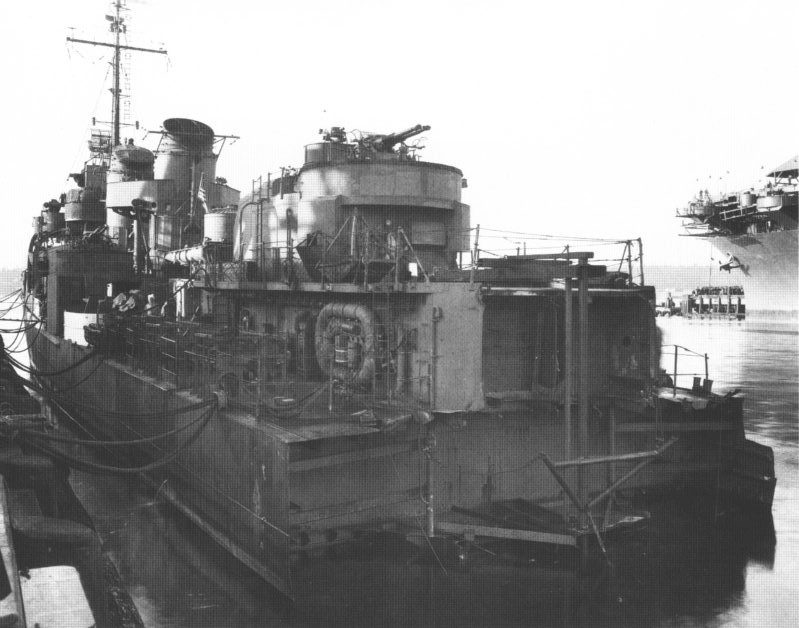
Abner Read was a Fletcher-class destroyer, named for Lieutenant Commander Abner Read. He was wounded on the Mississippi aboard Monongahela on 7 July 1863 and died the next evening at Baton Rouge. Bethlehem Steel laid the destroyer down at San Francisco on 30 October 1941. She was launched on 18 August 1942. Mrs. John W. Gates, wife of Captain Gates, sponsored her. She was commissioned at the yard on 5 February 1943, Commander Thomas Burrowes in command.
Shakedown ran down the California coast into April. She sailed with Task Group 51.2 for the Aleutians and took up patrol on 4 May. On 11 May she shelled Attu for the Army's 7th Division, and she bombarded the island again on the 16th. She was back in San Diego on the last day of May. Two weeks in a San Francisco drydock, then north again. On 14 June she sailed for Adak, joined Task Force 16, and patrolled off Kiska. On 22 July, in Task Group 16.22, she took part in a heavy bombardment. Between 12 and 15 August she shelled the island again for the landings. On 17 August the troops found that the Japanese had already gone. The garrison had been lifted off in the fog on 28 July.
The empty island still had a mine. At 0150 on 18 August, on an anti-submarine patrol off Kiska, an explosion aft tore her open. Smoke from ruptured tanks blinded the men sleeping aft. A few fell through the deck into the oil. The stern broke away and sank. Ute took her in tow at 0355 and brought her to Adak. Seventy men were killed or missing. Forty-seven were wounded. Burrowes was still in command. He signed the action report on 26 August. After temporary repairs in Alaskan ports, the tug Oriole towed her to Puget Sound. She went onto keel blocks at Bremerton on 7 October. Commander Thomas B. Hutchins III relieved Burrowes on 14 October. The new stern was finished on 21 December.
Hutchins took the rebuilt ship back to the war. She reached Pearl Harbor in February 1944. On the way toward Hollandia the starboard propeller was damaged, and she put into Milne Bay on 1 March. With Task Force 75 she bombarded Hollandia on 22 April and covered the landing at Humboldt Bay. On 30 April she bombarded the airstrips on the Wakde Islands. On 12 May she shelled batteries at Wewak that had been hitting the motor torpedo boats. On 17 May she covered the landings at Arara and bombarded the Wakde-Toem area. She fired on Biak with Task Group 77.3, and on 8 and 9 June she was with the ships that met a Japanese force off the north coast of the island. She bombarded Wewak again on the nights of 18 and 19 June, covered the Noemfoor landing on 2 July, and was in the Cape Sansapor operation on 30 July. After a trip to Sydney she supported the seizure of Morotai on 15 September, and on 7 October she bombarded Ponam Island in the Admiralties.
Commander Arthur F. Purdy relieved Hutchins on 1 October 1944. On 17 October she sailed for Leyte Gulf and entered San Pedro Bay on the 20th, the day of the landings. She patrolled off the beachheads. She was not in the night action in Surigao Strait, and she was not off Samar.
On 1 November, Task Group 77.1 was patrolling lower Leyte Gulf. At about 1341 a Val came in burning. Its bomb went down one of her stacks and exploded in the after engine room. The plane struck diagonally across the main deck and set the after part of the ship on fire. The water pressure failed. At 1352 an internal explosion listed her about ten degrees to starboard. At 1415 she rolled over on her starboard side and sank stern first. Destroyers and the tug Chickasaw picked up the survivors. Twenty-two of her crew were not saved. The plane is not credited to one unit. She received four battle stars: Attu, Hollandia, the Western New Guinea operations, and the Leyte landings.