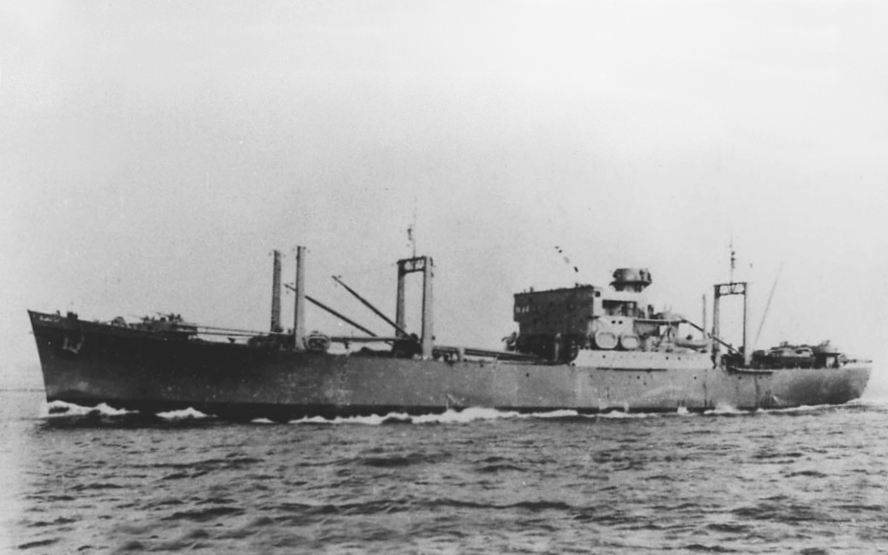
Alcyone is the brightest star in the Pleiades. The ship that carried the name began as a merchant C-2, the Mormacgull, Maritime Commission hull 30 and Sun Shipbuilding hull 179, laid down at Chester, Pennsylvania, on 12 January 1939. Miss Barbara Ann Moore sponsored her at the launch on 28 August. Moore-McCormack took delivery on 13 October and ran her as a cargo ship. The Navy bought her on 31 May 1941, named her Alcyone on 3 June, and gave her the cargo-ship number AK-24. The Boston Navy Yard fitted her for naval service. She commissioned there on 15 June 1941 under Daniel Michael McGurl. Her sister Alchiba commissioned the same day. Full load she displaced 14,225 tons, on a hull 459 feet long and 63 feet in the beam, and she made 16.5 knots. The complement was 399. She carried one 5-inch gun and four 3-inch guns.
She reported to the Train, Atlantic Fleet. After her shakedown she left New York on 4 September 1941, reached Reykjavik on the 16th, and unloaded passengers and cargo. She sailed on 5 October and was at Charleston on the 13th. Late in November she took cargo into the Caribbean: Guantanamo, Jamaica, San Juan, Vieques, St. Thomas, Antigua, and Trinidad, and she was back in New York on 27 December. Through the first months of 1942 she made two more of those runs. One job was to take civilians off Antigua. On one convoy, German submarines torpedoed three of the other ships. Alcyone was not hit. She reached Charleston on 12 April.
On 1 June 1942 she was assigned to the Naval Transportation Service. She left Norfolk on the 10th in a convoy carrying troops and equipment of the 1st Marine Division, the division that would land on Guadalcanal in August. She went through the Panama Canal on 18 June and reached Wellington on 1 July. She put that cargo ashore in New Zealand. She did not take it on to the beaches. From Auckland she sailed on 31 July, alone, and issued cargo at Noumea and at Espiritu Santo. She was at Sydney on 28 August, left Australia on 8 September, and reached San Francisco on the 29th.
Mare Island then made her an attack cargo ship. The yard added three 30-ton booms, a shop for her boats, and more berths. She left San Francisco on 6 November. On 26 November the Navy redesignated her AKA-7 and sent her to the Amphibious Forces, Pacific Fleet. She worked up off San Diego and sailed for the east coast on 21 December. She was through the canal again on 2 March 1943, repaired at Charleston, and trained in the Chesapeake until early June. On 8 June she sailed with Task Force 65 for the Mediterranean. The convoy beat off several attacks and reached Oran on 22 June. She loaded for Sicily, sailed on 5 July, and was off Scoglitti on the 10th. The sea was rough and aircraft kept coming over. She got her equipment and troops off and lost a few of her small boats. She left on the 13th, was at Oran on the 16th, and reached Norfolk on 3 August. The transport command commended the ship for that landing. McGurl was given the Legion of Merit for it. James Bertrand McVey relieved him that day.
She went back to the Pacific at the end of August and reached Pearl Harbor on 30 September. October was exercises off Maui. On 10 November she sailed with Task Group 52.11 for Makin. She was in the transport area on the 20th. Her boats unloaded her own holds and helped other ships get their people and cargo off. She left on the 24th. In the Pacific amphibious force she was in Transport Squadron 13, Transport Division 37. Commodore M. O. Carson had the squadron. He was not her captain.
She sailed from Hawaii on 13 January 1944 and left Oahu on the 22nd for Kwajalein. She reached the transport area on 31 January. Roi and Namur were the landing she was there to feed. Shore guns and the coral held the boats up. The ship's history says one coxswain was wounded putting a boat on the beach. It does not give his name. She stayed into the middle of February. After Roi and Namur she sent three of her landing craft, with other boats and a destroyer, around the smaller islands in the northern part of the atoll. That history puts the round at about 120 islands. She was at San Pedro on 26 February for an overhaul at Terminal Island. Hermann Pierce Knickerbocker relieved McVey on 5 April.
She left the west coast on 18 April and joined the force for the Marianas. She arrived off Saipan on 15 June. The lagoon was too shallow for the boats to reach a proper beach, so troops and cargo went onto the coral shelf, and mortar fire was heavy for the first days. She stayed eight days. One of her boat officers was given the Bronze Star for directing the boats into the beach. The ship's history does not give his name. She was back at Pearl Harbor on 3 July, loaded again, and anchored off Guam on 22 July. From there she returned to Pearl on 10 August.
In September she went to Manus. On 14 October she sailed with Task Group 79.2. Off Leyte on the 20th she unloaded while aircraft attacked and shore mortars fired. She finished on the 22nd and went to Hollandia for another load. She was off Leyte again on 18 November and reached Manus on the 24th. At Cape Gloucester she took aboard units of the 40th Infantry Division, carried them to Manus, and joined Task Group 79.4. The group exercised in Huon Gulf in December and then loaded for Luzon. She sortied on the last day of 1944. The Lingayen landings opened on 9 January 1945. Rough water, suicide boats, and air raids slowed the unloading. She was there five days and left on the 13th. Nothing in that gulf is credited to her as a sinking. She replenished at Leyte and was back off Luzon on 29 January for Zambales. That landing was not opposed. She finished on the 31st.
She left the Philippines on 11 February, called at Manus and Pearl Harbor, and reached San Francisco on 12 March. Moore Dry Dock in Oakland replaced her kingposts with quadruped masts, took out the troop berths, and put in temporary cargo cages. The yard finished on 2 June. She was assigned to the Service Force, loaded at Seattle, and sailed on 21 June for Ulithi. From 9 July she was with the ships that replenished the fast carriers off Japan. She finished unloading at sea on 2 August and went to Guam. Japan capitulated while she was in the Marianas. Harry C. Howe had relieved Knickerbocker on 10 August. She rejoined the logistics group on 23 August and entered Tokyo Bay on the 26th. The surrender was signed on Missouri on 2 September. Alcyone had already come in. She went back to Guam for another load and was in the bay again on 1 October, replenishing the occupation ships.
She stayed in Japanese waters into March 1946 and moved supplies among Yokosuka, Ominato, Aomori, Otaru, Wakayama, Sasebo, and Kure. Walter Frederick Toy, a Naval Reserve lieutenant, had her from December 1945. She left Yokosuka on 11 March, reached San Francisco on the 29th, and after a call at San Diego went through the canal on 9 June. She was at Norfolk on the 14th. Toy still had her when she was decommissioned at the Norfolk Navy Yard, Portsmouth, on 23 July 1946. The War Shipping Administration took her the next day. She was struck on 15 August. The Johnson Line bought her on 17 March 1947 and put her back in merchant service as Star Alcyone. She was scrapped in 1969. The Navy credited her with eight battle stars.