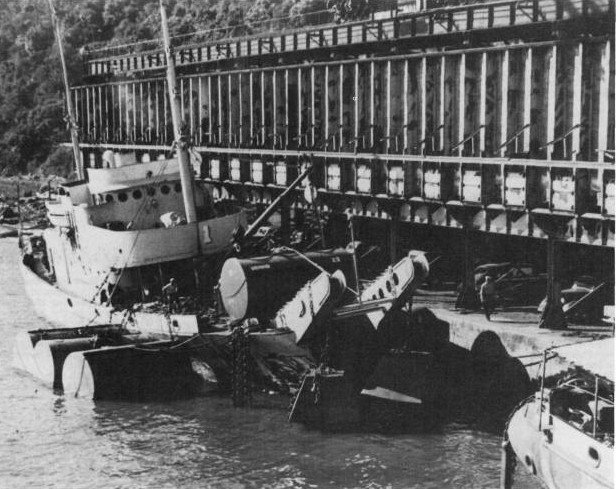
Aloe was the name ship of a class of net tenders, named for the plant. The Lake Washington Shipyard at Houghton laid her down on 14 October 1940 and launched her on 11 January 1941. She was placed in service on 11 June 1941. Lieutenant (junior grade) Harry Robert Shawk, of the Naval Reserve, was in charge. Through 1941 and 1942 she tended the antisubmarine nets and booms of the San Francisco area, still not commissioned.
She was commissioned on 30 December 1942. Lieutenant Donald Baker Howard, of the Naval Reserve, was in command. One secondary card prints 11 June 1941 as the commissioning. That is the day she was placed in service. She left San Francisco on 22 January 1943, reached Noumea on 18 March, and six days later went on by the New Hebrides to the Solomons.
On 7 April 1943 she lay moored to the Sturgis Dock at Tulagi. Howard still had her. Sixty-seven dive bombers, with a fighter escort drawn mostly from four carriers, came over the harbor. They were after larger ships. Kanawha and the New Zealand corvette Moa went down on the Tulagi side, and Aaron Ward (DD-483) went down across the sound. Aloe was not hit. Her one 3-inch gun and four .50-caliber machine guns were in the barrage. The ship history gives her one dive bomber shot down, one possible, and one damaged. That afternoon is the first of three battle stars. NavSource dates it the consolidation of the southern Solomons, 7 April 1943.
On 31 January 1944 she was reclassified a net layer, AN-6. A ship card dates the change from YN-1 on 20 January 1944. On 18 June 1944, east of Guam with a task group, Japanese planes attacked about six in the evening. The same account says her 20-millimeter and .50-caliber guns hit three of them. The Guam star runs from 21 July to 15 August 1944. There is no separate Guam battle in this record. The Okinawa star runs from 1 May to 30 June 1945. The account does not put her in a named fight on the landing day.
She was decommissioned on 3 August 1946 and placed in reserve on 26 September 1946, in the Columbia River group of the Pacific Reserve Fleet. Her name was struck on 9 October 1962. She was sold for scrap on 14 May 1971 to I. D. Logan. A ship card dates the transfer to the buyer on 10 June 1971. The Dictionary gives 805 tons, a length of 163 feet 2 inches, 12.5 knots, a complement of 48, one 3-inch gun, and two .50-caliber guns. NavSource gives 700 tons full and 805 limiting, a length of 162 feet 2 inches, 12.5 knots on trial, and four officers and 44 enlisted.
A note on sources. The raid paragraph is the Dictionary of American Naval Fighting Ships, Aloe, as printed on the Naval History and Heritage Command page and on the NavSource net-tender story "Aloe at Solomons, Guam and Okinawa," which names Butternut in the same harbor. Commanding officers are NavSource, credited to Wolfgang Hechler and Ron Reeves: Shawk from 11 June 1941, Howard from the commissioning to 15 August 1943, Richard Heber to 16 November 1944, and Carl Lawrence Stevens, Jr., to 9 December 1945. NavSource prints Stevens's start with a broken character before November. The day used is 16 November 1944. David Keith, Jr., took her on 9 December 1945, after the war, and is not filed. The three campaign windows are NavSource. The 20 January reclassification is shipscribe.com. The photograph is National Archives 80-G-350013, Aloe (YN-1) at the Tiburon net depot in 1941, hull number 1 on the bow, in the prewar No. 5 gray. The Commons file is 616 by 489 pixels. It is the wartime hull.