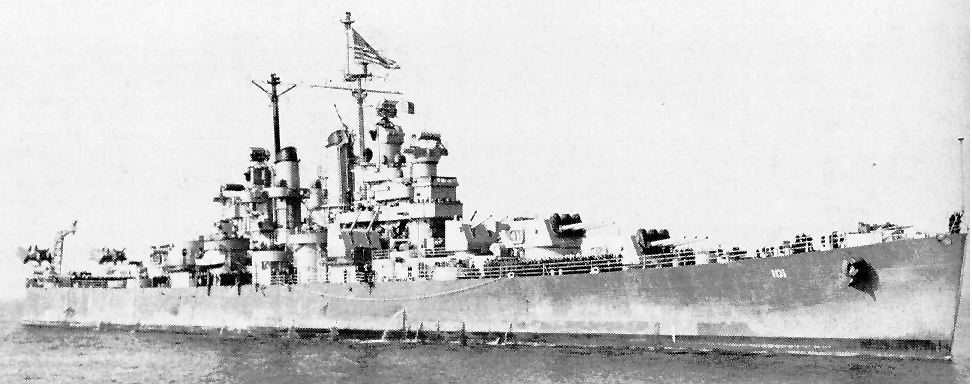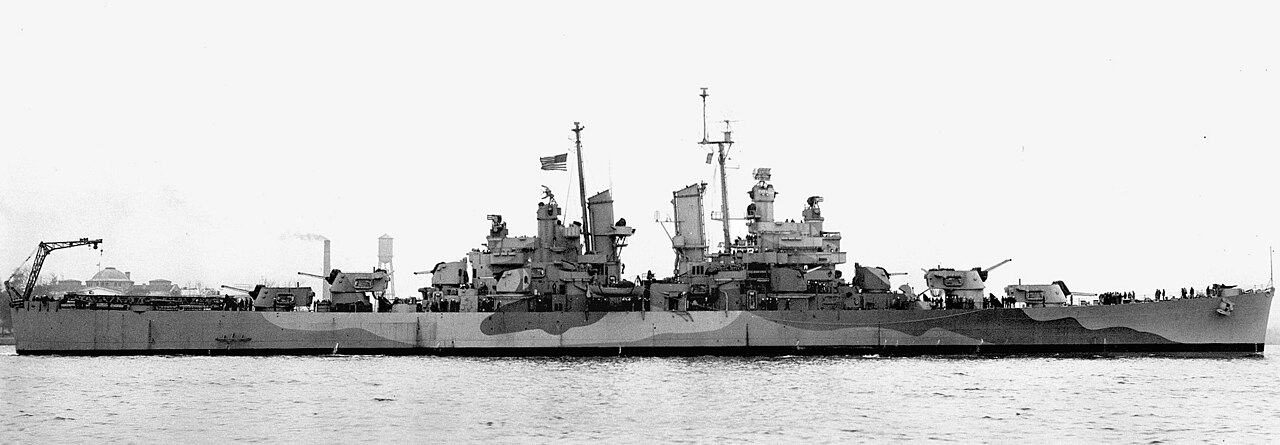
The name Amsterdam had already been assigned once in this war. On 2 August 1940 President Franklin D. Roosevelt chose it for a projected Cleveland-class light cruiser, CL-59, laid down at Camden, New Jersey, on 1 May 1941 by the New York Shipbuilding Corporation. Before that hull was finished the Navy converted her to an aircraft carrier, renamed her Independence (CV-22) on 12 February 1942, and launched her under the new name on 22 August 1942. The name then went to a second Cleveland-class ship, CL-101, for the manufacturing city in eastern New York, 28 miles northwest of Albany. Newport News Shipbuilding and Dry-dock Company laid her down at Newport News, Virginia, on 3 March 1943. She went down the ways on 25 April 1944, sponsored by Mrs. William E. Hasenfuss, the first Gold Star mother of Amsterdam, New York, who had lost a son in the Japanese attack on Pearl Harbor. The Navy commissioned her at the Norfolk Navy Yard, Portsmouth, Virginia, on 8 January 1945, with Captain Andrew P. Lawton in command. The DANFS line for the hull gives 10,000 tons, a length of 610 feet 1 inch, a beam of 66 feet 4 inches, a draft of 24 feet, 31.6 knots, a complement of 1,426, twelve 6-inch guns, twelve 5-inch guns, twenty-eight 40 mm guns, and ten 20 mm guns.
Captain Andrew Petrie Lawton had her from the commissioning. NavSource dates that command from 8 January 1945. After fitting out at Norfolk she got underway on 5 February for shakedown in Chesapeake Bay. On 17 February she left Hampton Roads for Trinidad and the second phase of the cruise. She operated from Trinidad through 13 March, held shore-bombardment practice off Culebra on the way north, and was back at Norfolk on 20 March. A short cruise to Cape May, New Jersey, for gunnery exercises followed, and she entered the Norfolk Navy Yard on 24 March. She left the yard on 20 April, trained again in the Chesapeake, and four days later sailed for the Caribbean. After exercises off Culebra and at Guantanamo Bay she transited the Panama Canal on 5 May and reached Pearl Harbor on 18 May, where she carried out gunnery and tactical exercises.
On 9 June she sailed for Leyte. She arrived in San Pedro Bay on 21 June and reported to the Third Fleet. After provisioning and refueling she sortied on 1 July with Task Force 38 to cover air strikes against the Japanese home islands. On 10 July the force's planes began raids on airfields, factories, and shipping. Amsterdam protected the carriers from air or surface attack. The cities attacked included Tokyo, Kure, Kobe, and Osaka. On 15 August the task force was preparing another strike on Tokyo when the ships received word of Japan's capitulation. She had not been in the fleet actions or the island landings of 1942, 1943, or 1944. Her war service was this last screening cruise.
For the next few weeks she remained off the east coast of Honshu while the armistice was negotiated. She steamed into Tokyo Bay on 5 September and stayed through the 20th, then shaped a course for the United States. She stopped at Buckner Bay, Okinawa, and at Pearl Harbor to take on people for the trip home. The DANFS caption places her off the Naval Air Station at Astoria, Oregon, on 14 October 1945, flying a large ensign and carrying Curtiss SC-1 Seahawk floatplanes aft. The narrative has her at Portland, Oregon, on 15 October. She stayed a fortnight for Navy Day and on 29 October got underway for San Pedro, California, arriving on 1 November.
After leave and upkeep she left the west coast on 19 November for Pearl Harbor, touched there on the 25th, and took on personnel and equipment for the return. She sailed again on 12 December, was back at San Pedro on the 18th, and rode at anchor there into early 1946. On 21 January she got underway for San Francisco. The crew then prepared her for inactivation and the Pacific Reserve Fleet. NavSource relieves Lawton in August 1946 and gives the ship to Captain Archibald Emil Uehlinger, a Naval Academy graduate of 1922 whose final rank on that list is rear admiral. He had her through the decommissioning. She was decommissioned on 30 June 1947 and laid up at San Francisco. Her name was struck from the Navy list on 2 January 1971. On 11 February 1972 she was sold to National Metal and Steel Corporation, Terminal Island, California, and later scrapped. She earned one battle star for World War II service. She was not sunk.
A note on sources. The narrative follows the Naval History and Heritage Command's Dictionary of American Naval Fighting Ships entry for Amsterdam (CL-101) for dates, places, the earlier hull CL-59, the sponsor, the July and August 1945 cruise, and the disposal. That page's caption dates her arrival off the Naval Air Station at Astoria to 14 October 1945; the narrative dates her arrival at Portland to 15 October. Both are stated as the page gives them. The commanding officers and their dates are NavSource's list for CL-101. DANFS names only Lawton, as Andrew P. Lawton, at the commissioning. NavSource gives no day in August 1946 for the relief. The Navy Department Library biography of Uehlinger says he was ordered to Amsterdam in August 1946 and had orders in April 1947 to return to the Bureau of Ordnance; NavSource carries him through the decommissioning on 30 June 1947, and the command lines follow NavSource. The local Wikipedia page agrees with DANFS on the launch in its infobox, 25 April 1944, and NavSource's launch photographs are captioned 25 April 1944. The service-history paragraph on that Wikipedia page says she was launched on 25 March 1944 and points to Norman Friedman, U.S. Cruisers, which was not fetched. DANFS is followed. DANFS gives a draft of 24 feet; NavSource gives a maximum draft of 25 feet. No battle in the existing list matches her service. She was not at Iwo Jima, Okinawa for the April 1945 landings, or the named actions of Leyte Gulf. The July and August strikes on Japan are not a separate battle on that list.