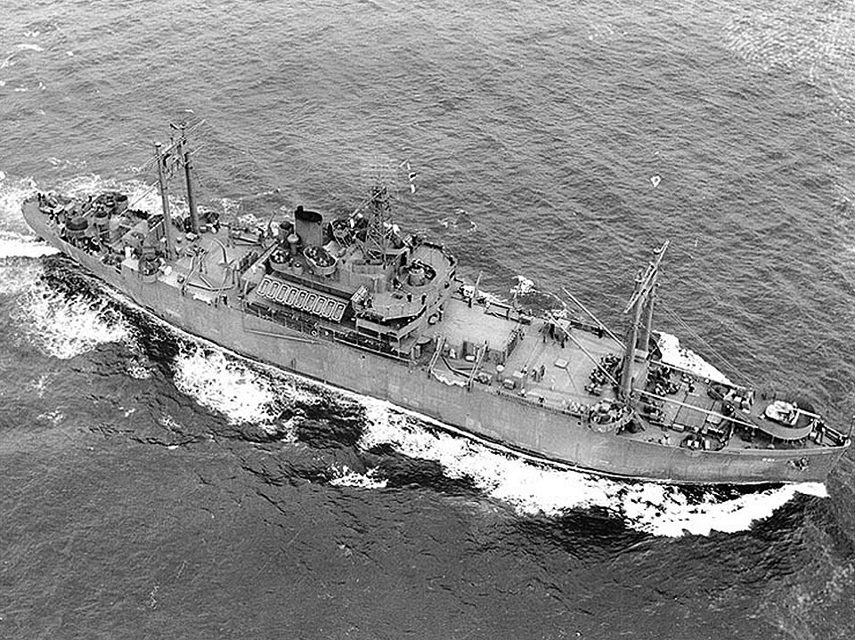
Appalachian, AGC-1, was an amphibious force flagship and the lead ship of her class. Federal Shipbuilding and Drydock laid her down at Kearny, New Jersey, on 4 November 1942 as Maritime Commission hull 200. She was launched on 29 January 1943 and acquired by the Navy on 27 February. Todd Shipbuilding converted her at Brooklyn, and she was commissioned on 2 October 1943, Captain James M. Fernald in command.
Rear Admiral Richard L. Conolly broke his flag in her at San Diego, after elements of the 4th Marine Division embarked. She sailed on 13 January 1944 for Hawaii and then Kwajalein. Her task force was the northern attack force, and its objectives were Roi and Namur. The attack opened on 31 January. The next day she entered the lagoon and began landing the headquarters battalion of the 4th Marine Division with its equipment. The area was secured by 5 February. Conolly shifted his flag to Maryland (BB-46), and Appalachian sailed the next day for the Ellice Islands.
For Guam she carried Major General Roy S. Geiger of the 3d Amphibious Corps. Her group sortied on 12 June 1944 and was turned back about 50 miles from the island because of the approaching Japanese fleet. It steamed a rectangular course for 16 days while the Battle of the Philippine Sea was fought, and put in at Eniwetok on 28 June. She reached Guam on 14 July, joined the pre-assault bombardment that morning, and gave fire support through the landing. In October she carried Major General A. V. Arnold, commander of the 7th Infantry Division, to Leyte. On 11 January 1945 she landed troops at Lingayen Gulf. Japanese planes attacked her in the South China Sea on the way out, and she evaded them.
After an overhaul at Mare Island she served in the Marianas and the Philippines. On 25 September 1945 she reached Aomori and landed troops there, and soldiers she carried occupied other Japanese cities. In 1946 she was a headquarters ship for press representatives at the Bikini atomic tests. DANFS gives her decommissioning as 21 May 1946, which does not fit its own account of her service that summer. NavSource gives 21 May 1947, at San Diego. She was struck on 1 March 1959 and sold for scrap in 1960. She earned four battle stars.