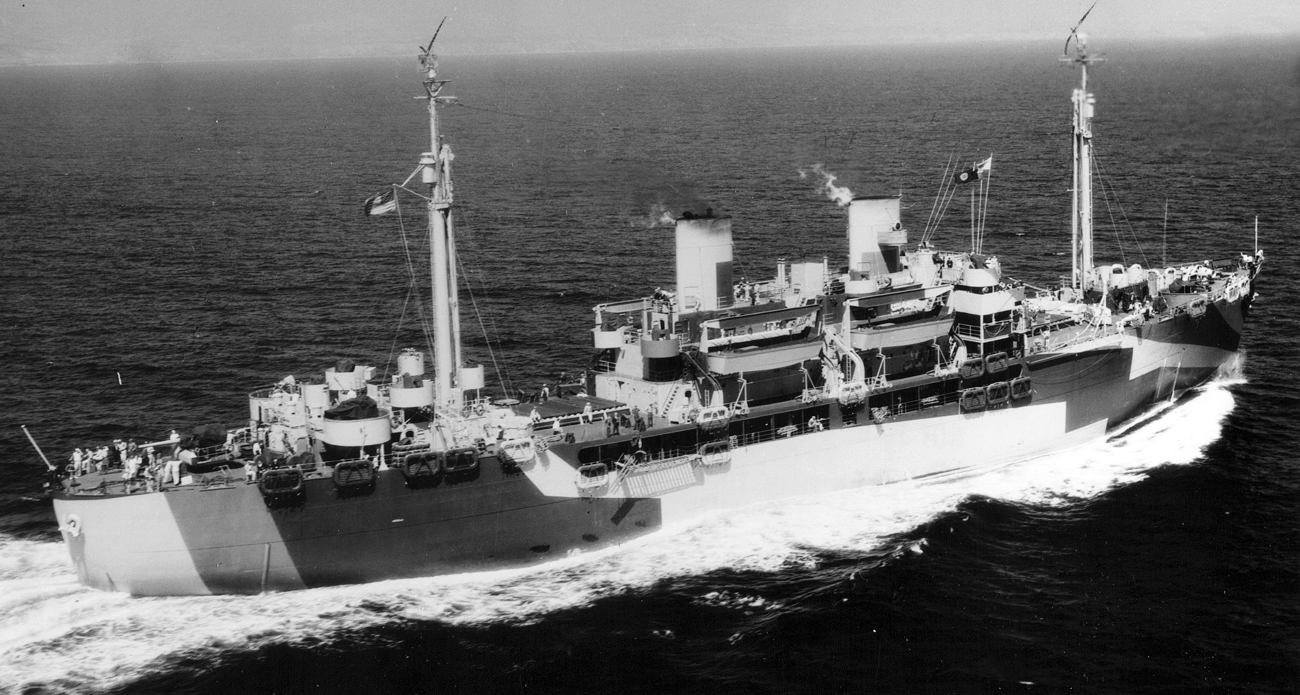
Appling was named for a county in Georgia. She was a Gilliam-class attack transport, Maritime Commission hull 1851, laid down by Consolidated Steel at Wilmington, California. The actress Claudette Colbert sponsored the launch on 9 April 1944. The Navy acquired her and commissioned her on the same day, 22 August 1944. Lieutenant Commander Alexander Lunde Stuart was in command.
Shakedown off the California coast came first. On 17 October she sailed for Finschhafen, New Guinea, but engine repairs forced a stop at Purvis Bay on Florida Island, and she did not arrive until 14 November. Training in Humboldt Bay followed. Christmas Day put 6th Army troops aboard at Hollandia. Task Group 77.9, inside the Luzon invasion force, took her out on 3 January 1945. Her anchorage on 11 January was the transport area in Lingayen Gulf, and the beach she fed lay east of San Fabian. That evening an enemy plane went down 2,000 yards off the starboard quarter, her guns sharing the shoot with ships nearby. She withdrew into Leyte Gulf on the following day.
Two months of exercises in Leyte Gulf followed. Late in March she loaded cargo and personnel marked for Operation Iceberg, the Ryukyus assault. On 27 March she left with Transport Squadron 13 of the Southern Assault Force. Off Okinawa early on 1 April she started lowering boats at 0605. Soldiers from other ships used the boats. Her own troops went ashore from 3 to 7 April. She then retired to Kerama Retto, acted as receiving ship until the 12th, returned to Okinawa, and on the 14th headed for Hawaii. Saipan was a short call. She made Pearl Harbor on 2 May and sailed for the United States the morning after. San Pedro on 10 May was for voyage repairs. On 7 June she went to San Diego for refresher training, sailed on 16 June for Majuro Atoll in the Marshalls, and continued to Guam in mid-July. She then turned back and reached San Francisco on 29 July.
Repairs took almost a month, and the fighting ended while she was in the yard. On 28 August she got underway by way of Eniwetok for the Marianas, stopped at Guam, and at Saipan took on part of the 2d Marine Division for occupation duty in Japan. On 23 September she arrived at Nagasaki with other ships of Transport Squadron 12. Five days on, she turned toward the Philippines. Subic Bay and Manila both gave her soldiers for the run into Sasebo. She left Sasebo on 19 October with veterans bound home and reached Portland, Oregon, on 27 November. Early in January 1946 she went back to the Philippines for another homeward lift, On 4 February she cleared the Philippines and continued as far as Pearl Harbor.
Crossroads, the atomic trials at Bikini, kept a fleet of ships to be examined, and she was placed in it. The question was what a nuclear blast would do to a hull. She reached Bikini on 2 June and remained in those waters through 15 August without ever serving as a target. Pearl Harbor was a call before clearance checks for radiation at San Francisco and at San Pedro. Port Hueneme on 26 September was meant to load cargo for a return to Pearl Harbor, but east-coast deactivation orders arrived with the holds still empty. She passed the Panama Canal on 22 November. Norfolk followed on 30 November. Portsmouth, at the Norfolk Naval Shipyard, took her out of commission on 20 December 1946. On 4 April 1947 the Navy struck her name. On 31 March 1948 the Maritime Commission received her. National Defense Reserve Fleet layup lasted until the Arrow Steamship Company took her on consignment, 9 September 1954. She was back in reserve on 12 December 1954, moored up the James River. Scrapping was the last sale. Two battle stars were awarded.