Building
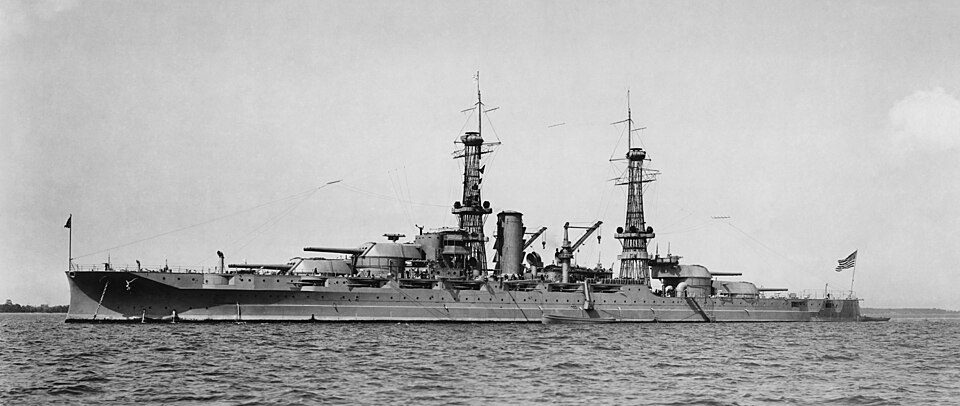
Battleship No. 39 was the second and last of the Pennsylvania class, the most powerful American "Standard-type" battleships of their day. Her keel was laid at the New York Navy Yard in Brooklyn on the morning of 16 March 1914, with Assistant Secretary of the Navy Franklin D. Roosevelt watching. Secretary Josephus Daniels named her for Arizona, then the newest state in the Union. She was launched on 19 June 1915, about fifteen months after her keel was laid, and commissioned on 17 October 1916, Captain John McDonald in command. Her engineer officer at commissioning was Lieutenant Commander Stafford H. R. Doyle, who six years later became the first captain of an American aircraft carrier.
She was 608 feet long and displaced 29,158 tons standard. Her main battery was twelve 14-inch guns in four triple turrets. She had twenty-two 5-inch guns in casemates and two submerged torpedo tubes, and was protected by a torpedo bulkhead and a full double bottom. Four Parsons turbine sets and twelve boilers drove her at her designed 21 knots, and in a 1924 trial she reached 21.5. As built, she carried 56 officers and 1,031 men.
The Great War and the peace
She left the yard on 3 April 1917, three days before the United States declared war on Germany. The coal-burning battleships went to Britain, but oil-fired Arizona stayed home and trained gunners on the East Coast. In July 1918 her racing boat crew won the Battenberg Cup, beating Nevada's crew by three lengths. A week after the Armistice she crossed to Britain. On 13 December 1918 she was one of nine battleships and 28 destroyers that escorted President Wilson's liner George Washington into Brest on his way to the Paris Peace Conference.
In the spring of 1919, while waiting to bring Wilson home, she was sent to Smyrna (now İzmir) in Turkey, where Greece and Italy were in a standoff over the peace treaty's award of the city to Greece. When Greek troops landed and the city fell into chaos, American citizens took shelter aboard Arizona. She went on to Constantinople and sailed for home on 15 June 1919.
The Pacific years
She was fitted with a flying-off platform for aircraft, became flagship of Battleship Division Seven in 1920, and in January 1921 passed through the Panama Canal with the fleet to join the Pacific Fleet, which she never left. She called at Peru, and from then until 1940 her home port was San Pedro, Los Angeles. The historian Paul Stillwell wrote that "the Pacific years included a great deal of sameness and repetition": torpedo-defense practice, battle-practice rehearsals and gunnery runs, broken by the annual Fleet Problems from 1923, which took her to Panama, Hawaii and the Caribbean. One scandal broke the routine. In 1924 a stowaway, Madeline Blair, was found aboard, and several officers and men were court-martialed. Admiral William V. Pratt, who thought the punishments excessive, had the reprimands struck from the officers' records when he became Chief of Naval Operations.
From 1929 to 1931 the Norfolk Navy Yard modernized her. She received extra deck armor of Special Treatment Steel and torpedo bulges, and her submerged torpedo tubes were removed. In March 1931 she carried President Herbert Hoover on a Caribbean vacation. On 10 March 1933 she was at San Pedro when the Long Beach earthquake struck, and her crew helped with relief work ashore. In 1934 Warner Brothers filmed her for the James Cagney picture Here Comes the Navy. Budget cuts kept her anchored for 267 days in 1936–37 and 255 days in 1937–38. Captain Isaac C. Kidd took command on 17 September 1938, and Rear Admiral Chester Nimitz flew his flag in her as commander of Battleship Division One until May 1939. In April 1940 the fleet was moved forward to Pearl Harbor as a warning to Japan. After an overhaul at Bremerton she returned to Hawaii. Kidd, now a rear admiral, raised his flag in her on 23 January 1941, and Captain Franklin Van Valkenburgh took command on 5 February 1941. On 22 October 1941, in heavy fog, Oklahoma rammed her bow during an exercise.
7 December 1941
Shortly after 08:00 on 7 December 1941, ten Nakajima B5N "Kate" bombers from Kaga and Hiryū attacked Arizona as she lay at her berth off Ford Island with the repair ship Vestal alongside. They scored four hits and three near misses with armor-piercing bombs. A near miss off the bow made observers think she had been torpedoed, but no torpedo damage has ever been found. One bomb glanced off Turret IV and burst in the captain's pantry. Another hit abreast the mainmast, and a third near a port antiaircraft gun.
The last bomb struck at 08:06 near Turret II and went down through the armored deck. About seven seconds later her forward magazines exploded. The blast vented through the sides, gutted the forward part of the ship, dropped the forward turrets and conning tower 25 to 30 feet, threw the foremast and funnel forward, and in effect broke her in two. Fires burned for two days, and debris rained on Ford Island. The shock wave blew out the fires on Vestal. Of the 1,512 men aboard, 1,177 were killed, about half of all American deaths that day. Rear Admiral Kidd and Captain Van Valkenburgh were among them. Whether the bomb set off a black-powder magazine first, as a 1944 Bureau of Ships report suggested, or went directly into a main powder magazine has never been settled, and probably never will be. Lieutenant Commander Samuel G. Fuqua, her damage-control officer, received the Medal of Honor for fighting the fires and getting survivors off the wreck. Kidd and Van Valkenburgh received it posthumously.
After the attack
Arizona was placed "in ordinary" on 29 December 1941 and struck from the Navy list on 1 December 1942. Unlike her neighbors, she was too badly wrecked to be salvaged for service. Her superstructure was cut away in 1942 and her guns were salvaged over the next eighteen months. Her two after turrets became the Army's coast batteries Arizona at Kahe Point and Pennsylvania on the Mokapu Peninsula. Battery Pennsylvania fired only once, on V-J Day, and Battery Arizona was never finished. The guns of Turret II were relined and mounted in Nevada, which fired them at Iwo Jima and Okinawa.
Her hull still lies where she sank, with many of her crew inside. The USS Arizona Memorial, dedicated to everyone who died in the attack, stands across her remains. She is under the care of the National Park Service, though the Navy still holds title, and she has the right to fly the national flag as if she were in commission. Contrary to a common belief, she is not still a commissioned ship.
Sources
Wikipedia, "USS Arizona" (citing Stillwell, Battleship Arizona: An Illustrated History; Friedman, U.S. Battleships; NHHC; the 1944 Bureau of Ships report).
NHHC/DANFS, "Arizona II"; Navy biography of Capt. Stafford H. R. Doyle (engineer officer at commissioning).