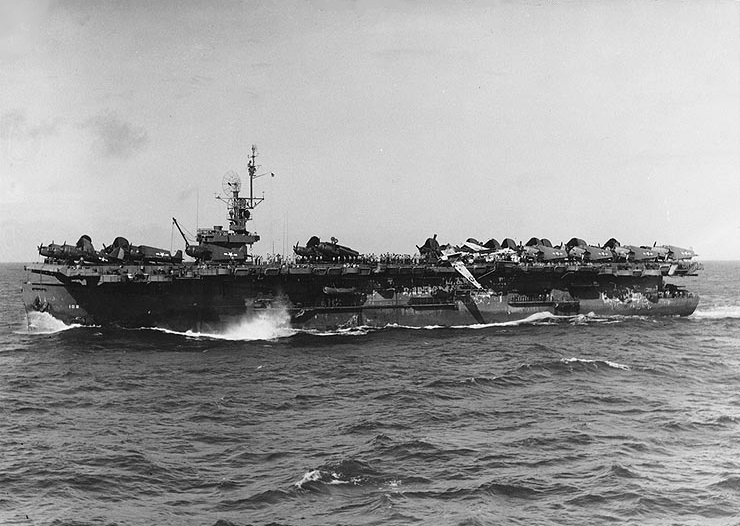
Attu is the westernmost of the Aleutians. Japanese forces took it in June 1942, and American troops took it back in May 1943. The escort carrier was named Elbour Bay until 6 November 1943. Kaiser at Vancouver laid her down on 16 March 1944 as Maritime Commission hull 1139, launched her on 27 May, and Mrs. George W. Steele sponsored her. Captain H. F. MacComsey commissioned her on 30 June 1944.
After shakedown she left San Diego on 7 August with aircraft and men for Pearl Harbor, stayed two days, and went on to Guadalcanal and Espiritu Santo. She was back at San Diego on 13 September, finished a post-shakedown availability at Terminal Island on 28 September, and loaded at Alameda. She left the west coast on 1 October, reached Finschhafen on 18 October, called at Seeadler Harbor, and returned by Pearl Harbor to Alameda. After two weeks in the yard she sailed on 23 November and shuttled supplies and troops between Guam and Pearl Harbor, reaching San Diego on 4 January 1945.
She sailed again on 20 January, reached Pearl Harbor on 27 January, and on 1 February headed for Eniwetok and Ulithi. On 16 February she left the atoll to meet ships of Task Force 50 and supply replacement aircraft and pilots to the fast carriers. She reloaded at Guam and kept that logistics duty through early July, then repaired at San Diego and sailed again on 24 July. She was in a fueling area south of the Japanese home islands when word came that Japan had capitulated.
On 11 November she started home. From 25 November she brought men back across the Pacific, steamed more than 38,000 miles, and returned more than 4,000 servicemen. In May 1946 she was ordered disposed of. She went to Norfolk by the Panama Canal and Jacksonville and was decommissioned there on 8 June 1946. Her name was struck on 3 July 1946, and she was sold on 3 January 1947. She received two battle stars.