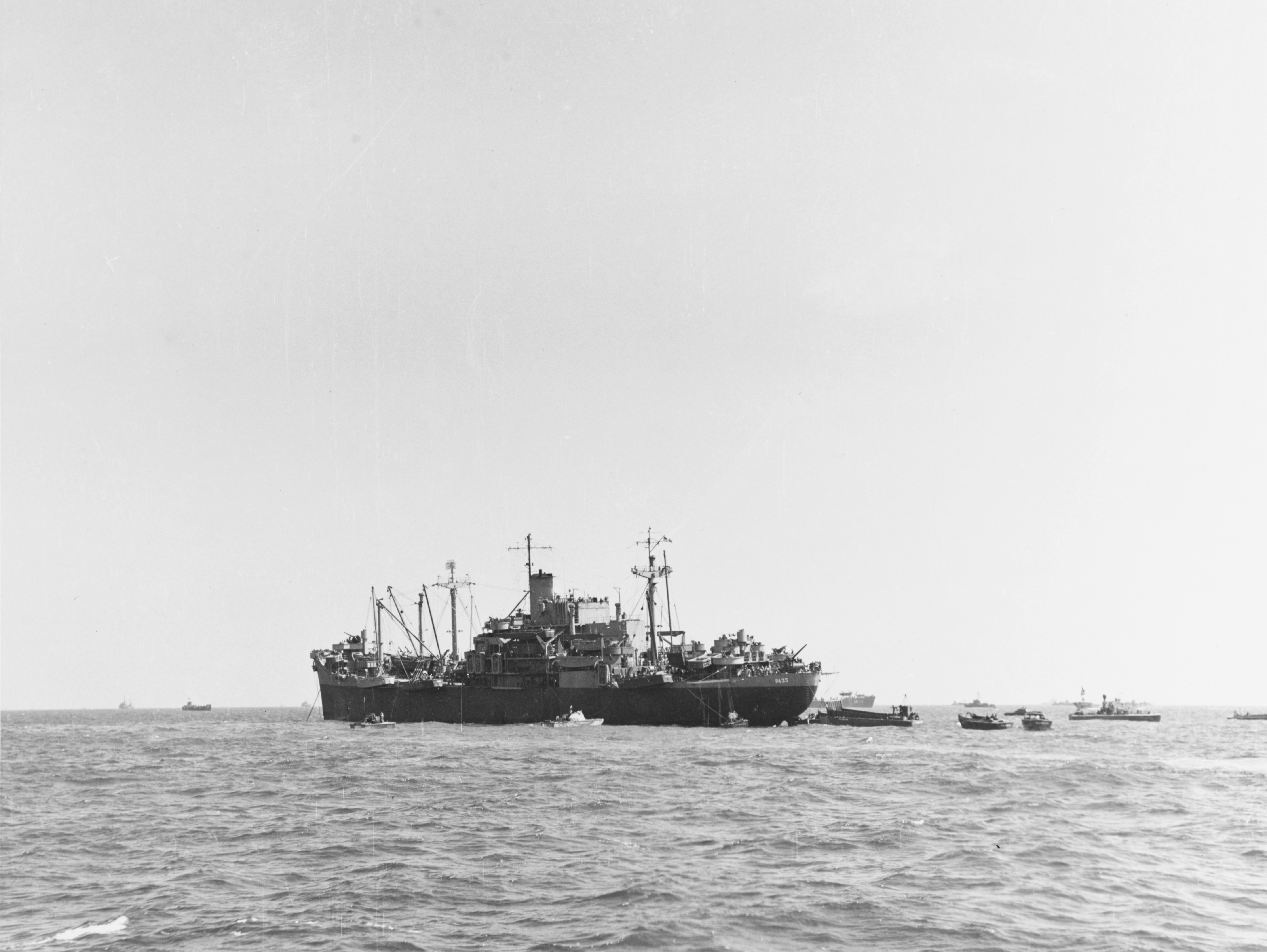
Bayfield was named for a county in Wisconsin. Her class was Bayfield. Western Pipe and Steel launched her at San Francisco on 2 August 1942 as Sea Bass, for the Maritime Commission, and Mrs. Clarence A. Reiter sponsored her. She was AP-78 until 1 February 1943, when she became APA-33. The Navy received her on 30 June 1943 and placed her in reduced commission the same day. She departed San Francisco on 7 July, arrived at New York on 29 July for conversion, and was recommissioned on 30 November 1943. Captain L. Spencer of the Coast Guard had her, and she was assigned to the Atlantic Fleet.
Drills with the Amphibious Training Force came first. The Atlantic crossing ended in England. Practice landings, off that coast and off Scotland, filled 6 March through 5 June 1944. She sailed for the invasion of France on that last day. Rear Admiral D. P. Moon used her as flagship. He commanded Task Force 125, the Utah Force. On 6 June she sent her troops onto the Norman coast, She stayed at anchor and took casualties aboard. On the 25th the ship headed back to England. July and early August were spent in the Mediterranean. From 13 August to 9 September she was flagship again, this time for Rear Admiral S. S. Lewis of Task Force 87, the Camel Force, during the assault on southern France. She reached Norfolk on 26 September.
Minor repairs followed, and in November she shifted to the Pacific. December 1944 and January 1945 were training months around Hawaii. On 27 January she left Pearl Harbor. She took part in the Iwo Jima assault from 19 to 28 February, got underway on 27 March, operated off Okinawa from 1 to 10 April, and then went back to Saipan. She carried cargo among the Pacific islands until San Francisco on 30 July 1945.
From August 1945 into March 1946 she took troops and cargo out once to Japan and twice to Korea. Between April and August 1946 she joined the atomic tests at Bikini. China duty came in two voyages, 7 July 1947 to 12 March 1948 and 1 November 1948 to 30 March 1949. Norfolk, and the Atlantic Fleet, had her from 20 May 1949. After a five-day pause she left for San Diego. Pacific duty lasted through 26 November 1949, and then she came back to the Atlantic. Eastern-seaboard work and Caribbean work held through 15 August 1950, the start of her first Korean tour.
Kobe, reached from San Diego on 16 September, was left the next day for Inchon. Seven months of support for the Korean fighting included the Inchon landing, the Wonsan landing on 26 October, and the Hungnam evacuation of 11 to 24 December. San Diego saw her on 26 May 1951. A round trip to Yokosuka was completed in September 1951. She was in the Far East again on 29 March 1952. Off Korea she supplied the forces, and that work ran to 1 December. Long Beach on 16 December. Three Far Eastern cruises followed, and she remained with the Pacific Fleet. From 21 August to 9 September 1954 she assisted in evacuating Vietnamese from northern Indochina. Four battle stars were awarded for the Second World War and four for Korea.