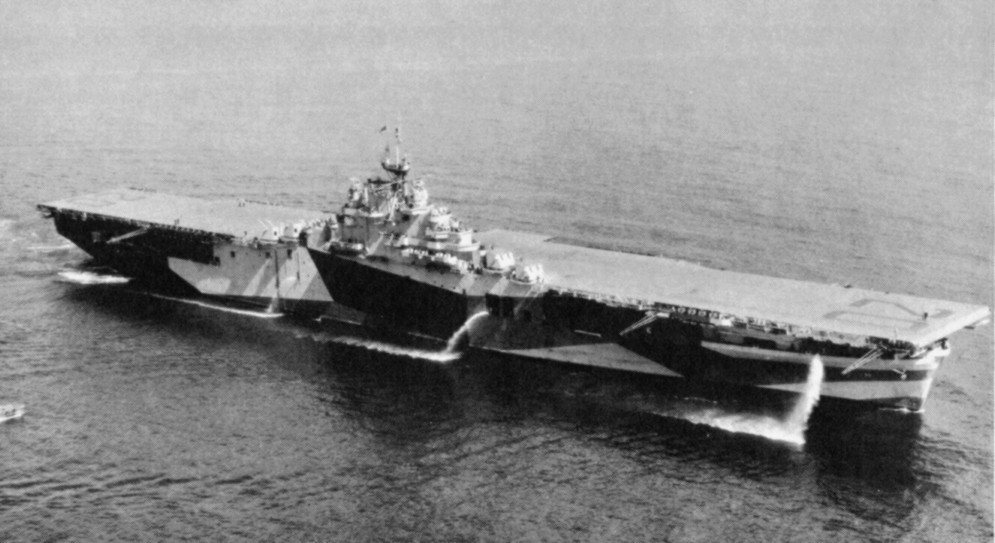
Building and namesake
Bennington was named for the August 1777 battle near Bennington, Vermont. That American victory helped bring about Burgoyne's defeat at Saratoga. The New York Navy Yard laid her down on 15 December 1942. She was launched on 26 February 1944, sponsored by the wife of Congressman Melvin Maas of Minnesota, and commissioned on 6 August 1944. After shakedown she passed through the Panama Canal on 21 December, reached San Diego on the 29th, and sailed west on New Year's Day 1945.
Into the war
She joined Task Force 58 and on 16 February took part in the first fast-carrier strikes on Japan itself, flown to isolate Iwo Jima. She left Honshū on 18 February to give close support at Iwo Jima, struck Japan again, and on 1 March hit the Okinawa airfields. On 18 March she joined the strikes on Kyūshū's airfields and bases before the Okinawa invasion, and the next day her planes hit the Kure Naval Arsenal and the Hiroshima area. On 7 April Task Force 58's planes found the Japanese force sailing toward Okinawa on Operation Ten-Go and sank Yamato, Yahagi and four destroyers. Bennington's pilots claimed at least two torpedo hits on the battleship, for the loss of one plane. She spent the rest of the spring supporting the Okinawa campaign.
Early in June, Task Force 38 (as the force had been renamed on 27 May) ran into Typhoon Connie, and Bennington's flight deck was damaged. She went to Leyte Gulf for repairs on 9 June and sailed again from San Pedro Bay on 1 July for the final carrier strikes on the Japanese home islands. She flew patrols over Japan until 10 September, when she entered Tokyo Bay. She earned three battle stars.
Postwar and the 1954 explosion
She ferried planes and men to Hawaii in January 1946 and was decommissioned into the Atlantic Reserve Fleet on 8 November 1946. During her modernization she was redesignated an attack carrier (CVA-20) in October 1952, and she returned to service in 1952. On 27 April 1953 an explosion in her No. 1 fireroom killed 11 men. On 26 May 1954, off Rhode Island, her port catapult accumulator burst and released vaporized lubricating oil, which some unknown heat source set off. A series of explosions killed 103 officers and men and injured more than 200, most of them badly burned. It was one of the worst peacetime disasters in the Navy's history. The Secretary of the Navy later decorated 178 of her crew for their actions that day. A court of inquiry found that the dangers of the hydraulic catapults were already known. A memorial to the dead stands at Fort Adams State Park in Newport, erected in 2004.
Later service and fate
After repairs at New York she rounded Cape Horn and reached San Diego on 20 October 1955. She then alternated Seventh Fleet deployments with West Coast operations. She became an antisubmarine support carrier (CVS-20) on 30 June 1959, earned five battle stars in Vietnam, and was decommissioned in 1970. She was sold for scrap on 12 January 1994 and towed to India to be broken up.
Sources
Wikipedia, "USS Bennington (CV-20)" (citing DANFS; court of inquiry records).
NHHC/DANFS, "Bennington II."
Flag: The extract's date for her first strikes on Japan ("the 16th") is ambiguous and needs a DANFS check. The 1970 decommissioning date also needs a check, and her 1967 Apollo recovery role is left out because the extract does not include it.