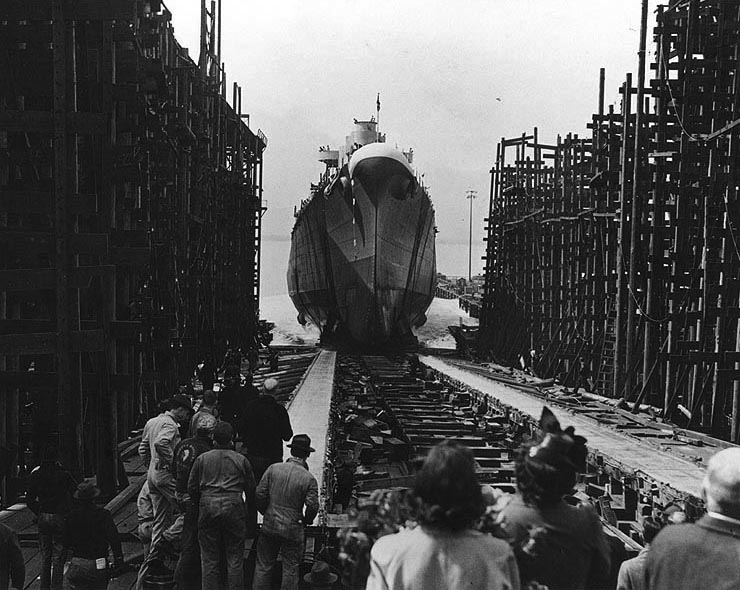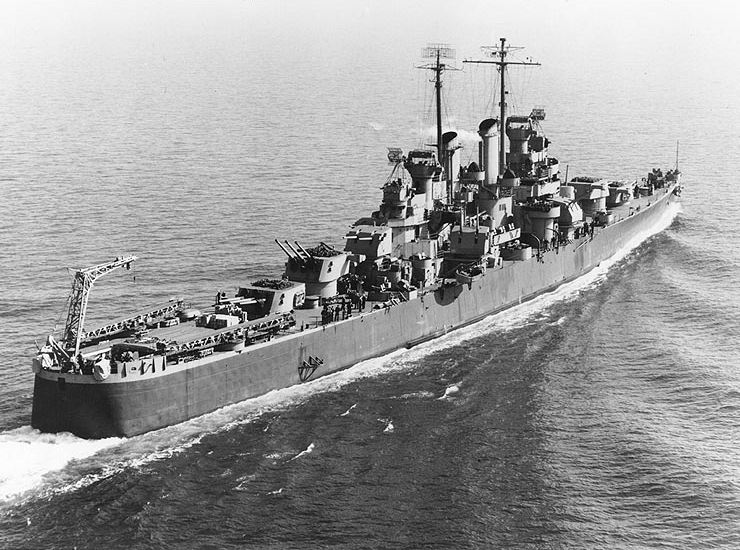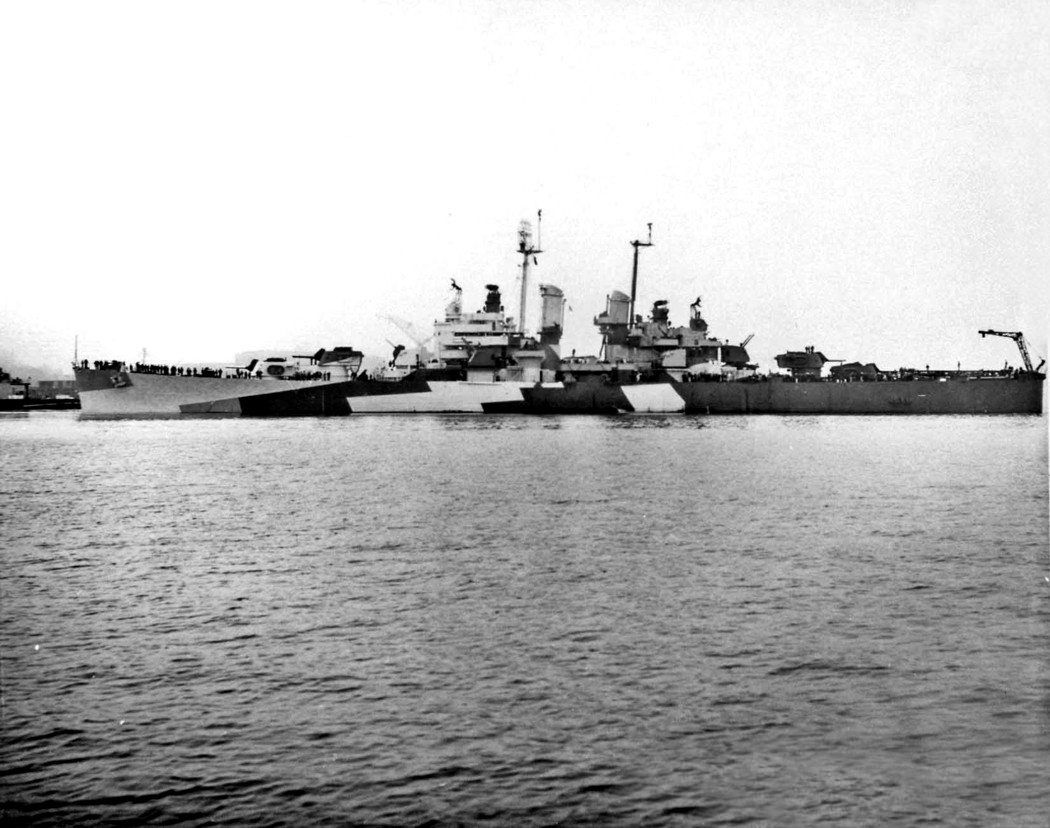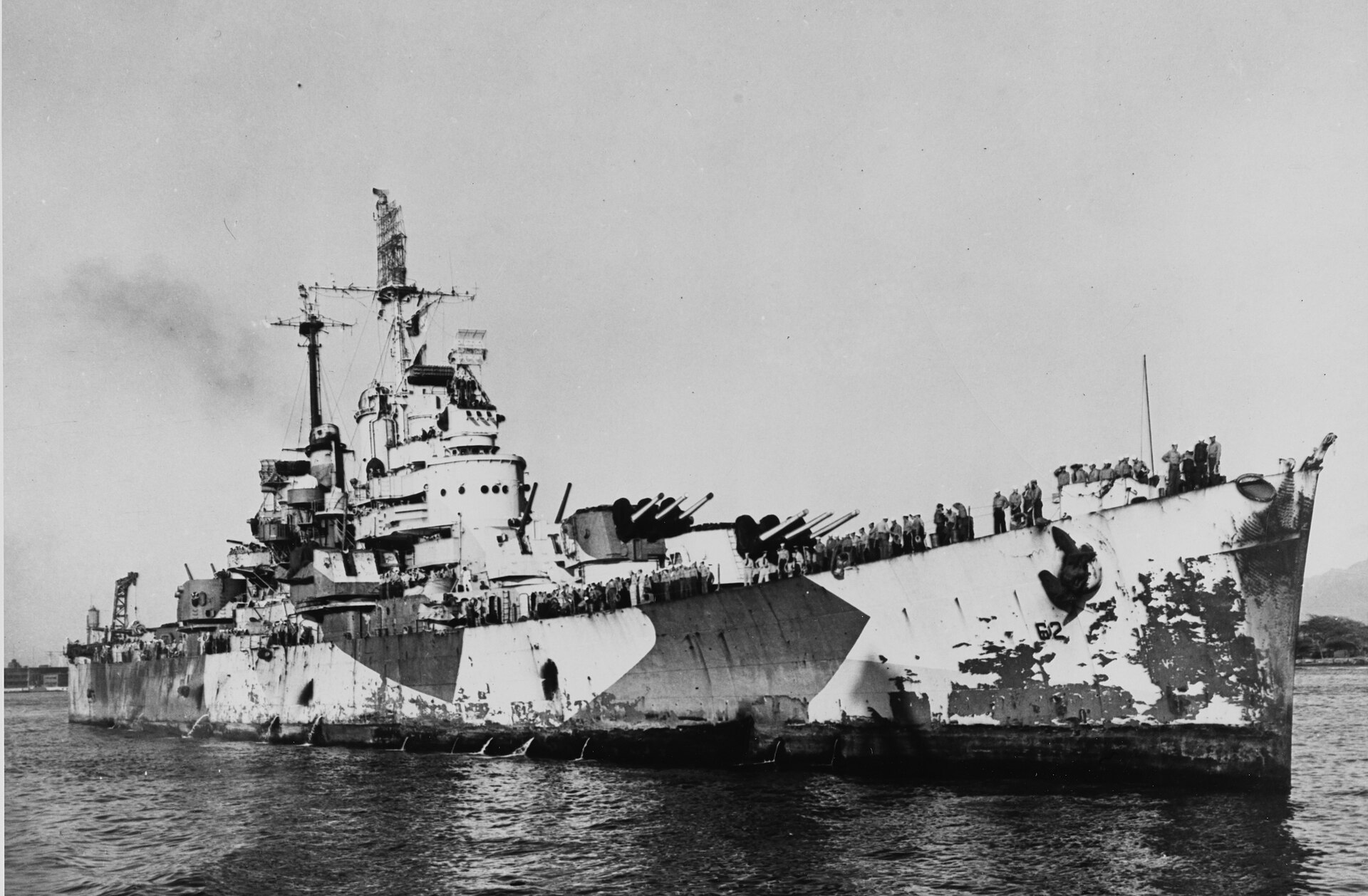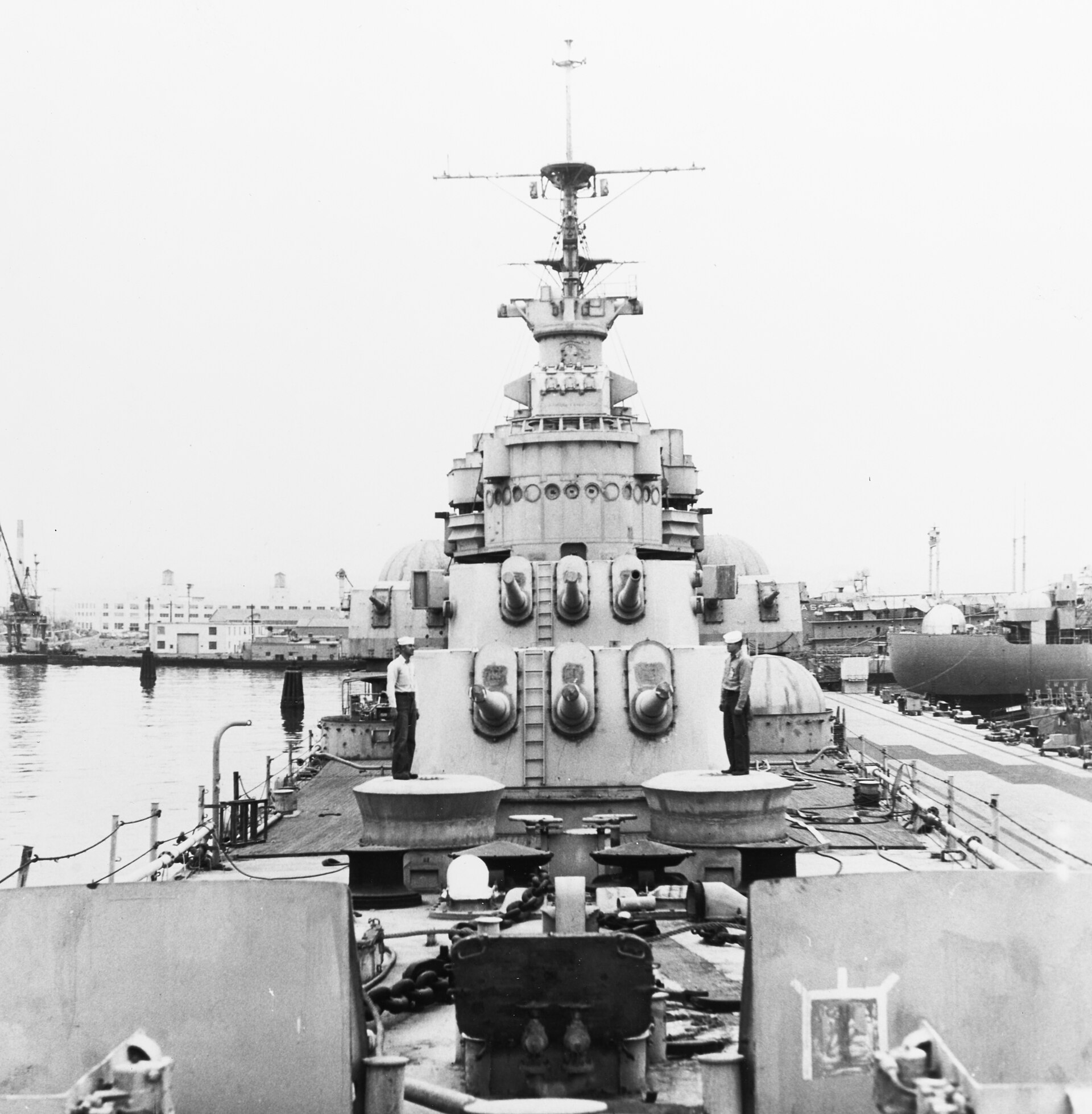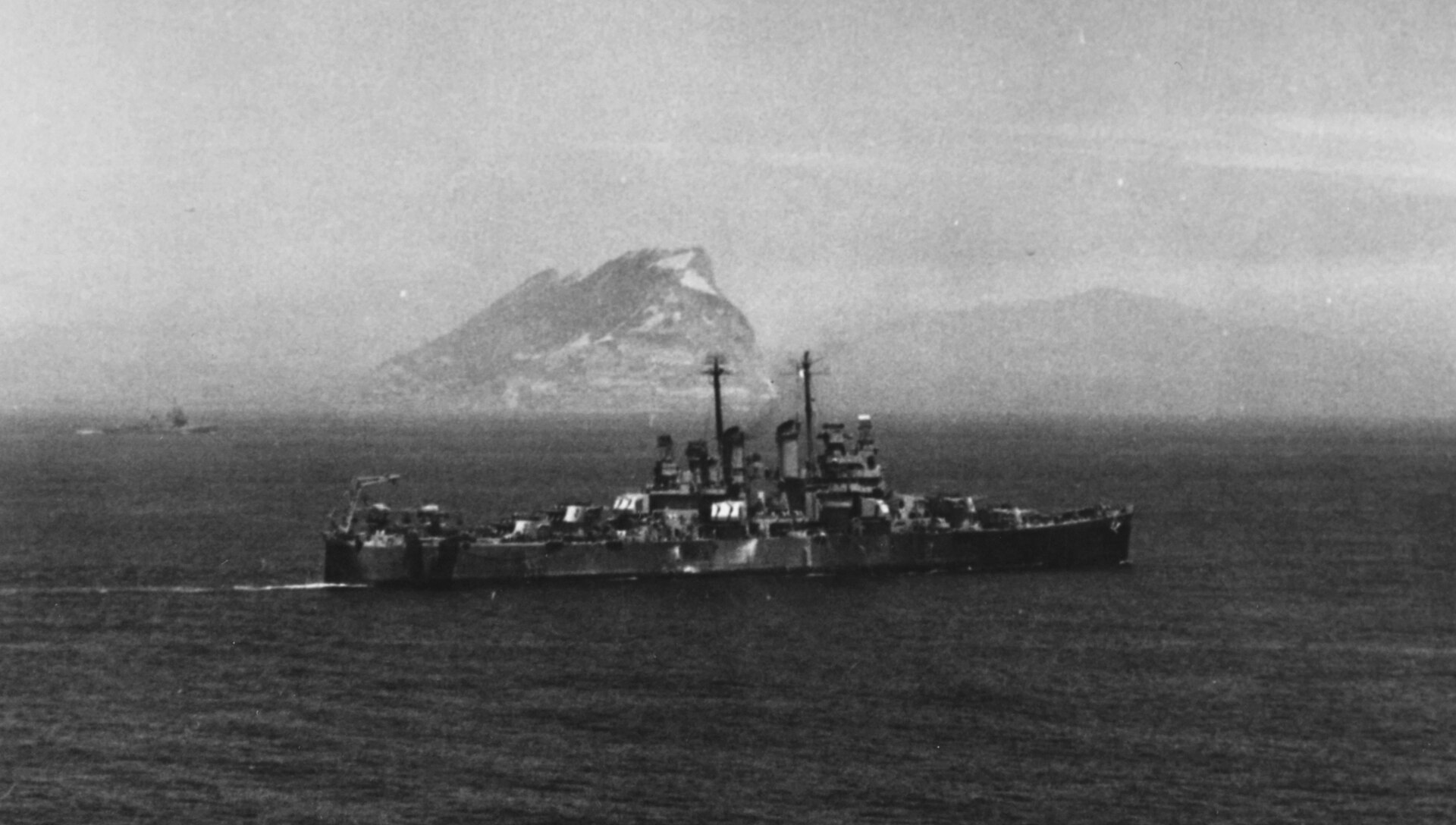
Birmingham, CL-62, was a Cleveland-class light cruiser, the second Navy ship named for the Alabama city. Newport News Shipbuilding and Dry Dock Company laid her down on 17 February 1941, and she went down the ways on 20 March 1942, sponsored by Mrs. Cooper Green, wife of the president of the Birmingham City Commission. She was commissioned at the Norfolk Navy Yard on 29 January 1943 with Captain John Wilkes in command, a submariner who had spent the first six months of the Pacific war running the Asiatic Fleet's boats in retreat. She was a little over 610 feet long, with twelve 6-inch guns in four triple turrets, twelve 5-inch guns, and a designed complement of 1,262.
She did not go first to the Pacific. After shakedown in Chesapeake Bay she sailed for the Mediterranean on 8 June 1943, and on the morning of 10 July she was off Sicily with the Licata attack force for Operation Husky. Her two floatplanes went up to spot for her guns against batteries on the slopes of Monte Desusino, and they paid for it: in poor visibility both were shot up, one by a German fighter and friendly antiaircraft fire together, and the second was jumped by Allied fighters. Her rear-seat gunner, already wounded by friendly fire, was thrown from his seat and killed in the violent turns. For nine more days she fired bombardment and counter-battery missions along the coast. She was back in Norfolk on 8 August, and three days later Wilkes handed her to Captain Thomas B. Inglis and went to England to help prepare the Normandy landings.
Birmingham passed through the Panama Canal on 22 August and reached Pearl Harbor on 5 September 1943. Within a week she was screening Lexington, Princeton and Belleau Wood in raids on Tarawa and Makin, and on 5 October she closed Wake Island to shell gun batteries and an ammunition dump. Then she went south to the Solomons. On the night of 8 November 1943, patrolling off Empress Augusta Bay to cover the Bougainville beachhead, she was caught in a night air attack lit by green, red and yellow flares. A Val that her gunners set on fire skipped its bomb into her starboard quarter and wrecked the hangar. A minute later an aerial torpedo exploded against her port bow and tore a 30-foot hole just abaft the chain locker. A second Val, blown apart overhead, dropped its bomb on No. 4 turret. Two men were killed and 32 wounded. She held thirty knots and her place in the formation, and kept firing through the night.
The temporary repair at Florida Island left a trunk open from the flooded forward compartments to the main deck so the water could vent. Every time she pitched, a geyser shot up out of it, and the crew called her "Old Faithful." She was rebuilt at Mare Island over the winter, collided with the merchant ship Manukai while shifting berths there on 7 February 1944, and was back at Pearl Harbor on 23 February.
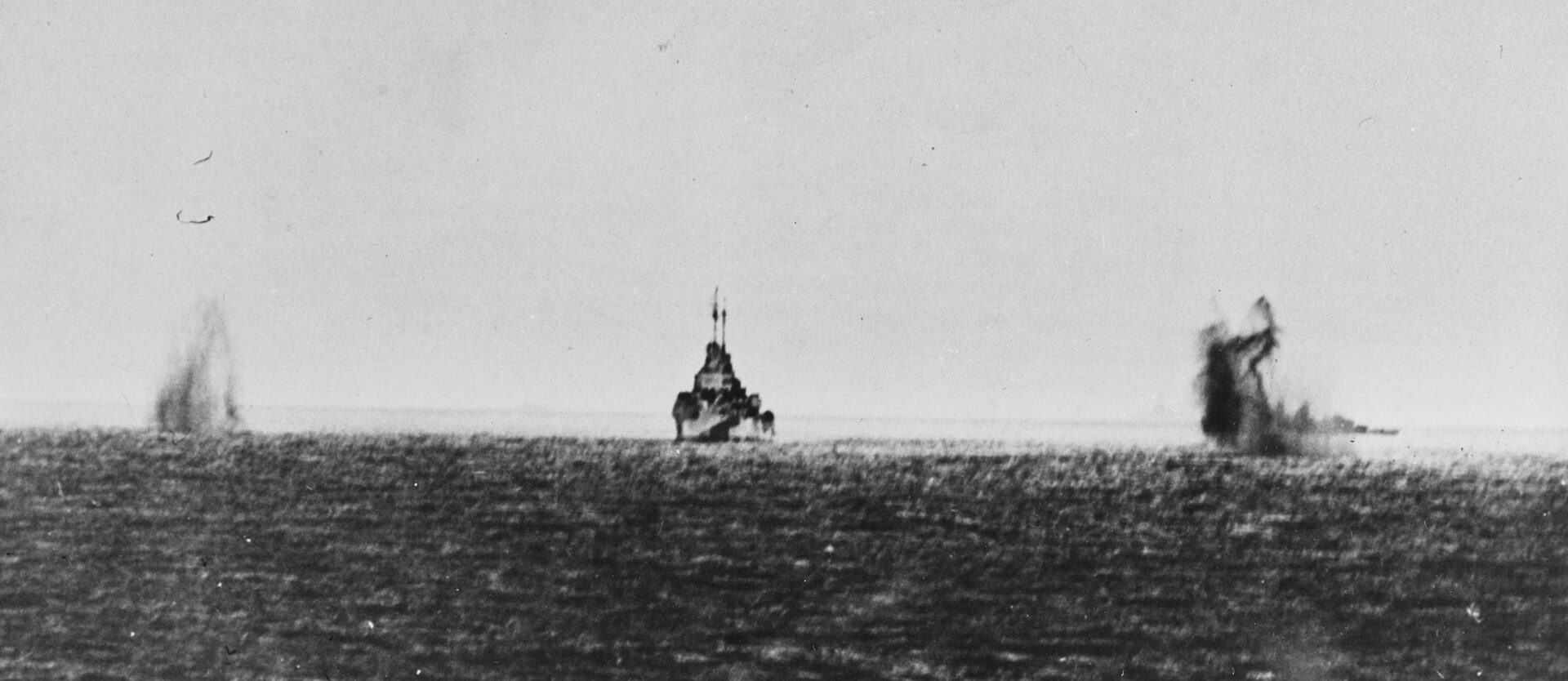
The Marianas campaign was the longest stretch of gunfire she ever delivered. Off Saipan on 15 June 1944 she closed to 3,000 yards to cover underwater demolition swimmers, and at 0846 half a dozen hidden Japanese batteries opened on her. Shells bracketed her and sprayed her upperworks with fragments, and for two hours she dueled them, drawing their fire away from the men in the water, until her shells set off an ammunition dump ashore. She worked over the landing beaches the next morning, then joined Task Group 58.3 for the Battle of the Philippine Sea, where her gunners shot down torpedo planes that reached the carriers on 19 June, and on the night of the 20th she burned smoke pots and streamed rafts for the aviators coming home in the dark. She went back to the islands afterward, to Tinian, Saipan, Guam, and Tinian again. Between 14 June and 1 August she fired 7,683 rounds of 6-inch and 10,875 rounds of 5-inch ammunition.
In September 1944 she screened the fast carriers over the Palaus and the Philippines. On 9 September she, Santa Fe and four destroyers were sent after a coastal convoy off Mindanao and wiped it out, and in October she shepherded the torpedoed cruisers Canberra and Houston away from Formosa while Japanese aircraft hunted them.
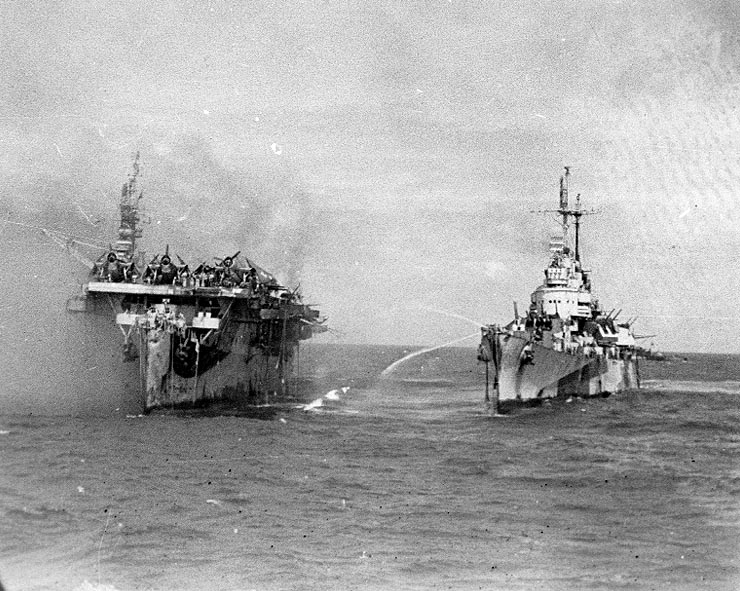
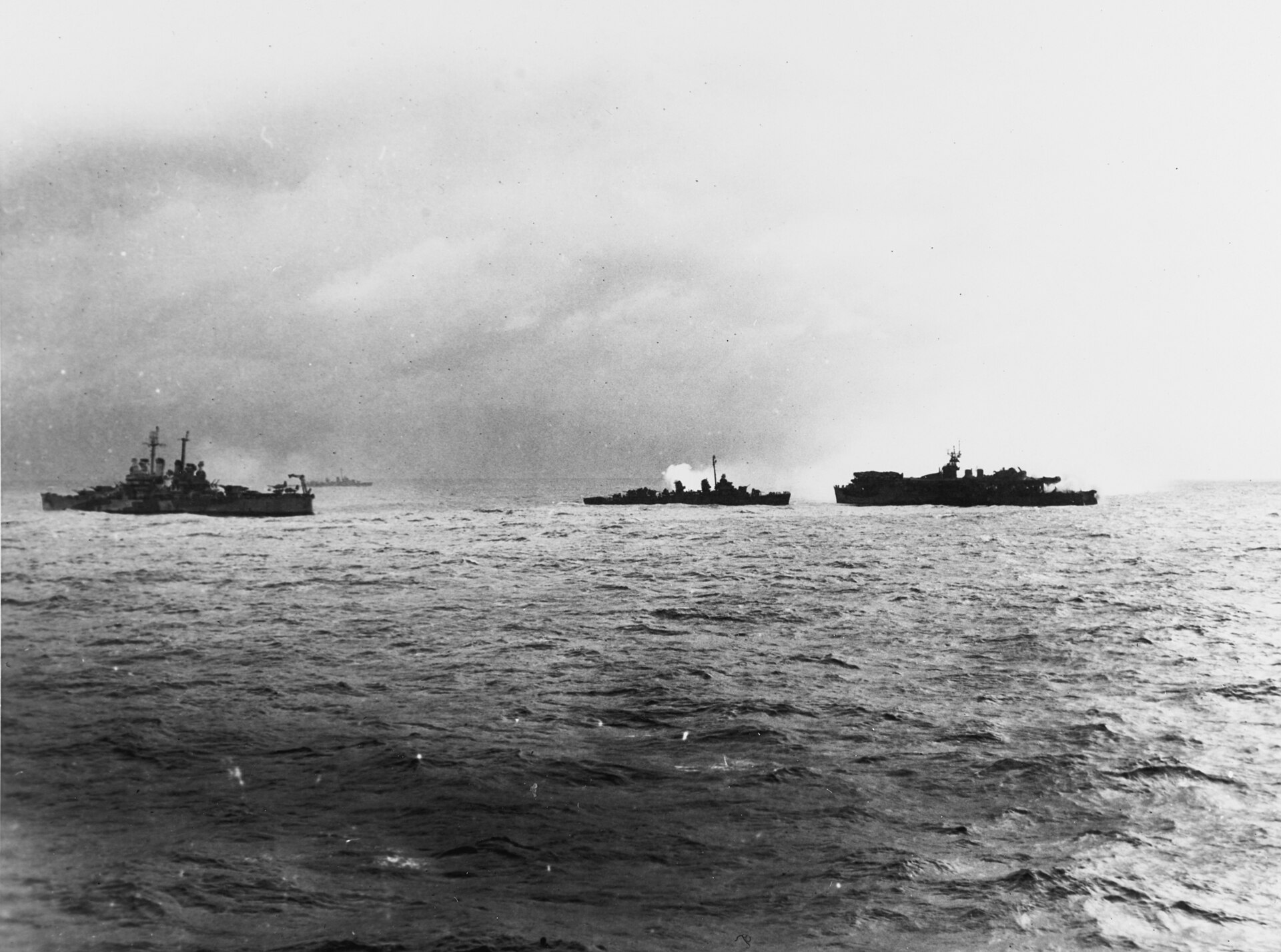
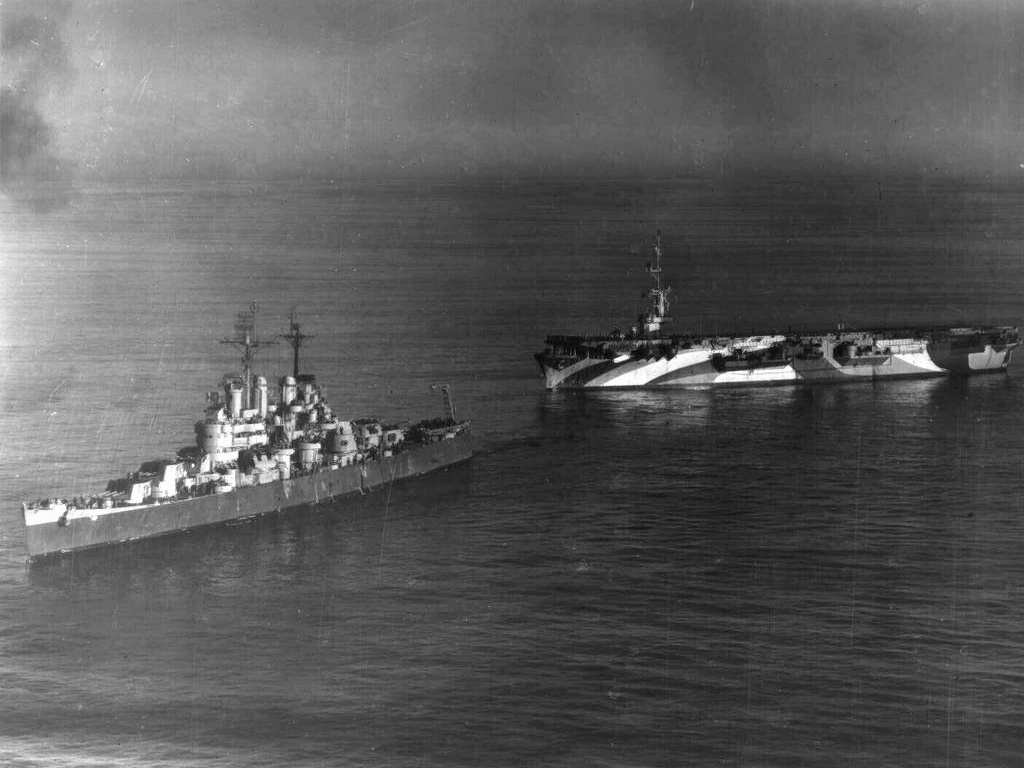
On the morning of 24 October 1944, at the opening of the Battle of Leyte Gulf, a single Judy dive-bomber put a bomb through the flight deck of the light carrier Princeton, and fires and explosions spread through her hangar. Princeton was hit east of Luzon, where she was steaming with Rear Admiral Frederick C. Sherman's Task Group 38.3, about 150 miles east of Manila. That day's carrier strikes on Vice Admiral Kurita's Center Force are known as the Battle of the Sibuyan Sea, but Sherman's group was in the Philippine Sea off Luzon, not in the Sibuyan Sea itself, and the surface action off Samar the next morning, 25 October, was fought by the escort carriers and screen of Taffy 3, not by Birmingham. Destroyers that tried to work alongside in the heavy swell were battered against her side, so Birmingham went in herself. She put 14 hoses and 38 men of her damage-control parties aboard the carrier, and they knocked down one of the two great fires. In the afternoon reports of incoming aircraft and a submarine contact forced her to haul in her hoses and back away. Both alarms passed. She came back.
At 1523, as she was closing Princeton's side again, with hundreds of her own men on deck rigging to tow the carrier, the fire reached the after magazines. The explosion tore off Princeton's stern and much of her flight deck, and steel fragments and debris swept Birmingham from end to end. DANFS counts 233 men killed and 211 seriously wounded, with 215 more lightly wounded. Her own war record counts 237 killed, 4 missing and 426 wounded. Captain Inglis, his arm broken, turned the ship over to his executive officer, Commander Winston P. Folk, who went down to the main deck and found the blood so thick that sand had to be spread so men could keep their footing. The ship's senior medical officer had been lent to another ship two days earlier and her dentist was killed, which left the junior medical officer to deal with hundreds of casualties. Princeton could not be saved and was sunk by torpedoes that evening. Inglis received the Navy Cross.
Repaired at Mare Island, re-gunned and fitted out as a flagship, Birmingham sailed west again in February 1945 under Captain Harry D. Power. She bombarded Iwo Jima from 28 February to 5 March, then went on to Okinawa, where she fired on the beaches from 25 March, shot down a Val that came at her during the bombardment on the morning of the landings, 1 April, and shelled Ie Shima, Naha and the caves where suicide boats were hidden. On 7 April she was in the hastily assembled surface force waiting for Yamato, which was sunk by carrier aircraft before it came anywhere near.
On the morning of 4 May 1945, at the Hagushi anchorage, an Oscar came down on her almost vertically from about 4,000 feet. It was too steep for most of her antiaircraft guns, and only her 20-millimeters could reach it. It went through the main deck on the starboard side and exploded below, destroying the sick bay, rupturing three decks, and opening a five-foot hole below the waterline. Living spaces, the armory and three magazines flooded. The fires were out by 0914. When the last flooded compartments were pumped out in drydock at Guam, the count stood at 52 killed and 82 wounded. It was the third time the ship had been badly hurt.
She was repaired at Pearl Harbor and was steaming toward a bombardment of bypassed Wake Island when news of the Japanese surrender came on 15 August 1945. Captain Richard H. Cruzen, who had been Admiral Kinkaid's operations officer in the Philippines and before the war had taken the old barkentine Bear to the Antarctic, had relieved Power. Birmingham went to Okinawa, then south, and from late September 1945 she was flagship of Rear Admiral Clifford E. Van Hook in Australian waters, moving among Brisbane, Sydney and Melbourne until she sailed for home. She reached San Francisco on 22 March 1946.
She reported to San Diego for inactivation on 2 April 1946 and went out of commission in reserve on 2 January 1947. She never served again. Her name was struck on 1 March 1959, and she was sold for scrapping that autumn. She received eight battle stars for her World War II service. She had taken a bomb and a torpedo off Bougainville and a suicide plane off Okinawa, and between them she had been about fifty feet from a carrier when its magazines exploded. She was not sunk.
A note on sources. The narrative follows the Naval History and Heritage Command's Dictionary of American Naval Fighting Ships entry for Birmingham II (CL-62), which is drawn from her war diaries and action reports, for dates, actions, rounds fired and casualty figures. Captain Inglis's own account and the ship's war record, reproduced at Researcher@Large, and Naval History magazine's October 2009 article "'Hell Broke Loose' at Leyte Gulf" supplied the details of 24 October 1944. They do not agree on that day's dead: DANFS gives 233 killed, the war record gives 237 killed and 4 missing, and Inglis wrote 229 killed instantly. All three figures are given here as their sources state them. The commanding officers and their dates come from NavSource and uboat.net. Uboat.net starts Cruzen's command on 8 September 1945 rather than 9 August, and NavSource shows Power's command beginning on 21 October 1944, which overlaps Inglis and Folk. The sale date is given as 13 October 1959 by DANFS and 12 November 1959 by uboat.net, and NHHC photo NH 89291 shows her leaving the reserve fleet for the wrecking yard about 9 December 1959.