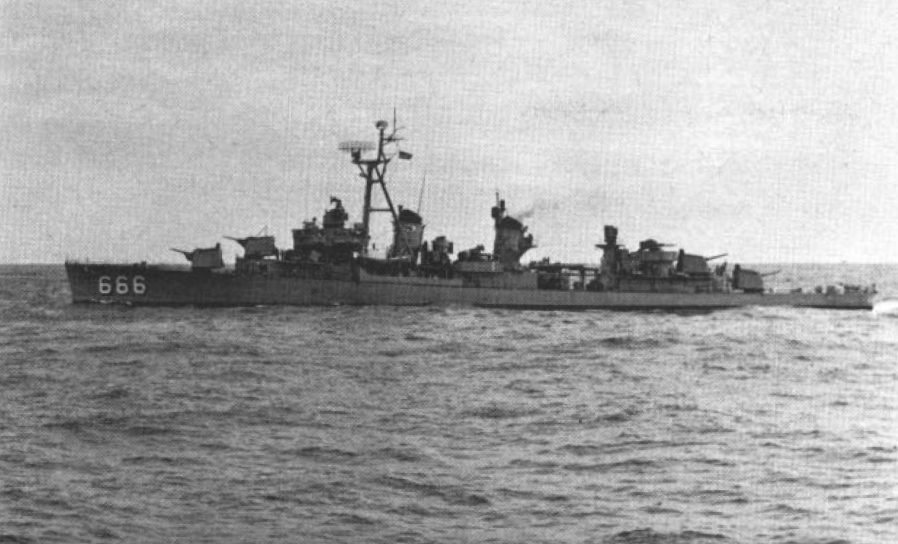
USS Black (DD-666) was a Fletcher-class destroyer. She was launched on 28 March 1943 and commissioned on 21 May 1943. Jack Maginnis was her captain from commissioning until 18 March 1944.
She reached Pearl Harbor by way of San Diego and reported aboard on 15 November 1943. Soon afterward she went to Tarawa and took up a screen off the lagoon entrance. She kept that station until 22 January 1944, leaving it now and then to shepherd transports out to the 180th meridian. On 15 January 1944, some fifty miles south of Jaluit, she picked up twenty-two survivors from two patrol planes that had gone into the water. Combat first found her at Majuro Atoll in the Marshall Islands, between 29 January and 8 February 1944.
Edward Reuben King took command on 18 March 1944. Under him the ship served in the landings at Aitape and Hollandia in New Guinea from 22 April to 7 May, the assault on Saipan from 11 June to 4 July, the taking of Guam from 21 July to 10 August, and the Leyte operation on 20 and 21 October and again on 13 and 14 November. Repairs at San Francisco then kept her in the yard until February 1945.
Once those repairs were done she sailed to Ulithi, arrived on 13 March 1945, and reported to the Fast Carrier Task Force, at that time Task Force 58. Between 17 March and 30 May she went with Fifth Fleet and Third Fleet raids that backed the Okinawa operation. A spell of rest and upkeep at Leyte Gulf followed. She then joined Third Fleet operations against Japan from 10 July to 15 August 1945. On 15 August, as Japan agreed to end the war, she was on the scene for a kamikaze attack that was among the last of the Pacific fighting.
After fighting ended she remained off Japan on occupation duty until 1 September. That day, in Task Force 72, she sailed with the occupation force bound for Inchon, Korea. She stayed on occupation duty in the Far East until 10 November 1945. Eugene Howard Simpson had become captain on 22 October 1945. She cleared Tsingtao, China, for the United States, reported for inactivation, and entered reserve, out of commission, at Long Beach, California, on 5 August 1946.
The Navy brought her back into commission on 18 July 1951, and she joined the Atlantic Fleet. She spent the following months in type and fleet work on the eastern seaboard and in the Caribbean. On 10 January 1953 she left Norfolk, Virginia, for the Pacific through the Panama Canal, on a voyage around the world. She arrived off Korea on 4 March, and two days later her guns began harassing fire against the beach. Those Korean operations ran on until 4 June 1953. On 9 June she started back toward Norfolk through the Suez Canal and reached the east coast on 6 August.
Into January 1955 she drilled in type exercises, operated with the fleet, and stood plane-guard duty on the Atlantic seaboard and in Caribbean waters. In January 1955 she moved to the Pacific Fleet and arrived at Long Beach on 26 January. For roughly fifteen years she regularly recrossed the Pacific to serve with the Seventh Fleet, escorting aircraft carriers, drilling in antisubmarine warfare, patrolling the Taiwan Strait, and visiting Far Eastern ports. Deployments number ten through thirteen after the Second World War, western Pacific cruises that began in early 1965, took her into the Vietnam War. Her work included an early turn in Operation Market Time, coastal patrol and interdiction, gunfire for troops ashore, and screens for carriers striking North Vietnam. The final cruise overseas wound up in July 1969, and decommissioning followed near the end of September that year.
The ship collected six battle stars for her Second World War service, two more in the Korean conflict, and three for Vietnam, eleven battle stars altogether. She had come through the war. Buyers took the hull for scrap on 17 February 1971.