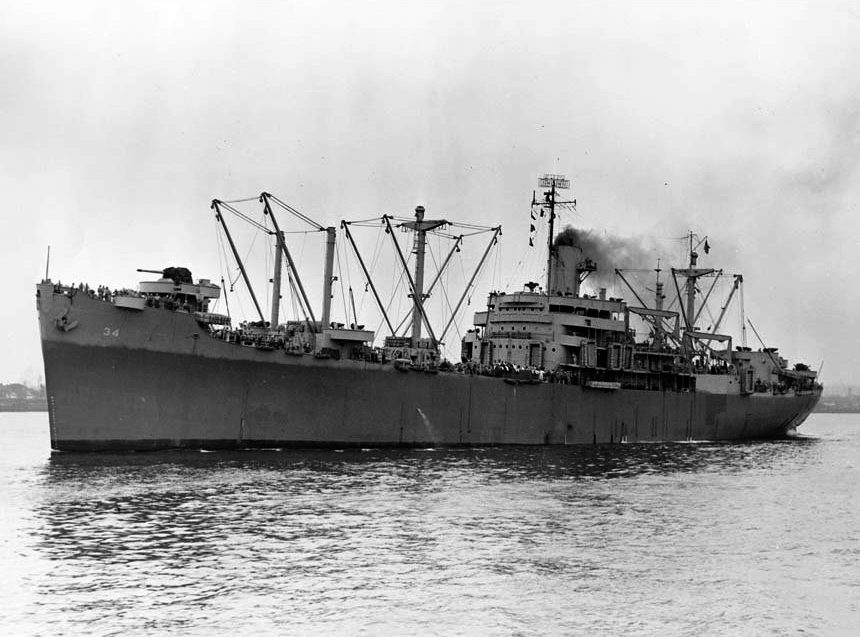
Bolivar, APA-34, was a Bayfield-class attack transport. Western Pipe and Steel laid her down at San Francisco as the merchant hull Sea Angel, Maritime Commission hull 269. DANFS gives the keel date as 13 May 1942 and NavSource as 13 March 1942. She was launched on 7 September 1942, first designated a transport, AP-79, and reclassified APA-34 on 1 February 1943. The Navy acquired her on 15 March 1943 and decommissioned her on 23 April for conversion by Todd Shipbuilding. She was recommissioned on 1 September 1943, Captain Joseph A. Gainard in command.
After training off San Clemente Island she became flagship of Transport Division 28 on 20 December 1943. She sailed from San Diego on 13 January 1944. On 31 January, at the disembarkation area off Kwajalein Atoll, she transferred elements of the 23d Marines to LSTs, which took them to the beaches of Roi the next morning. She left the lagoon on 8 February.
Her later landings were Saipan on 15 June 1944, where her first boats hit the beach at 8:44 a.m., Guam on 22 July, and Leyte on 20 October and again on 18 November. At Leyte on 18 November she saw a kamikaze hit Alpine nearby and was not attacked herself. At Lingayen Gulf on 9 January 1945 she took wounded men off California after the battleship was hit by a kamikaze. At Iwo Jima she held troops in reserve from 19 February, landed them on 21 to 24 February, and then took on wounded for almost two weeks. A shell from a shore battery killed one of her crew and wounded two on 3 March.
She took soldiers of the 81st Infantry Division toward Okinawa, but they were not called, and she carried wounded from Guam to Seattle in June 1945. She served in Operation Magic Carpet from 2 September, was decommissioned on 29 April 1946, struck on 19 July 1946, and returned to the Maritime Commission on 12 September 1946. She went back into merchant service and was sold for scrap in Taiwan on 30 March 1973. She earned five battle stars.