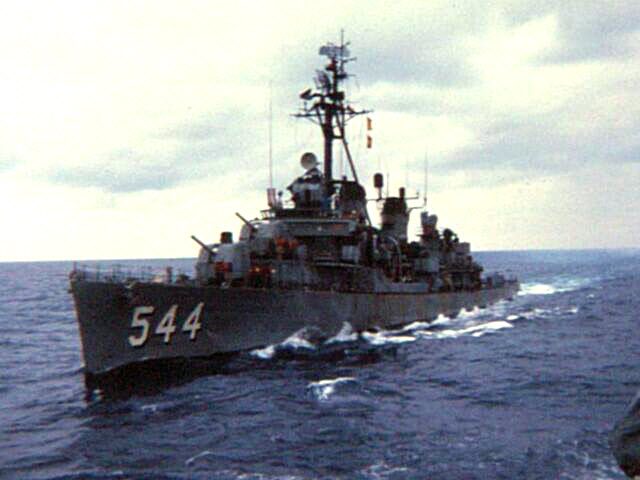
Boyd was a Fletcher-class destroyer, and for most of the Pacific war she was a fast-carrier screen ship. The one hard fight of her own was not against a fleet. On 8 December 1943 she was stopped off Nauru to pick up downed airmen, and a shore battery hit her.
The name came from Joseph Boyd, who enlisted on 4 April 1803 as a steward. On 16 February 1804 he was in Stephen Decatur's boat crew that entered Tripoli harbor and burned the captured frigate Philadelphia. He later became a clerk. This destroyer is the only Navy ship named for him.
Bethlehem Steel at San Pedro laid her down on 2 April 1942, launched her on 29 October 1942, and commissioned her on 8 May 1943. The sponsor was Mrs. C. W. Styer. Lieutenant Commander Ulysses S. G. Sharp Jr. was her first commanding officer. He later became Admiral Sharp, Commander in Chief, Pacific, during the Vietnam War. She was a standard Fletcher, about 2,050 tons and 376 feet, with five 5-inch guns, ten torpedo tubes, and a designed complement of about 329.
She left for Pearl Harbor on 14 July 1943. After training she covered the occupation of Baker Island on 1 September, then joined the fast carriers for the Wake Island raid of 5 and 6 October and the Gilberts landings, 19 November to 8 December. On 26 November, in the Gilberts, she was credited with sinking the Japanese submarine I-39. That credit is repeated in later accounts and is not firmly documented.
During the bombardment of Nauru she was sent in to recover the crew of a U.S. plane that had ditched. The order came at 10:33. At 11:33 she found the raft. At 11:40 she came alongside and put herself between the raft and the Japanese guns. At 11:42 the battery hit her. The first shell passed through the main deck into the engineering spaces, just above a fresh-water evaporator, cut a 600-pound, 850-degree steam line, and wrecked one of the two main power-distribution boards. Everyone in the forward engine room was killed. A second shell hit inside the number-one stack. Sharp worked the ship up to speed and chased the salvos. Robert N. Adrian, then a lieutenant, later wrote that the maneuvering kept her from being sunk, and that the forward guns could not bear, so only the three after 5-inch mounts answered.
The account usually printed gives 12 killed and 8 wounded. Adrian's recollection puts the dead at 15, including Lieutenant Thomas Malone, the chief engineer, and says the raft they had been sent to inspect was empty. A Navy Memorial lost-at-sea log for the ship lists 10 names, Malone among them. She withdrew under her own power. A shipboard account puts her into the floating dry dock at Pago Pago first. Repairs were made at Espiritu Santo.
She was back at Pearl Harbor on 23 March 1944 and joined Task Force 58. Through the spring and summer she rode the fast-carrier circuit: the Hollandia landings, 21 to 24 April; the raid on Truk, Satawan, and Ponape, 29 April to 1 May; Saipan, 11 to 24 June, and the first Bonins raid, 15 and 16 June; the Battle of the Philippine Sea, 19 and 20 June, screening the carriers; the second and third Bonins raids, 24 June and 3 and 4 July; Guam, 12 July to 15 August; the Palau, Yap, and Ulithi raid, 25 to 27 July, and the fourth Bonins raid, 4 and 5 August; the southern Palaus, 9 to 24 September, and the Morotai landings on 15 September.
In October she shifted to Task Force 38 for the strikes on Okinawa on 10 October, northern Luzon and Formosa from 11 to 14 October, and Luzon on 15 October. She was with the fast carriers for the Battle of Leyte Gulf on 24 and 25 October. She was not in the battle line at Surigao Strait. Through November she screened the carriers hitting Luzon again. From 31 December 1944 to 22 January 1945 she did escort duty. On 24 January she bombarded Iwo Jima, then covered the assault and occupation from 19 February to 1 March. She arrived off Okinawa on 25 March and stayed on screening duty until 30 June. In July she rejoined the Third Fleet for the strikes on the Japanese home islands, 10 July to 7 August.
She was among the first ships sent home after the surrender. She left Okinawa on 7 September, overhauled at Mare Island from 25 September to 28 November, reached San Diego on 14 January 1946, and went into reserve on 15 January 1947. The Dictionary of American Naval Fighting Ships misprints that San Diego arrival as 1943.
She was recommissioned on 24 November 1950, trained on the West Coast, and sailed for Korea on 28 May 1951. She served with Task Force 77 and on the Formosa Strait patrol, and was back at San Diego on 21 December. The second tour began on 12 July 1952: the Wonsan blockade, and the amphibious demonstration off Kojo from 6 to 15 October. She left Korean waters in late January 1953 and reached San Diego on 16 February. After the armistice she stayed a West Coast destroyer and made three more Far East tours. On 1 October 1969 she was decommissioned, struck, and transferred to Turkey as TCG Iskenderun (D-343). Turkey struck her in 1981 and she was scrapped. She earned 11 battle stars for World War II and five for Korea.