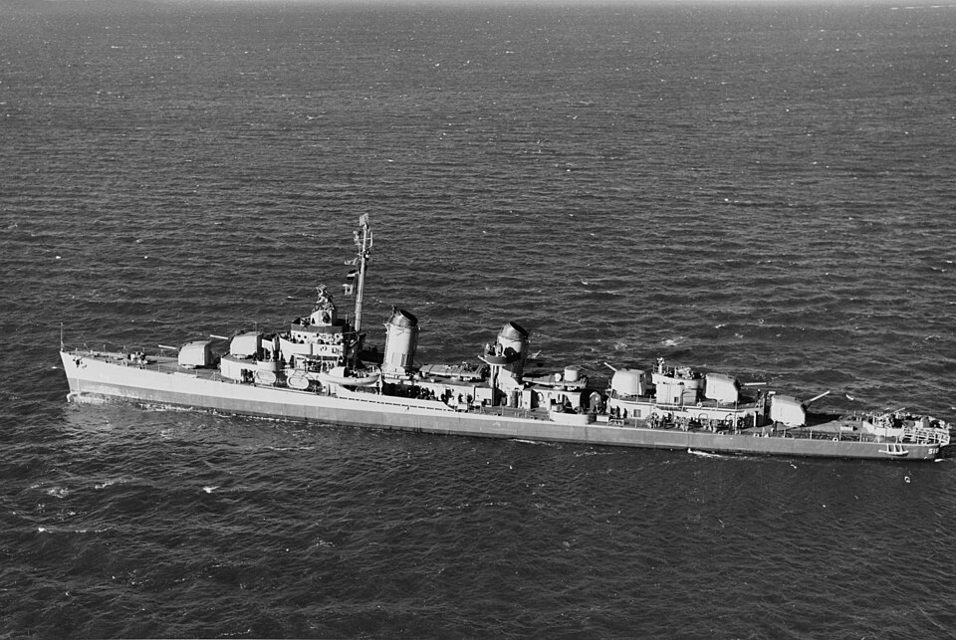
USS Brownson (DD-518) was a Fletcher-class destroyer of the United States Navy. She was launched on 24 September 1942 and commissioned on 3 February 1943 at the New York Navy Yard in Brooklyn, where the new ship finished fitting out. Joseph Benedict Maher became her commanding officer that day.
On 14 February, while she was taking ammunition aboard at Gravesend Bay on Long Island before shakedown, the steamer Pearson collided with her. The blow left only superficial damage. After a brief inspection she sailed for Guantanamo Bay, Cuba, and wrapped up training there on 17 March. She reached the New York Navy Yard on 20 March for post-cruise work, then spent about a month shifting among New York, Cape Cod Bay, Buzzards Bay, Casco Bay, Norfolk, and Melville, on antisubmarine patrols and in gunnery and antiaircraft practice.
On 21 April she was sent to look for the crew of a Consolidated B-24 Liberator that had crashed off the Maryland coast. The Coast Guard tug Carrabassett relieved her the next day, and she returned to New York. On 28 April she moved to Bayonne, New Jersey, for deperming and was back in New York that evening. Before dawn the next morning she joined the antisubmarine screen of convoy UGF-8, in Task Force 67, and sailed for Casablanca in French Morocco.
On the morning of 3 May, still bound for Casablanca, the screen commander ordered her to help search for the two-man crew of a Vought OS2N-1 Kingfisher, bureau number 01507, which had capsized while trying to land astern of the battleship Texas. Brownson ran at flank speed and screened Thatcher, Carmick, and the oiler Merrimack over the water where the floatplane had overturned. Both men, Lieutenant (junior grade) W. A. Turner and Radioman First Class T. J. Vaughan, were recovered, and the four ships rejoined UGF-8.
About three and a half hours later, an attempt to fuel underway brought a second emergency. At 1453 Brownson eased in astern of Merrimack and took a messenger line with a fuel-hose fitting. The line was too heavy to pass the snatch block and had to be cleared. Lieutenant Harry L. Champlain stepped outboard of it just as the block came free. The line, under heavy strain, snapped forward and up over the towing bit, caught him behind the knees, and carried him over the port side. Brownson and Merrimack each threw two life buoys and called Thatcher by voice radio. The three ships searched for more than half an hour. Champlain was not found. The rescue was ended, Brownson resumed fueling, and the ships went back to their stations in the convoy.
A little after 0600 on 10 May, by order of the task force commander, UGF-8 slowed and split. One portion kept on for Casablanca. Convoy II was sent toward Point Europa at Gibraltar, and Brownson, assigned to that group, reported to the British destroyer Ilex for screening duty. At 2100, after the Strait of Gibraltar, with the Point Europa light about three miles off, Brownson and Guest left the convoy, turned back, and entered Casablanca the next morning. Early on 12 May she patrolled the harbor mouth for submarines. Thatcher took over shortly after 0900 the next day, and Brownson moored at Berth 14 in the inner harbor. On 15 May she sailed with Guest and Thatcher, met convoy OS-47 west of Rabat, and on 17 May brought five merchant ships from that convoy into Casablanca. On 19 May she departed in the Task Force 67 screen with convoy GUF-8 for New York. In the early hours of 31 May the ships came up Ambrose Channel into the harbor. Brownson unloaded ammunition at Gravesend Bay, then went into Dry Dock No. 2 at the navy yard that afternoon for an availability lasting through 2 June.
On 7 June she loaded ammunition again at Gravesend Bay and headed north, anchoring in Berth H at Casco Bay the next day. Local training with Destroyer Divisions 47 and 48 lasted until 11 June, when she and Thatcher left for Delaware Bay to meet the small aircraft carrier Independence. They stood in just after 0800 on 13 June, anchored briefly, and early that afternoon started for the Panama Canal as Independence's escort. Brownson passed the canal and moored at Pier 18 in Balboa on the evening of 18 June. On the morning of 21 June she joined Task Group 52.1 with Independence, the light cruiser Mobile, and the destroyers Spence, Thatcher, Fullam, and Schroeder. The group cleared the Pacific entrance at 0730 for San Diego and arrived on 28 June, Brownson tying up starboard side to Broadway Pier. From 4 to 6 July she carried out gunnery and torpedo firing and shore-bombardment practice against targets on San Clemente Island with Trathen and Bradford. On 6 July she sailed for San Francisco, arrived the next morning, and remained until 11 July, when she met Bush, Mullany, and Ammen and took a place in the antisubmarine screen of Convoy 2045.
Brownson was sunk on 26 December 1943. Maher had been her captain from the February commissioning through that day.