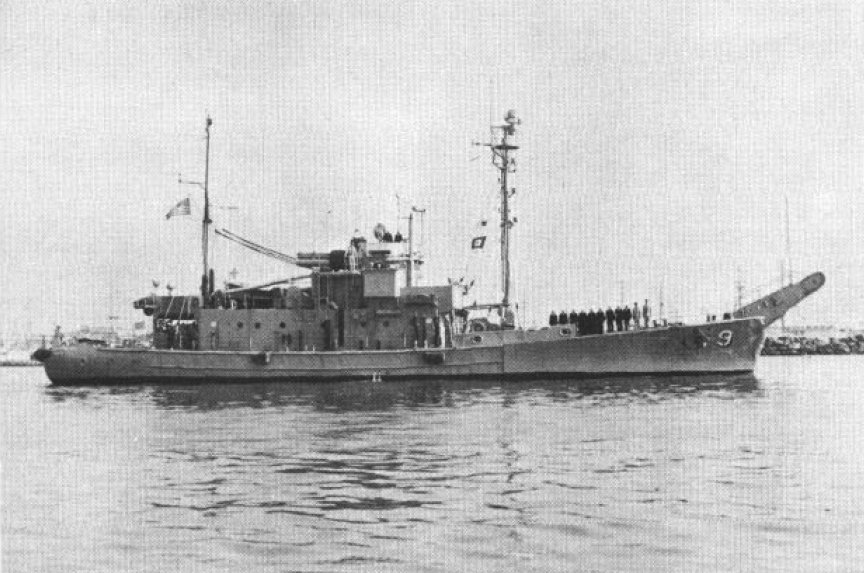
Butternut was a yard net tender, named for the tree. The Lake Washington Shipyard at Houghton laid her down on 11 March 1941 and launched her on 10 May 1941. The Navy placed her in service at the Puget Sound Navy Yard on 3 September 1941. Lieutenant Andreas Sorenson Einmo, of the Naval Reserve, was in charge. Through the winter she tended antisubmarine nets and did minesweeping for the Inshore Patrol of the Thirteenth Naval District.
On 13 May 1942 she was commissioned at Seattle. The Dictionary of American Naval Fighting Ships names Einmo in command that day. The NavSource list ends his tour that same day and starts Lieutenant (junior grade) Tiler Kaune. She left San Francisco on 1 June and reached Noumea on 27 June. From then until early 1945 she tended nets at New Caledonia, in the New Hebrides, and in the Solomons, aside from a spell at Port Chalmers, New Zealand, in August and September 1943, and an overhaul at Pearl Harbor.
The dates of that overhaul do not agree. The Dictionary places it from November 1943 to February 1944, and the change to the net layer AN-9 during it, in January 1944. Another account runs the repair from August 1943 into February 1944 and dates the redesignation 20 January 1944. A ship card dates the change from YN-4 on 20 January 1944.
On 7 April 1943 she was in or near Tulagi Harbor when the carrier aircraft of Operation I-Go came over Guadalcanal and Tulagi. Kaune had her. The harbor account names her and does not say she was hit. Her one battle star is not for that afternoon. It is for the consolidation of the northern Solomons, 13 July to 23 October 1944 and 4 to 22 January 1945.
In January 1945 she left the Solomons by Humboldt Bay, New Guinea, for Leyte. For the next two years she worked nets and other district craft in the waters around Leyte and Samar. She was not lost in the war.
The size of the ship is not one set of figures. The Dictionary gives 700 tons full, a length of 151 feet 8 inches, 14 knots, a complement of 40, and one 3-inch gun. A class line gives 560 tons, 163 feet 2 inches, 12.5 knots, and 48 men. NavSource gives 700 tons full and 805 limiting, a length of 162 feet 2 inches, 12.5 knots on trial, four officers and 44 enlisted, one 3-inch 50, two .50-caliber guns, and a Y-gun.
After the war she stayed in the Pacific. She supported Polaris work and later carried gear for tests of the Mark 46 torpedo. She was redesignated ANL-9 on 1 January 1969. The Dictionary decommissions her at San Diego on 18 July 1969 and strikes her that day. NavSource decommissions her on 18 June 1969, puts her back in service as the miscellaneous auxiliary YAG-60 on the Pacific Missile Range, and strikes her on 1 July 1971. A ship card has the 18 July 1969 decommissioning and strike, a reinstatement on 28 October 1969 as YAG-60, a second strike on 1 July 1971, and destruction as a target in June 1977.
A note on sources. The wartime narrative is the Dictionary of American Naval Fighting Ships, Butternut (YN-4), and the NavSource page for AN-9. NavSource spells Einmo's middle name Sorenson. The Dictionary uses the initial. NavSource's commanding-officer table, credited to Wolfgang Hechler, is the list used here through Jack Wilford Garrison, who had her from 30 June 1944 to 30 September 1945, and Frederick Herman Zook, who relieved him that day and had her to 31 December 1945. The table goes on for years after that and is not filed here. Frank Malavasic, Jr., is given an end date printed as "3- June 1944." That broken day is not used. The northern Solomons star, with the two date windows, is NavSource. Morison's harbor paragraph places her at Tulagi on 7 April 1943 and does not describe her guns or any hit. The photograph is All Hands for January 1966, page 26, the ship in 1965, bow number 9. It is not 1943.