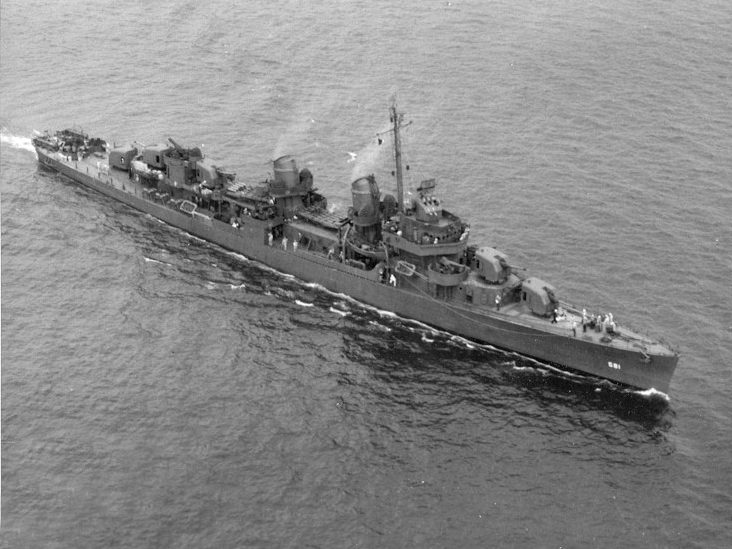
USS Charrette (DD-581) was a Fletcher-class destroyer. The Boston Navy Yard launched her on 3 June 1942, with Mrs. G. Charrette as sponsor, and she was commissioned on 18 May 1943. E. S. Karpe was captain from that day.
On 20 September 1943 she left New York City escorting the carrier Monterey toward Pacific duty. Pearl Harbor was reached on 9 October. She trained there until 10 November, then went out with Task Force 50 to raid Japanese bases in the Marshall Islands. Those attacks blunted enemy air power before the landings at Makin and Tarawa. On 26 November she joined the screen of the group flying cover over both islands, shielding the transports and giving gunfire support ashore. Twelve days afterward she screened battleships during a bombardment of Nauru, then rejoined the fast carriers bound for Efate.
On 21 December she sailed to screen carriers striking Kavieng, on New Ireland, through the three days before the assault at Cape Gloucester on 26 December. The force continued north and reached Funafuti on 21 January 1944, ready for the Marshalls. From 23 January through 5 February she screened carriers hitting Kwajalein and Eniwetok. On the night of 4–5 February she left station to run down a radar contact one of the battleships had reported. She closed to 3,200 yards, fired on a submarine, and the boat crash-dived. A depth-charge attempt followed, and her radar directed the destroyer escort Fair onto the contact. The submarine, possibly I-175, was sunk, the first Japanese boat destroyed by the Hedgehog antisubmarine weapon. Charrette moored in Majuro Lagoon the next day.
She sailed on 12 February 1944 for the first raids meant to shut Truk out of any useful part in the Pacific war. After the carriers were on station for their strikes, she joined Task Group 50.9 on 17 February in a sweep around the island for shipping trying to slip away from the air attacks. The group sank Katori, Maikaze, and a submarine chaser, then met the carriers again the following day. She escorted an oiler fleet to Majuro and underwent overhaul at Pearl Harbor until 15 March 1944. Putting to sea once more, she rejoined the carriers as they struck ships withdrawing from Truk toward the Palaus, ahead of the New Guinea operation. On 28 March she helped beat off a Japanese air attack and stayed in the screen through strikes on 30 March and 1 April. The carriers returned to Majuro on 6 April and, a week later, sailed to hit airfields and defenses on New Guinea and to support the Humboldt Bay landings on 22 April. After replenishing at Manus she went on with them, screening a strike against Truk on 29 April and guarding the battleships while they bombarded Ponape on 1 May.
Her next duty was the Marianas operation, for which she sailed on 6 June 1944. She covered carrier strikes on Guam, Saipan, and Rota from 11 June through 14 June, then turned north for attacks on aircraft at Iwo Jima connected with the landings on Saipan. On 15 June, as the carriers took position, scouting aircraft found the freighter Tatsutakwa Maru, of 1,900 tons. Charrette and the destroyer Boyd intercepted her, sank her, and recovered 112 survivors. The group afterward steamed south to join the Fast Carrier Task Force, then TF 58, against a Japanese fleet already known to be at sea. The air battle of the Philippine Sea opened on the morning of 19 June. Through both days, while Japanese naval aviation was badly reduced, she remained at screen, antiaircraft, and guard duty. On the night of 20 June she took part in recovering the last strikes after dark, showing beacon lights and picking up airmen who ditched when their fuel ran out. On 21 June the carrier force turned back to cover invasion troops in the Marianas, at Guam and Rota, and later bases in the Pagan Islands and at Chichi Jima. On 5 August she fired in the shelling of Chichi Jima and then returned to Eniwetok.
She left Eniwetok on 29 August 1944 for early September raids on the Palaus and on targets in the Philippines. That work prepared the invasion of Peleliu and opened the return to the Philippines. With Leyte ahead, the carrier task force sailed on 4 October to knock out Japanese airfields on Okinawa, in northern Luzon, and on Formosa during the assaults in the Philippines. On 12 October the heaviest of those blows fell on Formosa and brought Japanese aircraft back against the carriers. Charrette helped shoot down attackers in the raids that hit the cruisers Canberra and Houston. She joined the screen covering those damaged ships as they withdrew under air attack, then rejoined her carrier group heading north to meet the Japanese force that was closing in. That was her part in the Battle for Leyte Gulf. On 25 October the carriers she guarded sent their planes against the enemy northern force off Cape Engaño. From 29 October to 2 November 1944 she replenished at Ulithi, then screened fast carriers in early November strikes on Luzon airfields that lessened air opposition over the Leyte beachhead. She was back at Manus on 30 November, preparing for Lingayen Gulf.
In 1945 she supported the Lingayen landings from 4 January to 18 January and afterward guarded reinforcement convoys on the way into the gulf and on the way out. She left the Philippines on 2 February and on 25 February entered the Puget Sound Navy Yard for another overhaul. June brought her back to action for a month supporting the Borneo operations, after which she patrolled in the Netherlands East Indies. On 2 August she and the destroyer Conner made contact with a ship. Charrette survived the war. On 16 June 1959 she was transferred to the Hellenic Navy.