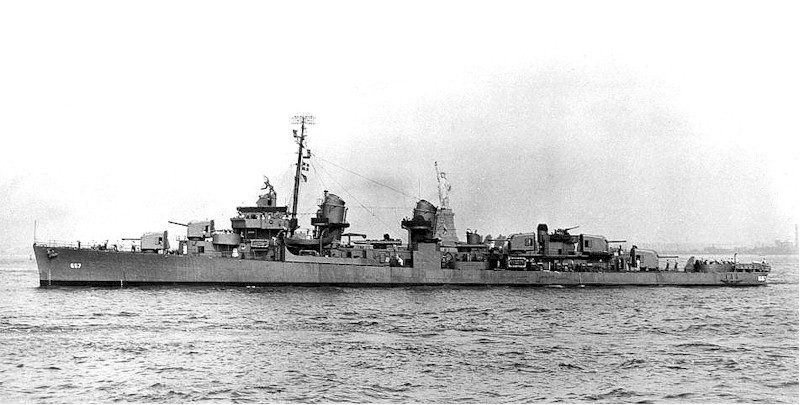
USS Chauncey (DD-667) was a Fletcher-class destroyer. Launched on 28 March 1943, she was commissioned on 31 May 1943. Merle Van Metre was her commanding officer from commissioning until 1 November 1943. Lester Cameron Conwell commanded her from that date until 2 March 1945, and Preston Bennett Haines commanded her from 2 March 1945 until 19 December 1945.
On 28 August 1943 she departed Norfolk, Virginia, and on 19 September she arrived at Pearl Harbor. She screened fast carriers in air attacks on Wake Island on 5 and 6 October 1943 and picked up three aviators who had come down at sea. After a short stay at Pearl Harbor she sailed with a second carrier group, reaching Espiritu Santo on 6 November 1943. Three days later she headed for the 11 November raids on Rabaul, timed with the landings at Bougainville. Once the carriers had sent in a successful opening strike, Japanese aircraft attacked in force. The action ran for 46 minutes, Chauncey's guns working almost the whole time, and many of the planes were destroyed.
Still with those carriers, she steamed north for the attacks that softened Tarawa on 18, 19, and 20 November. On the 20th, as troops landed, the carriers kept fighters overhead, searched for submarines, and flew support for the beach until the island fell after bitter combat on land. Chauncey helped break up another Japanese attack from the air against the ships. Attention then turned to the Marshalls. Her group was ordered to hit Kwajalein, where Japanese air power in the islands was concentrated, and to hit the vessels in harbor. Carrier strikes went in on 4 December 1943 against Kwajalein and Wotje. That night the Japanese came back. Chauncey's fire was part of the defense that destroyed many of the raiders, and by the middle of the night the attack had been pushed away. The ships continued to Pearl Harbor for replenishment and repair work.
Her next passage took her to Funafuti, where she met a seaplane tender and, with a companion destroyer, escorted the tender to Tarawa. Patrol there was brief. She returned to Funafuti to make ready for Majuro, and on 22 January 1944 she screened escort carriers on the run north. The assault on Majuro came on 30 January. Screening and patrol at Majuro and at Kwajalein filled her days while those atolls were seized and occupied. In mid-March she went back to the South Pacific. Early in April she spent ten days patrolling off Emirau, taken only shortly before. She brought escort carriers into station for the landings at Aitape on 22 April and remained with them while their aircraft supported the troops at close range. On 28 April the formation replenished at Manus, then went back to covering strikes off New Guinea through 12 May.
After that she guarded escort carriers as they assembled and practiced for the Marianas. She reached Kwajalein on 8 June 1944 to complete preparations and sailed on 10 June, screening carriers committed to the Saipan landings. Raids on 13 and 14 June came before the assault, and on 15 June the carriers covered the landing itself. On 16 June she shifted to the ships working off Guam, taking part in gunfire and air strikes. Her guns helped repel Japanese aircraft on that day and on 17 June. Back off Saipan she screened carriers until 25 June, then took transports under escort to Eniwetok. Early July found her with the carriers off Saipan and Guam once more. Beginning 9 July she joined the prolonged shelling of Guam that ran up to the landings on 21 July. For the balance of July she screened carriers over that operation, leaving once to escort unloaded transports to Eniwetok. On 10 August she departed Guam on an easterly course for Eniwetok and a repair stay at Pearl Harbor.
She went back to Manus ahead of the Philippine operation and on 14 October sailed for Leyte as escort to the Southern Attack Force transports. On 20 October she provided close cover for the landings. Through the night she patrolled about the transports, held in near the beach so cargo could come off faster. On 22 October she stood out with ships that had finished unloading and took them to Manus. That departure fell two days before the Battle of Leyte Gulf began. In November she made two escort passages from Manus to Leyte and Palau. A west-coast overhaul, together with training, occupied her until late in February 1945. She returned to Pearl Harbor, took a carrier under escort to Ulithi, and there entered Task Force 58 for the first stage of the Okinawa operation.
On 14 March the force sailed to strike airfields on Kyushu and shipping in the Inland Sea, together with targets at Kure and at Kobe. Destroyers, Chauncey among them, kept the screen. On 19 March Japanese bombers left the carrier Franklin heavily hurt. Her crew saved her from foundering. Chauncey closed in to cover the damaged ship and stayed with Franklin during the tow and during the later passage Franklin made under her own steam. Attacks on 20 and 21 March were turned aside. Chauncey fired in company with the screen, and many of the enemy aircraft were lost. Blows before the landing then fell on Okinawa and on islands close by. After the assault troops landed on 1 April 1945, she aided the forces on shore and looked after the transports. Screening went on. Beginning 6 April, as the first large kamikaze raids struck the ships lying off Okinawa, she used her guns again and again to fend those planes off. Until 29 May she also shelled the coast and served on radar picket station. She then put into San Pedro Bay, in the Philippines, to repair and resupply. Task Force 38 became her next assignment, for the closing air attacks on Japan. When the fighting was over she stayed with the occupation in the Far East. On 11 November she left Tsingtao, China, for the west coast. At San Diego on 19 December 1945 she was taken out of commission and placed in reserve.
When the Korean War began, she returned to commissioned service on 18 July 1950. On 1 November she put to sea for Atlantic Fleet duty. Norfolk, Virginia, was her home port. She served on the eastern seaboard and in Caribbean waters until 10 January 1953, then started for the Pacific coast on the opening portion of a voyage around the world. She arrived at Sasebo, Japan, on 11 February and screened the carriers of Task Force 77 off Korea in the months leading to the armistice. On 2 January 1974 she was sold for scrap.