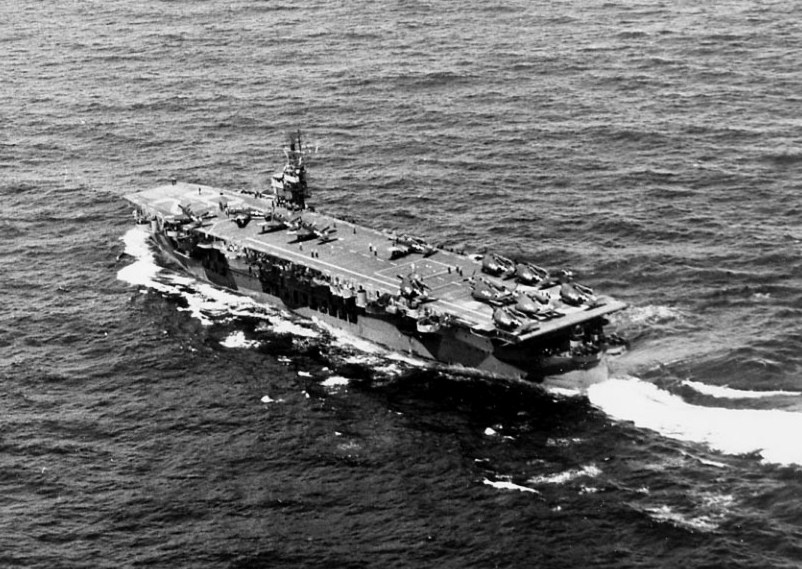
Chenango is a river in New York, and the name of a county and a town along it. This was the second ship the Navy gave that name. Sun Shipbuilding and Dry Dock, at Chester, Pennsylvania, launched her on 1 April 1939 as the tanker Esso New Orleans. Mrs. Rathbone sponsored her. The Navy acquired her on 31 May 1941. On 20 June 1941 she went into commission as the fleet oiler AO-31, with Commander W. H. Mays in command.
She had been drawn as one of the large oilers Standard Oil and the Navy planned together, and she became one of the four cut down into the Sangamon class of escort carriers. The flight deck went onto a tanker hull. She carried oil in the Atlantic and the Caribbean, and she made the run out to Honolulu. On 16 February 1942 she was at Aruba, in the Netherlands West Indies, when a German submarine stood off the island and shelled a refinery. On 16 March the Navy took her out of commission at New York and sent her to the Bethlehem yard at Staten Island for the rebuild. She recommissioned on 19 September 1942. Captain Ben Harrison Wyatt had her.
On 23 October 1942 she sailed with the North African assault force, the flight deck loaded with P-40 fighters of the Army 33rd Fighter Group. On 10 November she flew them off for Port Lyautey, in French Morocco, which the landing had just taken. She put into Casablanca on 13 November, fueled 21 destroyers, and reached Norfolk on 30 November. A hurricane on that passage did heavy damage. The yard turned her around, and by the middle of December she was bound for the Pacific.
She arrived at Nouméa on 18 January 1943. Air Group 28 was aboard, Wildcats of fighter squadron VGF-28 and Dauntlesses and Avengers of scouting squadron VGS-28. The group went ashore to Henderson Field to fly for the Marines on Guadalcanal, and she stayed with the escort carriers on the supply convoys. At the end of the month she was in Rear Admiral Robert C. Giffen's Task Force 18 with Suwannee (CVE-27). Wyatt commanded her, and he had the escort carriers in that force. The carriers were good for about 18 knots. On the afternoon of 29 January Giffen left them astern with two destroyers and took the cruisers on toward a night sweep. Her fighters recovered at sunset. On 30 January they launched again to cover Chicago (CA-29), under tow after the night's torpedoes. They were slow getting off, and the afternoon strike that sank Chicago was over before they arrived. Chenango came through those two days unhurt.
On 13 July 1943, after Kolombangara, her planes covered the damaged light cruisers St. Louis (CL-49) and Honolulu (CL-48) on the way out. On 15 July the Navy redesignated her CVE-28. Wyatt brought her to Mare Island on 18 August for an overhaul. Captain Dixwell Ketcham relieved him on 31 August. She trained new air groups off San Diego until 19 October, then sailed for the Gilberts and reached Espiritu Santo on 5 November. From 20 November through 8 December, off Tarawa, the aircraft worked the beaches ahead of the troops, covered the ships lying offshore, and watched the convoys. On 29 November one of her planes reported a submarine in that water. I-21 is the boat usually named for the report. The boat was already missing, and the identification is not certain. Escort Carrier Air Group 35 flew from her at Tarawa and stayed aboard through the Leyte operation.
Ketcham took her from San Diego on 13 January 1944 for the Marshalls. The air group supported the landings at Roi, Kwajalein, and Eniwetok, then she kept company with the oilers fueling the ships that struck Palau. She was at Espiritu Santo on 7 April. From 16 April to 12 May she covered the landings at Aitape and Hollandia with Sangamon (CVE-26), Suwannee, and Santee (CVE-29). For the Marianas she joined Task Group 53.7. Her planes cut up the airfield, the shipping, and the harbor on Pagan, photographed Guam, and from 8 July hit Guam day after day ahead of the invasion. She came back to Manus on 13 August.
Captain George van Deurs relieved Ketcham the same day. From 10 to 29 September she worked over the airfields in the Halmaheras for the landing on Morotai. She replenished at Manus and sailed on 12 October to soften Leyte before the landings of 20 October. The Navy history of the ship records three Japanese planes attacking her and Sangamon that afternoon, and all three shot down. She then went to Morotai to load aircraft. The fleet action in Leyte Gulf was fought while she was away on that trip. She returned on 28 October with replacement aircraft for the escort carriers that had remained, and the next day she sailed for an overhaul at Seattle that lasted until 9 February 1945.
She reached Tulagi on 4 March 1945 for training. She left Ulithi on 27 March for Okinawa, covered a feint landing on the southern tip of the island, and then took on the kamikaze fields in the Sakishima Islands, on Miyako and Ishigaki. Escort Carrier Air Group 25 flew those strikes. On 9 April a fighter coming aboard crashed through the barrier wires and set fire to armed aircraft parked forward of the island. Burning gasoline reached ammunition and rockets, and a bomb lay in the fire. Men took a fog nozzle in on that bomb, and a hose from the forward gun sponson kept the spray on them. The crew put the fire out. She was hurt, and she stayed on station until 11 June. Captain Harry Donald Felt relieved van Deurs on 2 May, so the last weeks off Okinawa were his.
She took a tanker convoy south to San Pedro Bay, at Leyte. On 26 July she joined the Third Fleet logistics force for the final strikes on Japan. Escort Carrier Air Group 33 operated from her from 31 July to 15 August. After the cease-fire she supported the occupation and carried out some 1,900 Allied prisoners of war and 1,500 civilians. She left Tokyo Bay on 25 October. A short overhaul at San Diego followed, and then the long trips home with veterans from Okinawa and Pearl Harbor. Felt left her on 13 January 1946. On 5 February she sailed from San Pedro, California, for Boston, and on 14 August 1946 she went out of commission there, in reserve.
On 12 June 1955, still in reserve, she was reclassified CVHE-28, an escort helicopter carrier. The Navy struck her name on 1 March 1959. She was sold, and on 12 February 1960 she left naval custody. The campaign ribbons give her eleven battle stars, one for the North African landing and ten in the Pacific, and the Navy Unit Commendation.