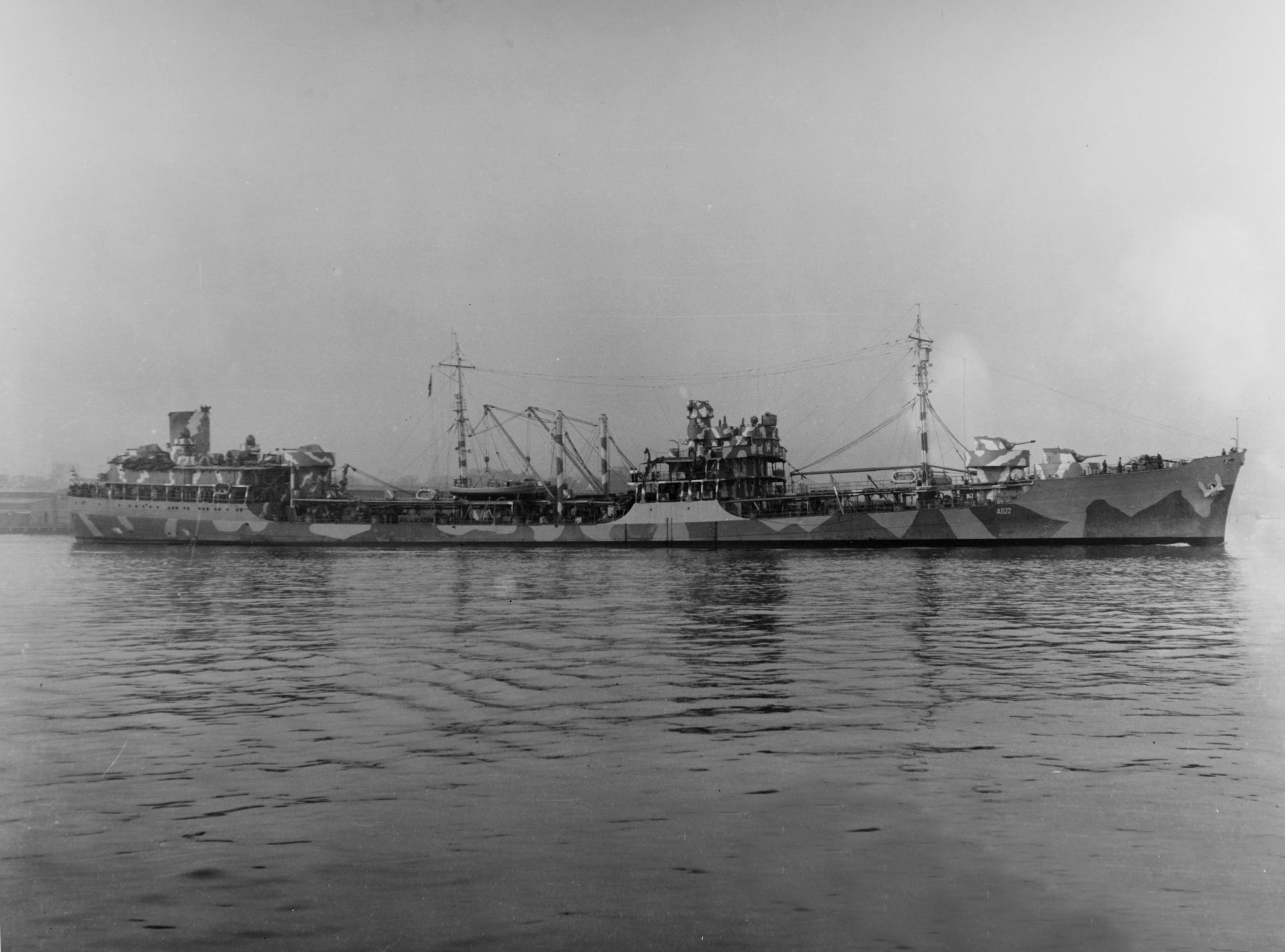
USS Cimarron (AO-22) was the second ship of that name, for the Cimarron River. Sun Shipbuilding and Dry Dock at Chester, Pennsylvania, laid her down on 25 April 1938 as Maritime Commission hull 2. Mrs. William D. Leahy sponsored her when she went down the ways on 7 January 1939. She was commissioned on 20 March 1939, and Lieutenant Commander William W. Behrens had her. She was a fast fleet oiler, 553 feet long, built to stay with the carriers. This is AO-22.
She left Houston on 31 May 1939 and reached Pearl Harbor on 21 July. Over the next year she made thirteen oil runs between the west coast and Pearl Harbor. On 19 August 1940 she sailed for the east coast. After yard work she carried oil between Baton Rouge and Norfolk. In August 1941 she took part in amphibious exercises. She stayed in the Atlantic until she left Norfolk on 4 March 1942 and reached San Francisco on 1 April.
From February 1942 Commander Russell M. Ihrig had her, and he still had her on 21 October 1943. On 2 April 1942 she sailed with the force that was going to fly Army bombers off a carrier against Japan. She was one of the two oilers. She fueled the ships at sea before the run in, and again on the afternoon of 17 April, then withdrew east with the destroyers. She was not attacked. She was back at Pearl Harbor on 25 April.
On 29 April she sailed to join the ships bound for the Coral Sea. She got there after the battle was over, fueled destroyers at Noumea, and was back at Pearl Harbor on 26 May. On 28 May she cleared Pearl Harbor to fuel the force that fought at Midway. The destroyers Dewey and Monssen guarded her and the oiler Platte while the carriers fought. She was not in that fight. She returned on 12 June.
On 7 July she left to support the Solomon Islands landings. Noumea was her base, and she reloaded at Suva and at Efate. On 5 and 6 August the destroyer Aaron Ward convoyed her toward Noumea. She was in San Francisco for repairs in November and sailed for the forward area on 18 December. She worked out of Noumea through the last of the Guadalcanal campaign, then fueled from Efate, carried cargo to Sydney, and fueled ships at Dumbea Bay for the occupation of New Georgia. She was not sunk.
She stayed in commission after the war. Her first Korean tour, from 6 July 1950 to 3 June 1951, took her to Okinawa to fuel the Taiwan patrol, to Kobe for the amphibious ships, and from Sasebo out to the task forces off Korea. Several times she went into the mined harbor at Wonsan to fuel the ships on the blockade there. From 14 June 1954 to 8 February 1955 she was flagship of the support group for the evacuation of refugees from North Vietnam. She kept deploying with the Seventh Fleet. In 1963 she was the active ship with the longest continuous commission in the Navy. Ten battle stars for the Second World War, seven for Korea, and four for Vietnam.
She was stricken on 1 October 1968. At nine in the morning on 15 September 1969 she was turned over for good to the Maritime Administration at San Diego and sold for scrap to Levin Metals. The yard took her at nine in the morning on 17 October 1969.