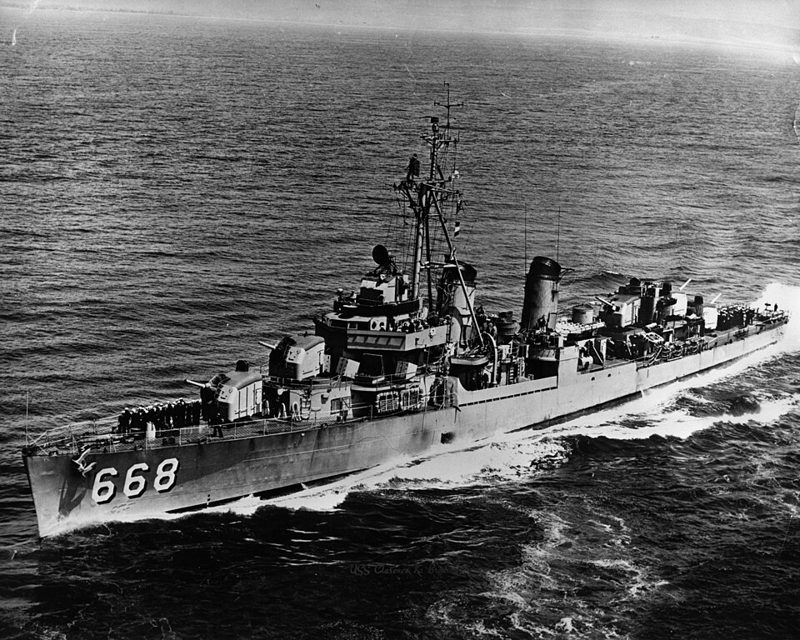
USS Clarence K. Bronson (DD-668) was a Fletcher-class destroyer. She was launched on 18 April 1943 and commissioned on 11 June 1943, with W. S. Veeder as commanding officer from that day.
On 21 November 1943 she reached Pearl Harbor to complete training. She stayed in Hawaiian waters into January 1944, broken only by one escort trip to Tarawa. She then joined the Fast Carrier Task Force, at that time the Fifth Fleet's Task Force 58. In the screen she covered carrier strikes flown for the Kwajalein landings and, through February, attacks aimed at Truk, at Saipan, and at Guam. She left Espiritu Santo on 15 March, and from 19 to 25 March guarded carriers while troops landed in the Bismarck Archipelago. Two days afterward, with Task Group 36.1, she was back in Task Force 58 for attacks on Palau, Yap, and Woleai. Late in April 1944 that force covered landings on New Guinea and, on the 29th and the 30th, struck Truk again. May found her in dry dock at Majuro.
On 6 June she sailed with Task Force 58 for the Marianas. She screened the carriers during the strikes that preceded the landings on Saipan, Rota, Tinian, and Guam, and she remained near Saipan as the assault there opened. On 19 and 20 June she stayed with those carriers through the Battle of the Philippine Sea, an American victory after which Japanese carrier aviation did not regain its former strength. When the air fighting ended she was one of the ships that pointed a searchlight skyward so pilots could home on the fleet. After replenishment at Eniwetok early in July, the force covered the invasion of Guam and sent planes against bases in the Palaus and the Bonins. In September it covered the capture of the Palaus. In October it struck Formosa, raided the Philippines and the Visayas, and took part in the Battle of Leyte Gulf of 23 to 26 October, including the action off Cape Engaño on 25 October.
In November and December carrier aircraft covered the landings on Mindoro. Through January 1945, raids on Formosa, Luzon, the Nansei Shoto, and ports on the China coast cleared the way for the assault at Lingayen. Strikes on Tokyo in February prepared the way for Iwo Jima. On 18 February Bronson left the main body of the task force and escorted cruisers to Iwo Jima. She bombarded before the landing and, after the assault on 19 February, fired in support of the troops ashore for four days. She then rejoined the carriers for a further series of blows at Tokyo and at the Nansei Shoto. From 3 March until 29 March she was off Iwo Jima again for gunfire support and for patrol against submarines, and afterward she left for overhaul on the West Coast.
She returned to Pearl Harbor on 9 July 1945 for training and put to sea on 2 August. Six days later she bombarded Wake Island. Continuing west, she entered Sagami Wan on 27 August and patrolled Japanese waters as part of the occupation until 5 December. Homeward bound, she called at San Diego and at New York and on 12 April arrived at Charleston, South Carolina. On 16 July 1946 she was decommissioned there and laid up in reserve.
She was recommissioned on 7 June 1951. East Coast work and Caribbean exercises occupied her until 18 May 1953, when she sailed from her home port, Newport, Rhode Island, and on 3 July joined Task Force 77 in Korean waters. With Task Force 77 and Task Force 99 she carried out blockade, patrol, and escort duty until 10 November, then began the last leg of a cruise around the world. Calls included Hong Kong, Aden, Gibraltar, and Bermuda, and on 15 January 1954 she stood up Narragansett Bay. Over the next four years she mixed local training with Caribbean exercises, North Atlantic operations under NATO, a tour as engineering school ship, and two cruises in the Mediterranean with the Sixth Fleet, in 1955 and in 1957. In 1956 she refueled from the carrier Franklin D. Roosevelt. In 1958 she was assigned to experimental duty for the Underwater Sound Laboratory. In 1959 she made reserve training cruises from Charleston and from her new home port, Mayport, Florida, along the Atlantic coast and in the Caribbean. On 11 April 1960, at Orange, Texas, she went into commission in reserve, and on 29 June 1960 she was decommissioned.
On 14 January 1967 she was transferred to Turkey. In the Turkish Navy she served as TCG İstanbul (D 340), named for the city of Istanbul. In 1987 she was stricken and the hull was broken up for scrap. Her American honors were the Asiatic-Pacific Campaign Medal, bearing nine battle stars; the World War II Victory Medal; the Navy Occupation Medal with the Asia clasp; and the National Defense Service Medal. For Korea she received the Korean Service Medal with one battle star, the United Nations Korea Medal, and the Korean War Service Medal. She also earned the Philippine Presidential Unit Citation, the Korean Presidential Unit Citation, and the Philippine Liberation Medal with two stars.