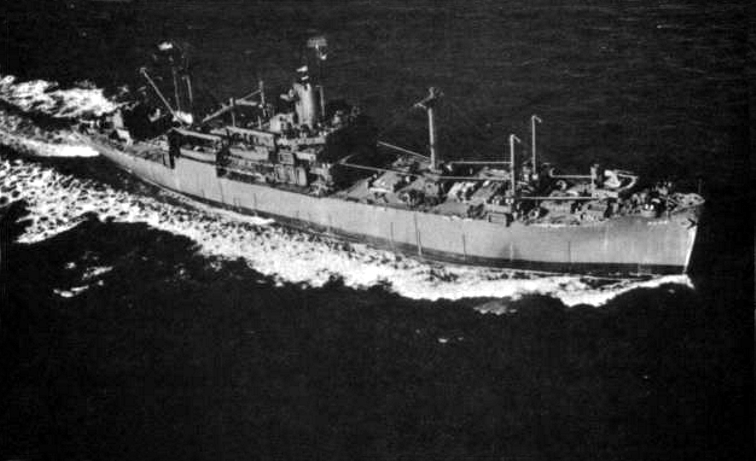
Clay was named for counties in eighteen states. Western Pipe and Steel launched her at San Francisco on 23 January 1943 as Sea Carp. Mrs. Earl Warren, the wife of California's governor, sponsored her. Numbered AP-84 at first, she became APA-39 on 1 February 1943, in the Bayfield class. The Navy acquired her on 29 June 1943. Commander H. B. Olsen, USNR, took the reduced commission that same day. She sailed from San Pedro on 9 July, reached New York on 2 August, and was decommissioned on 11 August so she could be converted. Captain E. W. Abdill recommissioned her on 21 December 1943.
Marines were aboard when she left Norfolk on 27 January 1944. Pearl Harbor on 15 February was the start of steaming later put at 100,000 miles. On 4 March she put to sea for a landing at Kavieng. Sea and air attack had already neutralized the Japanese bases there, the landing was called off, and she was back at Pearl Harbor on 9 April to train with the 2d and 4th Marines. She became flagship of Transport Division 10, Captain C. D. Morrison commanding the division. On 30 May she stood out of Pearl Harbor with the force headed for the Marianas. On D-Day at Saipan, 15 June, she ran a feint off the northwest coast that pulled a large Japanese body away from the real beach. Early in the afternoon she sent part of the 2d Marines into the main landing. Air attacks left her undamaged. Troops and Japanese prisoners went back with her to Pearl Harbor, where she arrived on 9 July. San Diego was the next stop, and the 5th Marines came aboard there for the Guam trip. On the way back out, resistance on Guam and on Saipan had already ended, and she was sent to Hilo to land those men and get ready for the next job.
Captain N. B. Van Bergen was the new skipper for hard rehearsals at Maui in August. Part of the 96th Division was embarked when she left Hawaii with the group aimed at Yap. The objective was then changed to Leyte, about 700 miles farther along, and the force staged at Manus. She sailed on 14 October. On 20 October she was in the Philippine landing and came out unhurt. From 24 October her track ran from Leyte to Hollandia and then to Morotai, For five nights there, aircraft out of Halmahera held the gun crews at their stations. Reinforcements of men and supplies went back to Leyte. She unloaded in a single day and on 14 November left for Manus, then Cape Gloucester, where she anchored on 27 November to prepare for Lingayen Gulf.
On 31 December 1944 the attack transports began the passage to Luzon, through waters with Japanese-held islands on the flanks. Before nightfall on 9 January 1945, American troops were moving inland from Lingayen. Suicide planes opened a wide attack. Her gunners helped drive them off. Japanese reports wrote the ship off. She had in fact finished unloading and set a course for Leyte by sundown. There she embarked troops of the 1st Cavalry Division, returned to Lingayen, and unloaded them in one day on 27 January. She reached Guadalcanal on 12 February with wounded soldiers, put the casualties ashore, embarked part of the 6th Marines, and started rehearsals.
In March she joined the force gathering for Okinawa, ships that had come from all over the Pacific and from the Atlantic. A hurricane was ridden out on the way, and the final run in was a night of planes and gunfire. Before daylight on 1 April she was off the Okinawa beach assigned to her. Kamikaze aircraft in mass, and suicide boats, did not touch her. Unloaded, she sailed on 5 April for San Francisco and an overhaul. More armament was added on the west coast, Captain E. M. Eller became commanding officer, and she refreshed at San Diego. On 27 July she headed west with some 1,700 passengers. During that passage the atomic bomb was used, Russia came into the war, and Japanese resistance gave way. On the day emissaries from Japan reached Manila to arrange the surrender, she was anchored in Leyte Gulf.
Cebu was next. She embarked part of the 182d Regiment and on 1 September she sailed in the Tokyo Force. Temporary Squadron 13 flew its flag in her, and Captain R. C. Bartman had the squadron. Early on 8 September she followed the swept channel in. Minefields lay along the route, and the current ran strong, and then she was in Tokyo Bay. The sunken battleship Nagato lay on the route. She used that ship's battered pagoda as a fixed mark and anchored off the silent industrial shore between Yokohama and Tokyo. The unload was swift. Next day she sailed for Cebu and a further occupation trip, to Otaru on Hokkaido. Guam on 12 October put Marines aboard. Their task was reoccupation duty up in north China. From Tientsin she went to Saipan, took on servicemen bound home, and carried them to San Pedro. One further Magic Carpet trip took her west across the Pacific again. San Francisco on 9 March 1946 was the start of the run to New York, where she arrived on 27 March. Commission ended on 16 May 1946, and the Maritime Commission sold her on 12 September. Four battle stars were awarded.