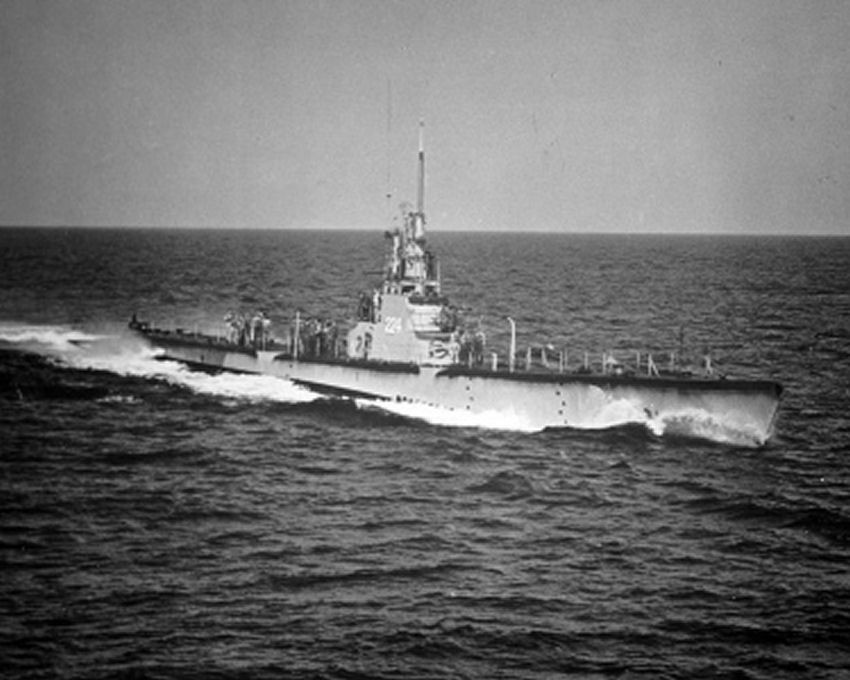
Cod is a Gato-class fleet submarine, and the only U.S. Navy ship named for the cod. Electric Boat laid her keel down at Groton, Connecticut, on 21 July 1942. She was launched on 21 March 1943, sponsored by Mrs. G. M. Mahoney, and commissioned on 21 June 1943. Lieutenant Commander James C. Dempsey had her. She is 312 feet long, about 1,525 tons surfaced and about 2,460 tons submerged. Four General Motors Model 16-248 V16 diesels, built at the Cleveland Diesel plant, drove her at about 20 knots on the surface and about 9 knots submerged. Those Cleveland engines are part of why she later came to Cleveland.
She made seven war patrols in the Southwest Pacific, from Brisbane, Fremantle, and Apra Harbor, Guam. Dempsey had the first three. Commander James A. Adkins, called Caddy, had the fourth, fifth, and sixth. Lieutenant Commander Edwin M. Westbrook Jr. had the seventh. The Navy rated all seven successful and awarded seven battle stars. It credited her with sinking more than 12 enemy vessels, totaling 26,985 tons. Museum accounts often put the confirmed sinkings higher, above 37,000 tons, and count more ships damaged.
On the second patrol, in February 1944, she sank a sampan by gunfire and torpedoed Japanese merchant ships in the South China Sea, off Java, and off Halmahera. On the third patrol, on 10 May 1944, she met a convoy of about 32 freighters and transports bound for Subic Bay, west of Luzon in the South China Sea. Lieutenant Commander James C. Dempsey closed to about 1,200 yards and fired three stern torpedoes at the destroyer Karukaya. Two hit. The first, under the bridge after about 26 seconds, collapsed the stacks and threw men overboard. The second, near the mainmast, broke the ship in half, and she sank quickly. Six bow torpedoes went into the convoy and sank the cargo ship Shōhei Maru, of 7,256 tons. The remaining escorts drove Cod down and depth-charged her. Later patrols added merchant sinkings off Luzon and Java, gun actions against small craft, and a torpedo-room fire that the crew put out.
The action she is remembered for was not a sinking of her own. On 8 July 1945 the Dutch submarine O-19 ran hard aground on Ladd Reef in the South China Sea, about 8°40′ N, 111°40′ E. Cod was already heading for Subic Bay with a medical case, and she was ordered to the reef. She arrived that night. Towing attempts on 9 and 10 July failed. Japanese ships and aircraft were still in the area, and the order came to abandon the boat. Westbrook took all 55 Dutch sailors aboard. Demolition charges, two stern torpedoes from Cod, and 16 hits from her 5-inch gun destroyed O-19, so the Japanese would not get her. It is the only international submarine-to-submarine rescue on record. Cod flew the O-19 flag beside the United States ensign on the way to safety. The Dutch crew later threw a thank-you party for Cod's men. A cocktail glass on her battle flag still marks that rescue, and the party that followed.
She left Australia on 31 August 1945, reached New London by way of Miami, and was decommissioned into reserve on 22 June 1946. The Navy brought her back in 1951 for Atlantic Fleet work and joint United States and Canadian antisubmarine exercises. In the 1952 LANTFLEX exercise she was credited with a simulated carrier kill. She was decommissioned again in 1954. In 1959 she was towed through the newly opened St. Lawrence Seaway to Cleveland, to train Naval Reservists. She was reclassified AGSS-224 in 1962 and IXSS-224 in 1971, and struck from the Navy list on 15 December 1971.
Cleveland residents formed the Cleveland Coordinating Committee to Save Cod. The Navy transferred guardianship on 25 January 1976, and she opened for public tours on 1 May 1976. The Interior Department named her a National Historic Landmark in 1986. She is moored on North Marginal Road, between East 9th Street and Burke Lakefront Airport, and she is open daily from May through November. Visitors still climb the vertical ladders and hatches the crew used. She is the only World War II U.S. fleet-submarine museum that has not had stairways or doors cut into the pressure hull, and she remains largely in wartime configuration. She was not sunk.