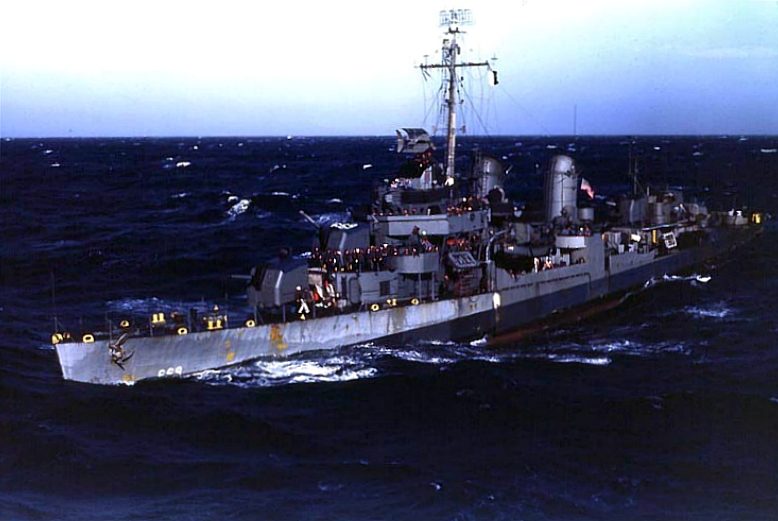
USS Cotten (DD-669) was a Fletcher-class destroyer of the United States Navy. Elizabeth Brownrigg Henderson Cotten christened her on 12 June 1943, the day she was launched. She was commissioned on 24 July 1943, and F. T. Sloat took command.
On 9 October 1943 she left Norfolk, Virginia, and on 31 October she reached Pearl Harbor, where she joined the Fifth Fleet. The sortie of 10 November carried her into the Gilbert Islands operation. She guarded the escort carriers that were flying support over the assault and kept watch for submarines near Tarawa. Pearl Harbor saw her again on 7 January 1944. On 16 January she sailed with the fast carriers, organized as Task Force 58 and later as the Third Fleet's Task Force 38, and on 29 and 30 January those carriers struck the Marshall Islands while she screened them. Majuro served as her base. She took part in the attack on Truk on 16 and 17 February, was on hand when troops went ashore at Emirau, and screened the carriers while they hit Palau and Yap, and also Ulithi and Woleai, from the end of March through 1 April. She stayed in that role for Hollandia on 21 through 24 April and for the raids of 29 April to 1 May on Truk, Satawan, and Ponape.
Pearl Harbor next gave the ship a short yard period. Cotten then rejoined Task Force 58 for the move against the Marianas. She screened carrier strikes on Saipan, sank a sampan on 17 June, and during the Battle of the Philippine Sea on 19 and 20 June shot down a dive bomber that was diving toward Enterprise. She kept screening for later strikes, some aimed at Guam and the Bonins and others at the Palaus, Yap, and Ulithi. Leaving Eniwetok on 30 August 1944, she went on raids meant to keep Japanese forces in the Philippines from interfering while the western Carolines invasion went forward, and on 1 October she was back at Ulithi.
On 6 October she sortied with Task Force 38. Between 10 and 14 October the force struck Formosa, together with Okinawa and the northern end of Luzon. Canberra and Houston, both already crippled, were offered as decoys to draw the Japanese fleet out, in the group called BaitDiv 1, while Cotten stayed among the ships that would do the striking. From 15 October she covered the troops landing at Leyte, and planes from the carriers under her care hit Luzon again and again. In the Surigao Strait portion of the Battle for Leyte Gulf, across 24–26 October, she helped repel air attacks aimed at the escort carriers, then took part in running down the Japanese ships still able to retire. With Task Force 38 once more, she shared in the pounding of Luzon that opened on 5 November. The typhoon of 18 December, which battered the Third Fleet, left her afloat, and on 24 December she entered Ulithi to mend what the storm had done and to take on supplies.
On 30 December 1944 she went to sea with Task Force 38 to cover the invasion of Luzon. In the screen she attended strikes on Formosa, strikes on Luzon on 6 and 7 January, strikes along Camranh Bay and the Indochina coast, strikes on Hong Kong and on Canton, and strikes on the Nansei Shoto. On 10 February those carriers, styled Task Force 58 again, sortied to begin the Iwo Jima operation. For the Honshu strike on 16 February, Cotten took a station out ahead of the force. The ships then came back so their aircraft could protect the assault troops on 19 February. She also screened the carriers for a 25 February attack on the Japanese home islands and for a 1 March attack on Okinawa, and shore bombardment off that island occupied her through 28 March. Teamed with Dortch on 14 and 15 March, she searched nearby waters for enemy shipping and destroyed two picket boats. A refit and a training period on the American Pacific coast followed. Passing Pearl Harbor, she joined the 6 August raid against Wake, called at Eniwetok and Guam, and on 3 September anchored inside Tokyo Bay.
Occupation tasks in Japan kept Cotten busy until 5 December, when she sailed for the United States. She reached San Diego, California, on 22 December and New York on 17 January 1946. On 15 July 1946 her commission ended, and Charleston, South Carolina, became her berth in the reserve fleet. C. Snelling Robinson, who had served aboard in wartime, later wrote the memoir 200,000 Miles Aboard the Destroyer Cotten.
Active duty began again on 3 July 1951. Caribbean cruises came first, along with plane-guard watches off Mayport, Florida. Her home port was Newport, Rhode Island, and she cleared that harbor on 18 May 1953 for the western Pacific, where she patrolled off the Korean coast. She left Japan on a westward track, finished a voyage around the world, and was home on 15 January 1954. Training near the East Coast and in the Caribbean followed. From 28 July until 28 November 1955 she operated with the Sixth Fleet in the Mediterranean. On 4 January 1957 she departed Newport for a long cruise into unfamiliar waters. She called at Trinidad, Freetown, Mombasa, Karachi, and Aden, worked the sea between Massawa and Aden, and visited Cape Town and Freetown before she made Newport on 1 July 1957. Another spell with the Sixth Fleet in the Mediterranean began on 3 September and ended at Newport on 27 November. She then stayed on the East Coast and in the Caribbean. Her last foreign cruise, March to November 1959, led through the Mediterranean, into the Red Sea, and on to the Persian Gulf. Decommissioning day was 2 May 1960, at Norfolk, Virginia, and she went back into reserve.
On 1 December 1974 the Naval Vessel Register dropped Cotten from its rolls. She was sold on 31 July 1975 to be scrapped, and the hull was cut up. Nine battle stars stand for her Second World War record, and one battle star stands for her Korean War duty.