The ship
USS Currituck (AV-7) is the second ship of the name. DANFS says the name is a sound of the coast of North Carolina and Virginia. NavSource and uboat.net date the keel 14 December 1942 at the Philadelphia Navy Yard. She was launched there on 11 September 1943. DANFS names the sponsor as Mrs. M. F. Draemel. The launch caption on NavSource prints Mrs. Milo. F. Draemel. She was commissioned on 26 June 1944. William A. Evans had her. DANFS gives the name as Captain W. A. Evans and names him at the commissioning. NavSource's command table prints William Ashby Evans Jr., USN, USNA 1924, through 19 November 1945. A shipscribe class sheet prints 6 June 1944 in the commissioning column. The date used here is 26 June 1944.
The DANFS reprint heads the measurements as 14,000 tons, length 640 feet 5 inches, beam 69 feet 3 inches, draft 22 feet 3 inches, and it marks both the 19 knots and the four 5-inch guns with the abbreviation a. Complement 1,247. NavSource prints 9,090 tons light and 15,092 tons full, length 540 feet 5 inches, the same beam, draft 22 feet 3 inches limiting, and 19.2 knots on trial. The same page lists 162 officers and 1,085 enlisted, which is the same complement, and the guns as four single 5-inch 38-caliber mounts, four twin 40 mm, three quadruple 40 mm, and twenty single 20 mm. A HyperWar dimensions sheet, separate from the DANFS reprint, prints 14,300 tons full load, 541 feet, a beam of 71 feet, and 18 knots. The numbers are left with the sheets that print them. DANFS marks the class as Currituck.
To Leyte
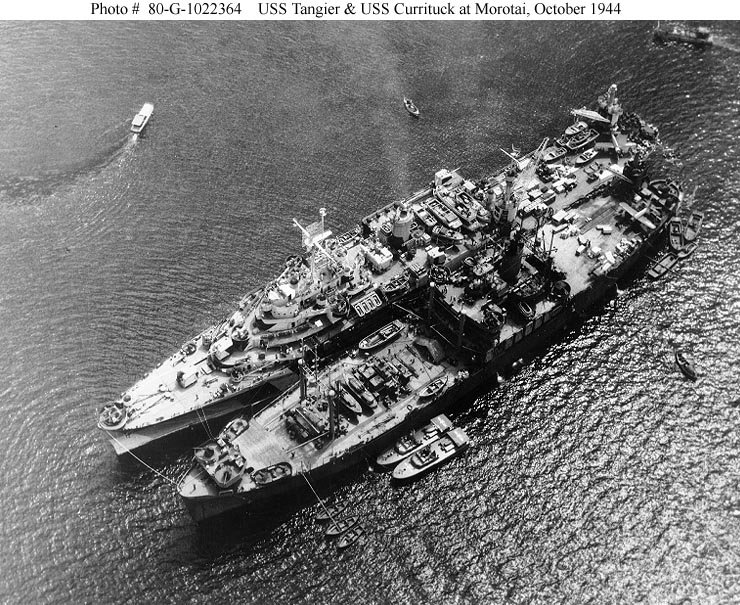
She put to sea from Philadelphia on 31 August 1944, bound for the Pacific Fleet. At Balboa, in the Canal Zone, she embarked passengers for Manus, then went on to Mios Woendi to unload cargo. She carried men, airplane spare parts, and supplies for Tangier (AV-8) from Manus to Morotai, returned briefly to Mios Woendi, and arrived in San Pedro Bay, Leyte, on 6 November. There she tended seaplanes flying missions in the Leyte operations.
She sailed from Leyte on 6 January 1945 for the initial landings at Lingayen Gulf, Luzon, three days later. NavSource dates that campaign 9 to 18 January. She remained at Lingayen, at Cabalitan Bay, and at Mindoro, tending seaplanes and directing seaplane search operations. She returned to Leyte on 6 February, sailed for Manila on 3 March, and arrived three days later. Boarding parties went out to inspect abandoned Japanese vessels in the harbor. From 27 April to 6 May her tender duties included maintenance of the 76th Wing of the Royal Australian Air Force.
She left Manila on 10 June 1945. The DANFS reprint says she maintained a base for seaplanes conducting night searched from Lingayen Gulf between 11 June and 20 August. Those are the reprint's words. She returned to Manila on 24 August and sailed for Okinawa on 30 August. She stayed in the Far East for the reoccupation of the Chinese mainland, tending seaplanes at Jinsen in Korea and at Shanghai, Tsingtao, and Taku in China. She returned to Okinawa on 28 October, got underway for the United States on 9 December, and arrived at San Francisco on 30 December.
After the surrender
After local operations from San Francisco and San Diego she sailed on 2 December 1946, touched at the Marquesas, and visited Sydney from 13 to 20 March 1947. She returned by the Panama Canal to Norfolk on 18 April. She was placed out of commission in reserve on 7 August 1947, berthed at Philadelphia.
She was recommissioned on 1 August 1951 and got underway on 17 December for Norfolk. From there she operated locally and in the Caribbean, mostly on training duty. She left Norfolk on 23 August 1952 for a cruise that included Thoneim, Norway, and Leith, Scotland, and she was back on 17 October. The reprint prints the Norwegian port as Thoneim. After local operations and a short voyage to Bermuda she sailed again on 24 August 1953, passed the Panama Canal for operations around the Galapagos Islands, and returned to Norfolk on 25 September. On 6 July 1954 she cleared for a European cruise, calling at Milford Haven, England, then Taranto, Italy, and again at Milford Haven and Portsmouth, and she returned to Norfolk on 18 September.
From 26 August to 13 December 1956 she served with the 6th Fleet in the Mediterranean. Training cruises to the Caribbean and local operations at Norfolk followed, until 9 January 1958, when she entered the Philadelphia Naval Shipyard. She was decommissioned there on 12 February 1958 for modernization and recommissioned on 20 August 1960. NavSource's recommissioning line prints Captain Cecil A. Bloam. The command table on the same page prints Cecil Austen Bolam. DANFS does not name the officer. After shakedown and training on the east coast and in the Caribbean she arrived at her new home port of San Diego on 3 December 1960. The DANFS reprint ends with that year.
NavSource carries the later service. It lists Vietnam Defense from 4 July to 4 August 1965, and Vietnam Counteroffensive Phase II on 2 to 26 September 1966, 30 November to 18 December 1966, 17 January to 6 February 1967, and 19 March to 13 April 1967. It records the decommissioning on 31 October 1967 at Bremerton, Washington, lay-up in the National Defense Reserve Fleet at Suisun Bay on 5 December 1967, and it spells that place Benecia. Struck on 1 April 1971. Sold for scrapping on 10 January 1972 to Union Minerals and Alloys Corporation, contract PD-X-926, for $89,106.27, delivered on 23 March 1972 to Oakland for scrapping by Learner and Company. uboat.net dates the sale 10 January 1973. NavSource says she earned two battle stars for World War II and two campaign stars for Vietnam. The DANFS reprint does not give a star count.
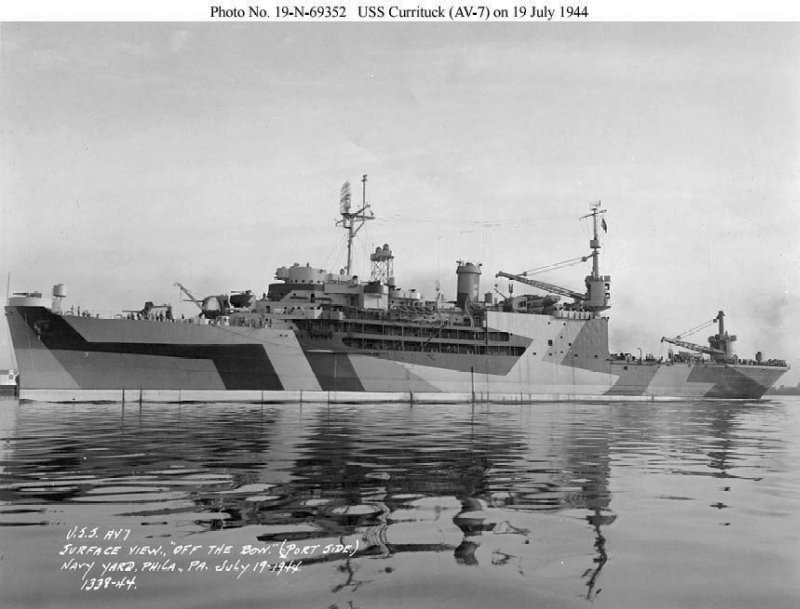
The photograph on the card is Bureau of Ships 19-N-69352, near the Philadelphia Navy Yard on 19 July 1944. The print header names USS Currituck (AV-7). The handwritten line on the print says U.S.S. AV7, surface view, off the bow, port side, Navy Yard, Philadelphia, 19 July 1944. NavSource says the frame was taken three days before completion. The picture below is Navy 80-G-1022364, Morotai in October 1944. The Naval Historical Center caption names Currituck as the upper ship and Tangier as the lower, moored while supporting seaplane operations in connection with the Leyte invasion.