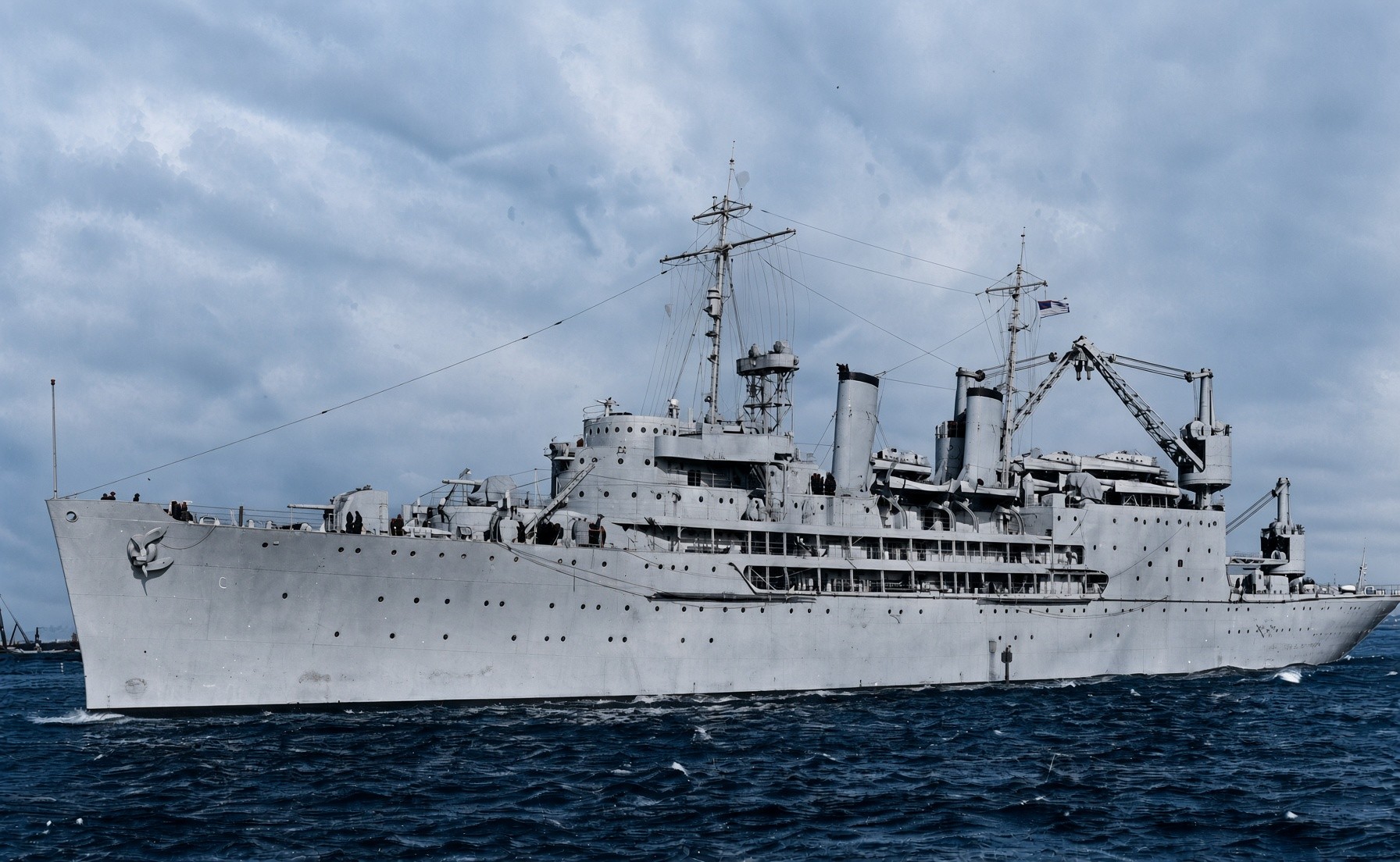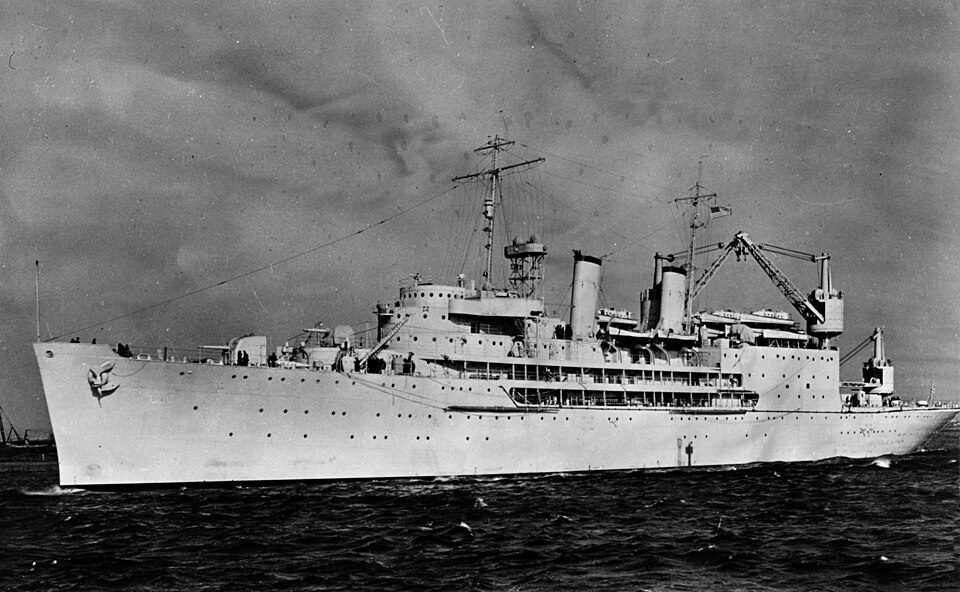
USS Curtiss (AV-4) was the lead ship of her class, a seaplane tender built for that work rather than converted from another ship. She was named for Glenn Hammond Curtiss, the aviation pioneer. New York Shipbuilding at Camden launched her on 20 April 1940. Mrs. H. S. Wheeler sponsored her. She commissioned on 15 November 1940, with Commander S. P. Ginder in command. Her sister was Albemarle (AV-5).
She trained out of Norfolk and in the Caribbean into the spring of 1941. On 26 May she sailed for Pearl Harbor, and from there she tended patrol bombers. From 15 October to 9 November she carried aviators, aircrew, and cargo out to Wake Island.
On 7 December 1941 she got underway and fired at the attacking planes. At 0836 she sighted a periscope and opened fire. A torpedo from the midget submarine missed her and struck a dock at Pearl City. The boat surfaced four minutes later. Gunfire damaged it, and it dived. Monaghan then took up the attack with depth charges.
At 0905 a plane she hit crashed into her number 1 crane and burned. A bomb from a dive bomber exploded below decks near that crane and set the hangar, the main deck, and number 4 handling room on fire. The plane went into the water off her port beam. Nineteen of her men were killed, and many were wounded. The bomb is not pinned to one plane. She was not sunk. The crew put the fires out. On 28 December she sailed for San Diego. The damaged crane was taken off and 20 mm guns were put in its place. The yard work took four days. She was back at Pearl Harbor on 13 January 1942.
Until June she ferried men and supplies to Samoa, Suva, and Noumea. From 16 June to 4 August she was flagship for Commander, Naval Air, South Pacific, at Noumea. She then worked from Espiritu Santo as a seaplane tender, a flagship, and a repair and supply ship for destroyers and small craft in the Solomons, until 9 July 1943.
After an overhaul at San Francisco she reached Funafuti on 7 November 1943, flagship for Commander Air, Central Pacific. She stayed at Funafuti until 29 December, then at Tarawa from 31 December 1943 to 8 March 1944, Kwajalein from 10 March to 26 June, Eniwetok from 27 June to 9 August, Saipan from 12 August 1944 to 1 January 1945, and Guam from 2 January to 7 February.
She arrived off Okinawa on 22 May 1945 as flagship for Commander, Fleet Air Wing 1. On 21 June a kamikaze and its bomb tore two holes in her hull and exploded on the third deck. Thirty-five men were killed and twenty-one wounded. Damage control kept her afloat. Four days later she was underway for an overhaul at Mare Island. She earned seven battle stars.
On 5 December 1945 she embarked that air wing commander again at Okinawa. He was also Commander, Task Force 75. She operated with patrol squadrons in the Formosa Strait, ferried men and supplies, and visited Tsingtao until 8 March 1947.
In July 1950 she joined the Seventh Fleet for the Korean War. From Iwakuni and Kure she tended two squadrons of PBM Mariners and a squadron of British Sunderlands. She returned to San Francisco on 14 January 1951.
She was flagship for the tests at Eniwetok: Greenhouse from 23 February to 13 June 1951, Ivy from 29 September 1952 until she returned to San Diego on 4 December, Castle from 10 January to 28 May 1954, and Redwing from 21 March to 8 August 1956. Castle was the series in which the first hydrogen bomb was exploded.
She left San Diego on 27 December 1956 for Operation Deep Freeze II, with the wintering-over party and scientists for the International Geophysical Year. She entered McMurdo Sound on 19 January 1957 and transferred cargo by helicopter to the icebreaker Glacier. She put men and cargo ashore there and at Little America, then returned to San Diego on 25 March with ice damage. She was placed out of commission in reserve on 24 September 1957. She was struck on 1 July 1963 and sold for scrap in 1972.