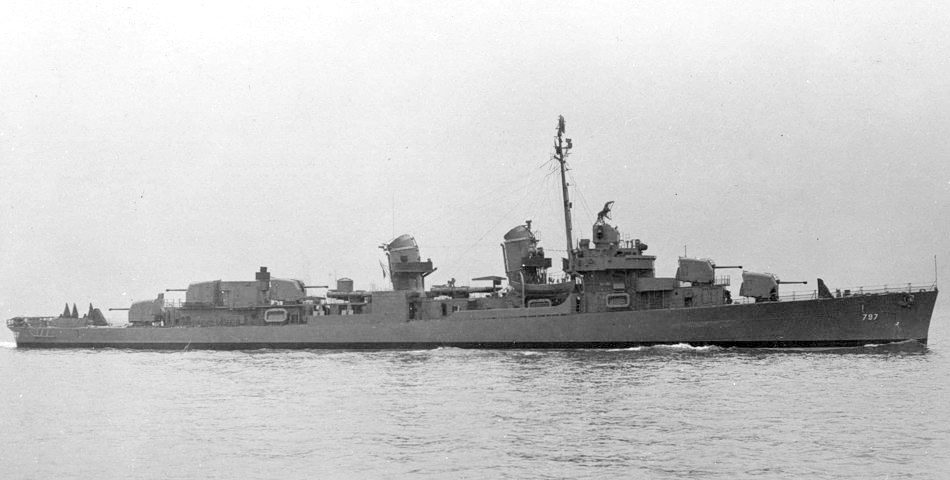
USS Cushing (DD-797) was a Fletcher-class destroyer. Launched on 30 September 1943, she entered commission on 17 January 1944 with Louis Frank Volk as her first captain.
On 5 May 1944 she left Norfolk, Virginia, bound for training at San Diego and at Pearl Harbor. She escorted a convoy onward to Eniwetok in the Marshalls, then returned to Bremerton, Washington, so her submarine-detection gear could be improved. On 24 August 1944, at Eniwetok, she joined the Fifth Fleet and sailed for the Palau landings. With the carriers she covered their attacks on Mindanao, Samar, Cebu, and Negros, and on 17 September she stood by the troops in the Battle of Angaur. She went back to the screen for strikes against Formosa, Manila, and the northern part of Luzon. Those operations were intended to neutralize Japanese bases before the Philippines invasion, and the destroyer helped recover many aviators who had come down at sea.
In the Battle for Leyte Gulf, on 24 October 1944, her guns brought down at least one Japanese airplane during heavy air attacks. She finished replenishment at Ulithi, in the Carolines, on 22 November. On 10 December she put to sea with the fast carriers, then organized as Third Fleet Task Force 38 and later as Fifth Fleet Task Force 58, for strikes on Luzon. She rode out the typhoon of 18 December, brought aboard survivors from other ships, and was in Ulithi once more on 24 December for repairs. Between about 20 and 23 December she also worked alone, picking up ditched flyers. One contact was a twin-engine Betty. Cushing fired VT shells at her near maximum range, some twenty thousand yards off to the west. The bomber, which appeared damaged, closed the destroyer while weaving under the heavy gunfire and crashed close astern, most likely from 20 mm hits. It may have been an early suicide attempt. Sonar also caught a torpedo from a submarine, and Cushing turned in time to let it pass.
On 1 January 1945 she was with the carriers again and remained until 28 January, covering attacks on Formosa, along the Indochina and China coasts, and in the Philippines. In Task Force 58 she joined strikes against the home islands, taking a radar-picket post where the aircraft launched and helping to stop many Japanese planes that tried to reach the carriers. She stayed on the carrier screen for the preparatory blows at Iwo Jima and at Okinawa, and she took part in the shelling that softened Okinawa. In the Battle of Okinawa she served once more as radar picket, and the fighter direction she provided was credited with many Japanese aircraft. William D. Adams relieved Volk on 18 May 1945. After a June replenishment at Leyte she went back to the carriers for Tokyo-area strikes that lasted to the close of the war. From 27 August 1945 she lay at anchor in Sagami Wan and directed traffic at the harbor mouth for the occupation forces until she sailed for the United States. John Wyatt took command on 15 September 1945. Bremerton saw her again on 20 November 1945. She left commissioned service for the reserve at Long Beach on 3 February 1947, with six battle stars for the Second World War.
She was recommissioned on 17 August 1951. Leaving Long Beach on 15 November, she arrived in Norfolk on 30 November and joined the Atlantic Fleet. Training cruises ran through the northern Atlantic and the Caribbean. On 7 January 1953 she departed Norfolk for plane-guard work beside Task Force 77 off Korea. Over 2 and 3 June her guns fired on Hodo Pando, North Korea. The return was a voyage around the world, with visits to Manila and Singapore, then Colombo, Aden, and Piraeus, and afterward Genoa, Cannes, and Algiers. She moored at Norfolk on 22 August. The Korean War added two battle stars.
Along the east coast she kept to anti-submarine practice and reserve training, and in 1954 she deployed to the Mediterranean. A move to the Pacific Fleet brought her into Long Beach on 26 January 1955. Far Eastern tours followed in 1955 and in 1956, then through 1957–58, and again in 1959–60. She served as plane guard, worked hunter-killer problems with Task Force 77, patrolled the Taiwan Strait, and called at ports to further the People to People program of President Dwight D. Eisenhower. When she was back in American waters, her west coast routine mixed submarine and anti-aircraft drills with training for midshipmen and for reservists. In October 1960 her home port became Charleston, South Carolina, and she moved to the east coast. On 8 November 1960 the Navy laid her up in reserve at Norfolk.
On 20 July 1961 the ship was loaned to Brazil. She served there as Paraná (D29). Paraná was struck on 1 August 1973, and scrapping of the hull was carried out in February 1982.