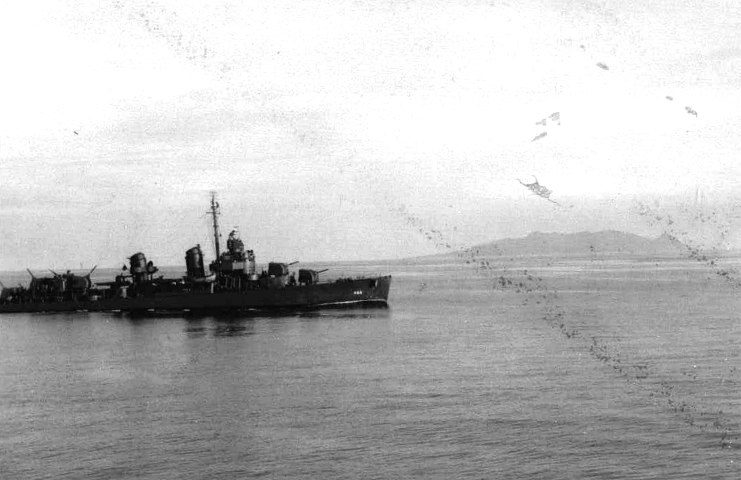
USS De Haven (DD-469) was a Fletcher-class destroyer of the United States Navy. She was launched on 28 June 1942 and commissioned on 21 September 1942. C. E. Tolman was her captain from the day she entered service.
She sailed from Norfolk, Virginia, and on 28 November 1942 reached Tongatapu in the Tonga Islands. From there she guarded a convoy of troopships headed for Guadalcanal, carrying relief for Marines who had been ashore since the landings in August. Between 7 and 14 December she watched over the transports lying off the island.
She then worked from Espiritu Santo and Nouméa while operations in the Solomon Islands continued. In the southern Solomons she patrolled to interrupt the Tokyo Express, the Japanese practice of sending supplies at night to troops still holding out on islands already invaded. In January 1943 she took part in two bombardments of Kolombangara.
On 1 February 1943 De Haven covered six tank landing craft and a seaplane tender as they put a beachhead ashore at Maravovo on Guadalcanal. That afternoon, while she brought two of the landing craft back toward their base, she was warned that Japanese aircraft committed to Operation Ke were about to attack. Nine planes she could not identify came into view. Six of them turned sharply toward her, and she opened fire. She brought three of them down, but all six had already released their bombs.
Three bombs hit the destroyer, and a near miss did more damage. One struck the superstructure full on and killed the commanding officer at once. After that first blow the ship was lost. She settled quickly and sank in Ironbottom Sound, roughly two nautical miles east of Savo Island. One of the landing craft she had been escorting took the survivors aboard. De Haven's casualties were 167 killed and 38 wounded.
Robert Ballard located the wreck in 1992. On 8 July 2025 the expedition vessel E/V Nautilus identified De Haven again on the bottom of Ironbottom Sound, near 9°9′ south, 159°52′ east. She received one battle star for her World War II service.