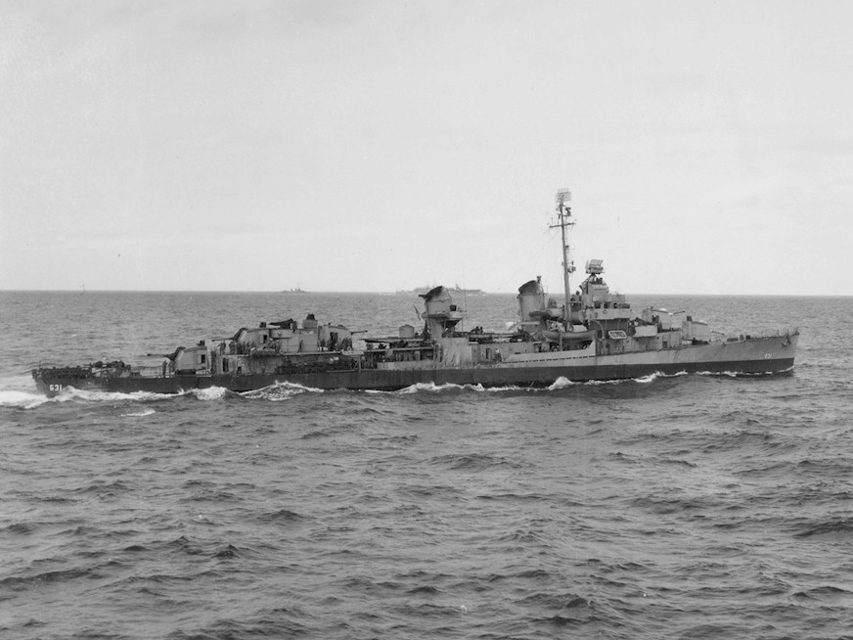
USS Erben (DD-631) was a Fletcher-class destroyer in the United States Navy. Launched on 21 March 1943, she was commissioned on 28 May 1943 under Captain Joseph Henry Nevins. On 2 October 1943 she arrived at Pearl Harbor from Boston, joined the Fifth Fleet, and beginning 1 November trained among the Hawaiian Islands. Carrier exercises in those waters included the rescue of an aviator who had gone down. She departed Pearl Harbor on 8 November, joined a carrier task group on 15 November, and screened it through the air attacks that prepared the Gilbert Islands for invasion, more than once taking aboard fliers whose aircraft had crashed or run out of fuel. On 20 November, as Marines landed at Tarawa, she remained with the carriers launching strikes in support and, late in the afternoon, met thirteen Japanese torpedo planes with antiaircraft fire. On 4 December she fired again, this time at Japanese aircraft that struck the task group while it retired from attacks in the Marshall Islands. On 18 December 1943 Morgan Slayton relieved Nevins in command.
Replenishment at Pearl Harbor complete, Erben sailed on 21 December 1943 for Funafuti to exercise with the support group gathered for the Marshalls invasion. Under way again on 23 January 1944, she shelled Taroa and Wotje on 29 January. The following day she looked for Japanese ships off Maloelap and fired into a fishing vessel run up on the beach. On 31 January, while the assault landings were in progress, her guns supported the troops ashore. She returned off Taroa on five nights for bombardment and harassing shoots. From 2 February she patrolled the Marshalls from a base at Majuro.
On 17 March 1944 Erben returned to Guadalcanal. After seeing troop transports through to Cape Torokina, she made ready at Milne Bay for Hollandia. Through April she screened carriers that gave air cover to the landings at Aitape and Hollandia. May was given largely to training in the New Hebrides and the Russell Islands. Kwajalein, reached on 8 June, was the staging point for the Marianas. Between the sortie beside the carriers on 12 June and the return to Eniwetok on 4 August she hardly left the sea. In those weeks she screened carriers that launched strikes before the landings and covered the assault, including the period of the Battle of the Philippine Sea, and she guarded the assault ships against submarines and against air attack.
A short overhaul and a further training period in the Hawaiian Islands followed, about a month in all, and she then shaped a course for Manus. From that anchorage, on 14 October 1944, she escorted transports to the landings on Leyte on 20 October. Patrol and antiaircraft defense of the transports lasted until 24 October. With the Battle for Leyte Gulf under way, she sailed for Humboldt Bay and covered LSTs as they retired. Reinforcements went back with her to Leyte on 14 November. She left the same day, calling the route through Manus, Majuro, and Pearl Harbor on the way to a west-coast overhaul.
Captain William Hutton Snyder assumed command on 3 March 1945. On 15 March Erben was back with the fleet, rendezvousing a day out of Ulithi with the fast carriers for strikes against Kyushu and Okinawa. Two of those strikes, on 26 and 30 March, left her with four rescued aviators. Okinawa's invasion landings on 1 April opened the heaviest phase of the pounding of the island, and for two months afterward she screened carriers operating offshore. She used her guns to turn kamikazes away, took survivors from ships that had been hit, shelled shore targets, and pulled many fallen aviators from the water. The same three-man aircrew from Randolph was recovered by Erben on 3 May and again on 23 May. Through June she lay in Leyte Gulf while her sonar was repaired and the ship exercised. On 1 July she sailed to screen air strikes on Japan and to share in the bombardments, patrolling ahead of the main body as a guard against Japanese aircraft trailing the planes coming back from those strikes. On 9 August, as steel works at Kamaishi were bombarded, Erben's guns destroyed two enemy luggers. She cruised off Japan in company with the carrier until 15 September, when she entered Tokyo Bay for replenishment. Passengers came aboard at Okinawa after she sailed on 1 October, and she brought them to Long Beach on 21 October 1945. Stanley P. Wyatt took command on 9 December 1945. Decommissioning followed on 31 May 1946, and the ship went into reserve.
Fleet growth in the Korean War brought Erben back into commission on 19 May 1951. Long Beach, her home port, saw her sail on 27 August for Yokosuka. She immediately took a place in the destroyer screen that guarded Task Force 77's carriers against submarines. Late September and October were spent bombarding the coast in the Songjin-Chongjin area, where the fire broke up enemy communications and the routes that fed supplies. On 9 October she took from a small boat a North Korean who was getting clear of the Communists. Antisubmarine practice off Okinawa came next. She then resumed screening duty and on 2 December picked up a downed pilot. Alongside Manchester she bombarded Korea's west coast, afterward moving to the east coast for close fire support of the men fighting ashore. San Diego received her on 21 March 1952 for overhaul. On 1 November she sailed for another tour off Korea, carrying out work much like the first tour, with calls at Taiwan and Hong Kong and time in company with Royal Navy ships. She returned to San Diego on 1 June 1953.
In the five years of active service that remained, Erben completed four further cruises to the western Pacific. Those deployments included the Taiwan Patrol and operations with Seventh Fleet carriers. She got under way for the Far East on 8 June 1957, reached Pearl Harbor on 14 June, and stayed through 16 June for repairs. Midway Island was the next call, on 23 June. She was at Yokosuka from 29 June to 6 July, shifted to Yokohama that day, and remained there until 8 July. Naha, on Okinawa, took 13 July. Kaohsiung, Taiwan, saw her on 17 July and again at anchor from 26 to 28 July. On 1 August 1957 she was once more in Yokosuka. A second decommissioning, on 27 June 1958, returned her to reserve.
South Korea received the destroyer on 16 May 1963. Renamed ROKS Chung Mu, she first carried the hull number DD-91. In 1979 the Republic of Korea Navy renumbered her 911. From 1983 onward she served as a stationary training ship. In time she was scrapped. A 5-inch gun taken from her is shown at Seoul's War Memorial of Korea.