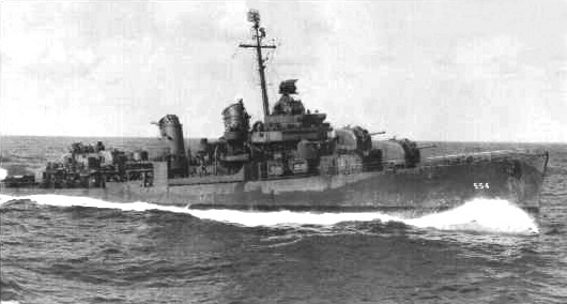
USS Franks (DD-554) was a Fletcher-class destroyer of the United States Navy, named for William Joseph Franks, an acting master's mate who had received the Medal of Honor. Seattle-Tacoma Shipbuilding Corporation launched her at Seattle, Washington, on 7 December 1942. Sponsorship came from Martha F. W. Carr, a cousin of that namesake. The Navy commissioned the ship on 30 July 1943. Nicholas Adair Lidstone commanded her from that day until 30 June 1944.
She reached Pearl Harbor on 25 October 1943 and made ready for the Gilbert Islands landings. The sortie followed on 10 November. Franks guarded escort carriers whose aircraft covered the troops going ashore at Tarawa, remained on patrol near Betio through 27 December, and then returned to Pearl Harbor for a short repair period. On 22 January 1944 she sailed with the Southern Attack Force against Kwajalein, searching for submarines and moving in on Ebeye to look the island over and shell it. Another replenishment at Pearl Harbor ran from 18 February to 4 March. She then crossed to the Solomons for convoy escort and local patrol, entering Purvis Bay on 15 March.
In March and April 1944 her scouting and shore-bombardment targets included Mussau, north of New Ireland, the atoll of Kapingamarangi, and Bougainville. During May she guarded minelayers working Buka Passage. On 16 May, in company with Haggard, she gained contact with the Japanese submarine I-176, and the two destroyers attacked and sank the boat. The next month she turned back to the central Pacific. From 12 July she bombarded Guam ahead of the assault, and on 21 July she fired in support of the troops landing there. After taking on stores at Eniwetok she went south to prepare for the Palaus, arriving off those islands on 15 September. She screened the force and directed fighters, and on 23 September she covered the occupation of Ulithi. David Richard Stephan had relieved Lidstone on 30 June 1944.
On 1 October 1944 Franks left Manus for about six weeks with escort carriers in Philippine waters. She took part in the strikes that preceded the Leyte landings and in the landings themselves. On 25 October, in the action off Samar during the wider battle of Leyte Gulf, she helped protect those carriers while Japanese battleships brought heavy gunfire down on the formation. After replenishing at Manus she was back at Leyte late in November. In December she shifted to the fast carrier force, covering the Mindoro landings and the strikes that prepared the Luzon assault of January 1945.
Still beside the fast carriers, she joined strikes on the Japanese home islands on 16 and 17 February 1945, just before the landings at Iwo Jima. Ulithi was her starting point on 14 March, when she headed out for attacks on Kyushu and the Nansei Shoto in advance of Okinawa. On 18 March enemy aircraft hit the task force hard. Franks was credited with one of the raiders, and her guns helped bring several more down. She then joined the battleships. On 24 March she closed Okinawa's southern shore for a bombardment that masked the plan to land at Hagushi, on the western side of the island. She stayed offshore to recover airmen while carriers covered the assault of 1 April.
On 2 April 1945 a collision with the battleship New Jersey left Franks badly damaged and fatally injured Stephan, who was still her commanding officer. Gerald Frederick Case took command that day and held it until 22 April 1945, when Eugene Baker Henry relieved him. The destroyer went at once to Ulithi for patch repairs and on 13 April left for a full overhaul at Puget Sound Naval Shipyard. She returned to the western Pacific on 17 August 1945, at Eniwetok. On 3 September she met the fast carriers and took up sea-rescue work and weather reporting for flights between Okinawa and Honshu. She entered Tokyo Bay on 13 September and on 1 October started for the west coast.
The Navy decommissioned her and laid her up in reserve at San Pedro, California, on 31 May 1946. She survived the war in that status until the hull was sold for scrap on 1 August 1973. Nine battle stars marked her World War II service.