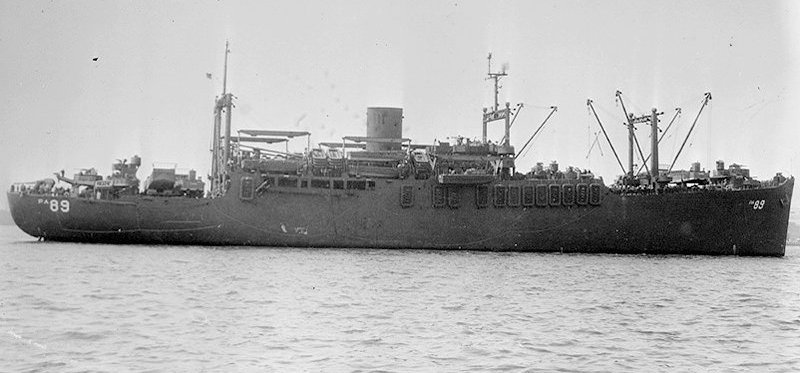
Frederick Funston kept the name she already carried. Seattle-Tacoma Shipbuilding launched her at Tacoma on 27 September 1941, and Miss Barbara E. Funston sponsored her. The Army turned her over on 8 April 1943. The Navy commissioned her on 24 April 1943, with Commander J. E. Murphy in command. Her class was Frederick Funston. Years later, on 28 April 1950, she would be renumbered T-AP-178.
She sailed from Norfolk on 8 June 1943 for rehearsal landings along the Algerian coast. On 10 July she was off the Sicilian assault beaches and got her men through a heavy surf. Three days later she went to Oran to train for Salerno. From 8 to 10 September she lay off that shore and landed soldiers, then returned to North Africa for reinforcements. Salerno received them on 22 September and again on 23 September. Three trips from Oran to Naples took Army service troops, plus engineers and rangers. Paratroopers were aboard when she left Oran on 30 November, bound for Northern Ireland. After they had landed she continued to New York, arriving on 31 December 1943.
Naval construction battalions loaded at Davisville, Rhode Island. She then sailed for the Pacific and reached Honolulu on 16 March 1944. Those men went ashore, and Marines came aboard for Saipan. She landed them in the initial assault on 15 June, spent a week off the beach sending cargo in and taking casualties, and returned to Honolulu. The wounded moved to hospitals. Soldiers came aboard, and on 24 July she reinforced Guam. August was training among the Hawaiian Islands. She crossed to Manus and on 14 October sailed for Leyte, 21 October was the day troops and cargo went ashore, one day behind the opening assault. She cleared the next morning for Aitape, to take reinforcements aboard. Those troops went ashore at Leyte on 14 November.
New Guinea waters, Huon Gulf among them, were the drill ground ahead of the first Luzon landings on 9 January 1945. That night a lookout spotted a suicide swimmer and shot him only 50 yards from the hull. Unloading ended the next day. By way of Leyte and Ulithi she went to Guam, embarked Marines for Iwo Jima, and held them in reserve. They did not land until 27 February, though she lay offshore through the assault. On 8 March she brought casualties back to Guam. Guadalcanal issued her new landing craft. Through April she exercised at Noumea. May took her to the west coast for overhaul.
The Philippines saw her on 3 October, and she did inter-island transport work until 8 December, then returned to San Francisco. Occupation troops for the Marianas, and veterans on the way home, filled a voyage that opened on 22 December and closed on 7 February 1946. On 4 April 1946 her commission ended and the Army took her back. Out of Seattle she worked in the Army Transportation Corps fleet until Military Sea Transportation Service stood up in 1950. She then returned to naval custody, not in commission, to operate with a Civil Service crew, and from 28 April 1950 her number was T-AP-178. Six battle stars were awarded.