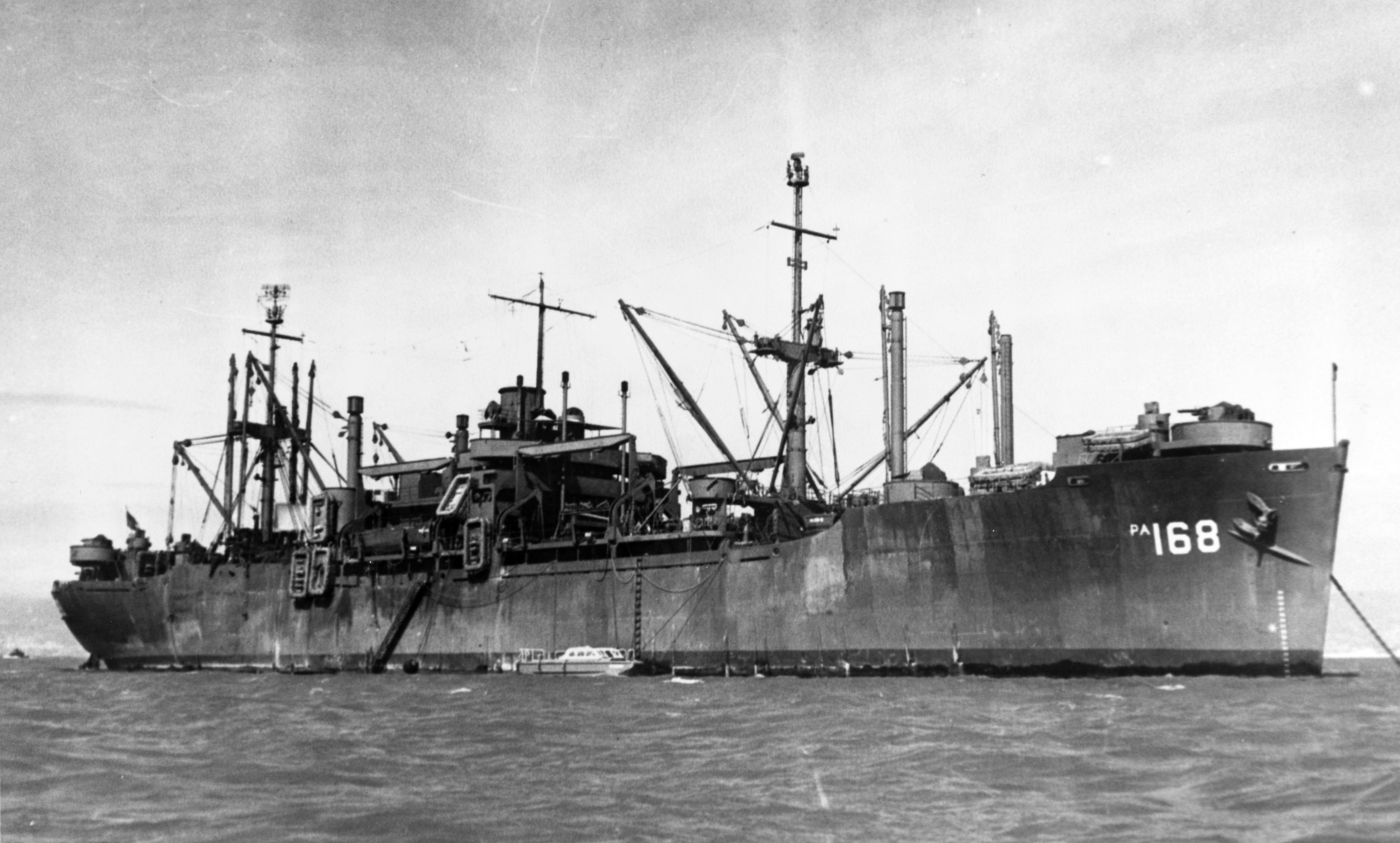
Gage was named for a county in Nebraska. Oregon Shipbuilding at Portland built her under a Maritime Commission contract and launched her on 14 October 1944. Mrs. H. L. Edmunds sponsored the ship. The Navy acquired her on 4 November and commissioned her on 12 November, Commander L. J. Alexanderson, USNR, in command.
Shakedown out of San Diego led on to San Francisco. She sailed from there on 17 January 1945, bound south into the Pacific. A military civil-affairs party landed from her at Kaurimarau in the Russell Islands. On 4 February she arrived off West Kokum Beach at Guadalcanal with 298 Marines and a load of military cargo. She joined Division 34 in Transport Squadron 12 and spent the next weeks on amphibious exercises in the Solomons. Guadalcanal fell astern on 15 March, bound for Ulithi, where the Okinawa force was gathering. From that anchorage she went to Hagushi Beach and on 1 April took part in the opening landing, while naval guns and aircraft hammered the shore. Across five days and nights of nearly unbroken alerts for suicide planes, she put ashore Marines from the 3rd Battalion of the 4th Regiment, a unit of the 6th Division. With them went a naval construction battalion, medical personnel in company strength, and the equipment those outfits needed in a fight. The work ended on 5 April. Marianas and Hawaii were the route home, and San Francisco received her on 11 May.
There she embarked the men and gear of an Army Air Corps casuals draft and landed them at Manila on 12 June. Amphibious Group 9 at Leyte was her next reporting point, on 22 June, and she was sent along to New Guinea. Troops boarded at Langemak Bay and at Humboldt Bay for Iloilo, on Panay. San Francisco saw her again on 2 August. Word that Japan had given up found her in Seattle, where Todd's yard had the ship in dry dock and under repair.
She stood out of Seattle on 21 August with 1,724 Army casual replacements, who went ashore at Saipan on 5 September. On 18 September she sailed with about 1,600 Marines and late in October set them ashore at Hiro Wan, on Honshu, as part of the occupation. On the way home she lifted 1,700 Army veterans at Okinawa and Manila under Magic Carpet orders and reached Portland, Oregon, on 14 December.
Another Magic Carpet round trip, San Francisco to Yokosuka and back, ran from 10 January to 25 February 1946, and a similar run to Samar and back ran from 4 April to 10 May. On 28 May she left San Francisco to support Navy occupation parties. In China the ports were Tsingtao and Tientsin. In Japan they were Yokosuka and Sasebo. Sasebo was astern on 26 June. Army veterans embarked in the Marianas and in Hawaii, she passed the Panama Canal, and Norfolk was reached on 29 July. The Norfolk Naval Shipyard kept her until decommissioning on 26 February 1947. She then lay in the Atlantic Reserve Fleet. On 1 October 1958 the Navy struck her name. That same date she passed into reserve fleet hands of the Maritime Commission, for a berth on the James River. One battle star was credited for the war.