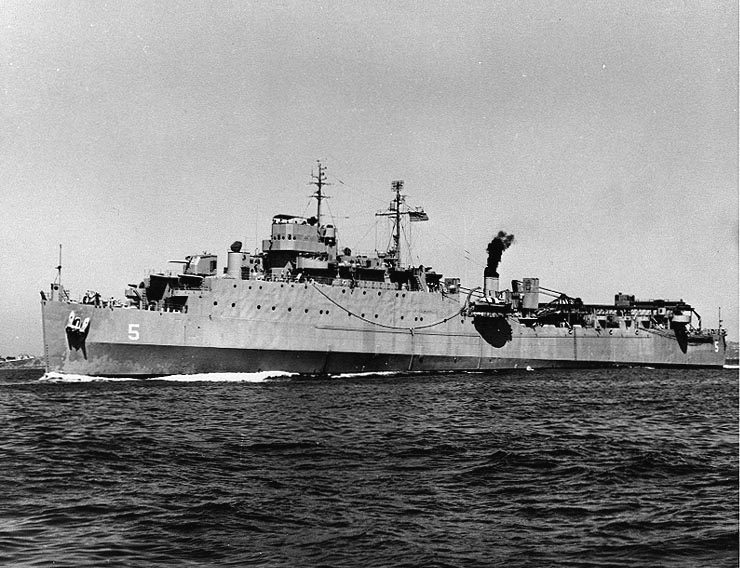
Gunston Hall, LSD-5, was an Ashland-class dock landing ship named for the Virginia estate of George Mason. She was authorized as a mechanized artillery transport, APM-5, and became LSD-5 on 1 July 1941. Moore Drydock at Oakland laid her down on 28 December 1942 and launched her on 1 May 1943, Mrs. Harvey S. Haislip sponsoring. She was commissioned on 10 November 1943, Commander D. E. Collins in command.
She sailed from San Diego on 13 January 1944 with 225 men of the 4th Marine Tank Battalion, two amphibious units, 15 tractors, 15 tanks, 17 landing craft and 15,000 gallons of gasoline. On 1 February 1944 she stood off Roi and Namur and unloaded as the Marines landed. She stayed to repair small craft until 6 February, then re-embarked her passengers and went to Guadalcanal by way of Funafuti.
DANFS says the pattern held through eight more assaults. She was at Emirau on 20 March 1944, Hollandia on 22 April, Guam on 21 July, Peleliu on 15 September and Leyte on 20 October. In 1945 she was at Lingayen Gulf on 9 January, Iwo Jima on 19 February and Okinawa on 1 April, and then lay at Kerama Retto repairing small craft until 1 July. She was not hit, though she saw other ships struck by kamikazes. She went to Portland, Oregon, for overhaul in July 1945 and supported Operation Crossroads at Bikini in 1946. She earned nine battle stars for World War II.
She was decommissioned at Treasure Island on 7 July 1947, converted for Arctic service at Puget Sound, and recommissioned on 5 March 1949. In the Korean War she took Marines to Pusan, made shuttle trips at Inchon on 15 September 1950, tended minesweepers at Wonsan, and in April 1952 carried 15,000 prisoners from Koje-do to Ulsan and Cheju-do. She served in the exchange of prisoners in September 1953 and in the 1955 Passage to Freedom evacuation of Vietnamese civilians. She earned nine battle stars for Korea. She was sold to Argentina in 1970, served there as Candido de Lasala, and was decommissioned in 1981.