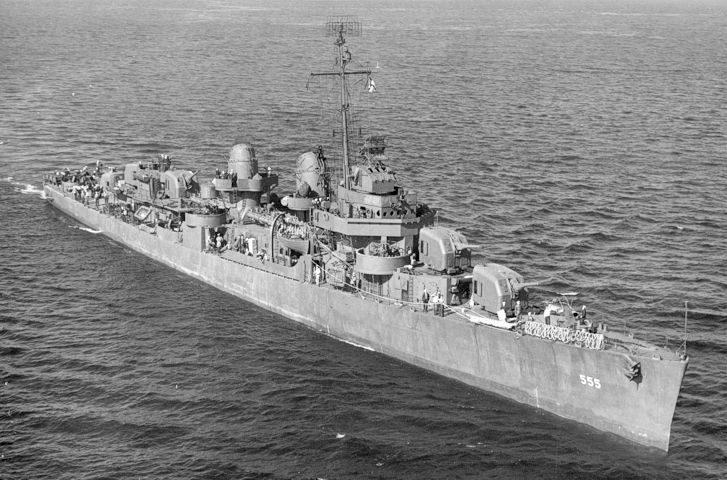
USS Haggard (DD-555) was a Fletcher-class destroyer of the United States Navy, named for Captain Haggard of the Louisa. Seattle-Tacoma Shipbuilding Company launched her at Seattle on 9 February 1943. Mrs. E. B. McKinney sponsored the ship. Haggard was commissioned on 31 August 1943, and D. A. Harris assumed command the same day.
On 29 September she put to sea for shakedown off California. With that training behind her, she left Seattle on 24 November and entered Pearl Harbor on 30 November 1943. The next two months went to tactical drills alongside other destroyers in Hawaiian waters. Her first combat duty was the Marshall Islands assault. She sailed on 22 January 1944, covered an unopposed landing at Majuro on 31 January, and then moved to Kwajalein Atoll. From a station inside the lagoon on 2 February she fired in support of the Marines until the island was taken three days later. Patrol and transport escort around Kwajalein followed, and between 17 and 19 February she shifted to Engebi, in Eniwetok Atoll, where her five-inch guns again worked close to the beach as Eniwetok was secured.
American control of the Marshalls sent her on to Espiritu Santo, in the New Hebrides, on 7 March. In the months after that she served with the Third Fleet across the New Guinea and Solomons area, scouting, escorting convoys, and screening escort carriers. She sometimes kept company with mine vessels. On 9 May she covered a minelaying run in the Solomons and, at Buka Passage, passed 800 yards off a beach the enemy still held. On the night of 16–17 May, patrolling with Franks (DD-554) and Johnston (DD-557), she picked up a sound contact underwater. Depth-charge attacks by the three ships followed, and the Japanese submarine I-176 was credited jointly to them.
Haggard joined the Fifth Fleet at Eniwetok on 21 May while the Marianas operation was being prepared. She left that anchorage on 8 July and arrived off Guam on 17 July with the battleships Pennsylvania (BB-38) and New Mexico (BB-40) and other ships, then shelled the beach defenses. Marines landed on 21 July, and she turned to close gunfire support. Palau was the next group required as an air base for later moves. On 24 August 1944 she was withdrawn from Guam to Espiritu Santo, and she later operated with the Western Escort Carrier Group off the Solomons. During the Peleliu landing on 15 September she screened carriers that bombarded the island and backed the Marines ashore. Planes from the same group also bombed Ulithi, and the ships entered Seeadler Harbor at Manus on 1 October.
The Philippines campaign came next. Haggard was attached to an escort-carrier group off Samar for the Leyte invasion and for the surface actions of 23–25 October. She formed part of Rear Admiral Felix Stump’s Taffy 2, Task Unit 77.4.2, in the Battle off Samar. On the morning of 25 October, warships under Admiral Takeo Kurita came down from the north and headed for the landing beaches in Leyte Gulf. Carriers of Taffy 3, Task Unit 77.4.3, drew off at their highest speed. Destroyers in the action, among them Hoel (DD-533), Heermann (DD-532), and Johnston, closed the Japanese ships, and aircraft from both escort groups attacked over and over in hope of turning that heavier force aside so the light American ships could get away. Haggard stayed astern of her own carriers as their guard and received many near misses from the enemy’s heavy guns. Two escort carriers and three destroyers were lost. The defense nevertheless preserved the rest of the small American formation and damaged ships among the attackers. Kurita turned back to the north, and his force left Leyte Gulf alone.
She remained with the escort carriers through November while their aircraft supported the fighting in the Philippines. A short stay at Ulithi, from 25 November to 10 December, preceded duty with Task Force 38 for the Luzon invasion. Between 10 and 20 January 1945 Admiral William Halsey’s Third Fleet pushed into the South China Sea. Haggard screened with the other destroyers while the carriers struck Luzon, Formosa, Indochina, and the China coast, destroying shipping and airfields in a wide display of mobile naval power. She returned to Ulithi on 26 January 1945 and, on 9 February, sailed with Task Group 58.4. Randolph (CV-15) and Yorktown (CV-10) were among the carriers. The group attacked Tokyo on 16 and 17 February, in the days immediately before the Iwo Jima landings, and kept up air support for that assault until the ships reached Ulithi again on 4 March 1945.
Haggard went to sea once more with the Fifth Fleet carriers under Vice Admiral Marc Mitscher for further blows against Japan. On 18 and 19 March, during strikes on Honshu, Japanese suicide planes struck the task force. Her gunners brought several of those aircraft down while Franklin (CV-13) and Enterprise (CV-6) took damage. After fueling underway, the fast carriers set course toward Okinawa on 22 March, and Haggard was placed on picket duty forward of the formation. Shortly before midnight radar showed a submarine on the surface. The boat dived, and she followed with depth charges. Ten minutes after that attack it rose on her port beam. Commander Soballe put the helm hard left, drove in at full speed, and rammed the submarine amidships. It sank within three minutes. Emergency work on the crushed bow got Haggard back to Ulithi on 25 March. The submarine is generally taken to have been Ro-41. I-371 had already been reported missing eleven days before the ramming.
On 29 April 1945 a kamikaze hit Haggard, and San Diego came to her assistance. She survived the war. The Navy sold her for scrap on 3 March 1946.