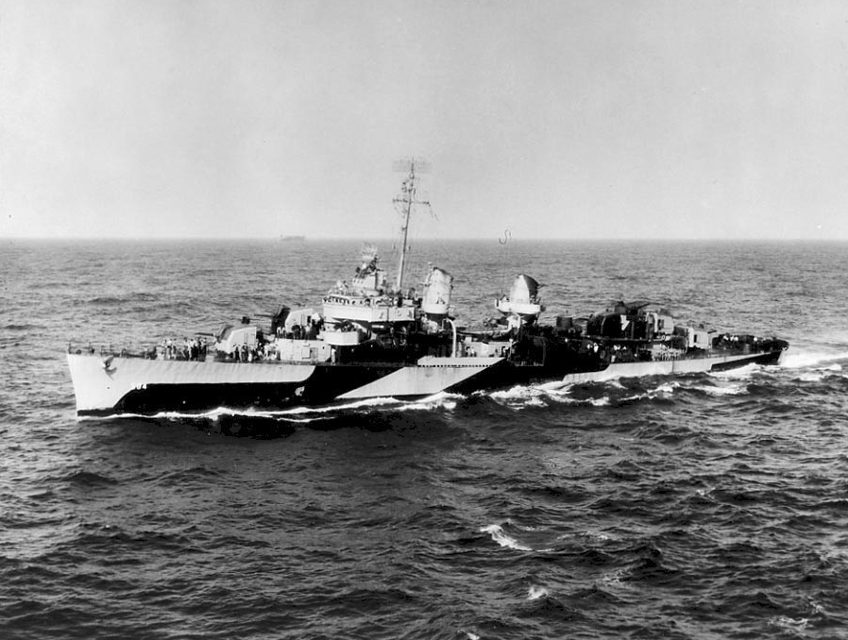
USS Halligan (DD-584) was a Fletcher-class destroyer of the United States Navy. She was launched on 19 March 1943 and commissioned on 19 August 1943, with C. E. Cortner taking command that day.
After shakedown off Bermuda, she joined the battleship Iowa in mid-November while President Franklin D. Roosevelt traveled with his party toward the Teheran Conference. Halligan stayed with the screen as far as Casablanca, then spent the next few weeks on antisubmarine work off North Africa. On 11 December she met Iowa again for the voyage home and reached Charleston, South Carolina, on 17 December.
Sent on to the Pacific, she left Charleston on 21 December, arrived at San Diego on 4 January 1944, and entered Pearl Harbor on 11 January. Sailing with Task Force 52 on 22 January, she took part in the Marshall Islands assault. From 31 January to 25 February she screened and patrolled through the Kwajalein operations, then remained in the forward area until her return to Pearl Harbor on 22 May. She next screened the escort carriers Natoma Bay and Manila Bay, which were carrying Army fighters for the Saipan operation. Aircraft launched on 22 June, and Japanese dive bombers attacked the group the next day.
After time at Pearl Harbor she sailed on 15 September for Eniwetok and Manus in the Admiralties. She reached Seeadler Harbor on 3 October and joined a force gathering for the Philippine invasion. Underway on 14 October, she entered Leyte Gulf on 20 October as Japanese planes attacked in an effort to push the landing forces back off the beaches. While she guarded the transports through almost continuous air raids, two bombs fell between her stacks, hit the water, and failed to go off. On 25 October she shot down at least two aircraft, one of them a bomber with two engines. Later that day she left Leyte to screen the battered escort carriers of Taffy 3 as they withdrew from the fight off Samar. She joined those carriers on 26 October and reached Manus on 1 November. There she helped with rescue work after Mount Hood exploded on 10 November. Two days later she sailed for Leyte and closed the year screening escort carriers on the route between Leyte and the Admiralties.
Her next duty was the Luzon invasion at Lingayen Gulf. With Admiral Jesse B. Oldendorf's heavy support force she left the Palaus on 1 January 1945, passed Surigao Strait on 3 January, and crossed the Sulu Sea toward Luzon's western coast. Far inside enemy-held waters, the fleet faced widespread kamikaze attacks. Ommaney Bay was badly hit on 4 January. After her survivors were taken off, torpedoes from Burns sank the burning carrier. Japanese planes returned the next day. Antiaircraft fire brought down most of them, yet suicide aircraft still damaged several ships in an afternoon raid. On 5 January Halligan shot down one kamikaze and sent rescue and repair parties to the damaged Stafford. Off Lingayen Gulf from 7 January, she screened escort carriers and searched for submarines during the landings on 9 January. She remained off the Luzon coast until 17 January, then screened six escort carriers to Leyte Gulf, arriving on 22 January. She sailed for Ulithi the next day, arrived on 25 January, and prepared for Iwo Jima.
Assigned to gunfire support against the shore, she left Ulithi on 10 February, carried out a practice bombardment at Tinian in the Marianas, and sailed from Saipan on 12 February. On 17 February she served as lifeguard north of Iwo Jima during the air strikes before the landing. At dawn a Japanese twin-engine bomber attacked from the port bow. Repeated hits set the plane on fire. The large bomb it released landed about 100 yards off that bow and did not explode, and the burning aircraft crashed more than a mile away. On 19 February Halligan closed until about 2,700 yards lay between her and the Iwo Jima beach. As the first Marines went in, she joined the heavy supporting barrage, destroyed a Japanese shore battery, and spent much of D-Day firing on her assigned targets. Later that day she screened escort carriers with other destroyers, and for the rest of her time off Iwo Jima she continued as screen and plane guard for the carriers offshore. Among the last destroyers to come back from the operation, she reached Ulithi in mid-March.
She soon sailed again with Task Force 54 for the invasion of Okinawa. In a fire-support unit she arrived off the southwestern coast on 25 March and patrolled the waters from Okinawa over to Kerama Retto, also covering minesweepers in areas sown with mines in irregular patterns. Patrols went on through 26 March. Around 18:35 a violent explosion shook the ship and threw smoke and debris about 200 feet into the air. She had struck a moored mine head-on. The blast set off the forward magazines and tore away the forward section, bridge included, back to the forward stack. PC-1128 and LSM(R)-194 soon arrived to help. Ensign Richard L. Gardner, the senior officer left alive and unhurt, organized rescue parties, moved the living to waiting craft, and then ordered the ship abandoned as the smoking hulk drifted. PC-584, commanded by Cecil N. Smith, saved about 80 men, and Smith received the Silver Star for the rescue. About half of her crew of 300 died, and only two of her 21 officers survived. The abandoned destroyer went aground the next day on Tokashiki, west of Okinawa, where surf and enemy shore batteries battered the hulk further. Halligan was lost to a mine on 26 March 1945.