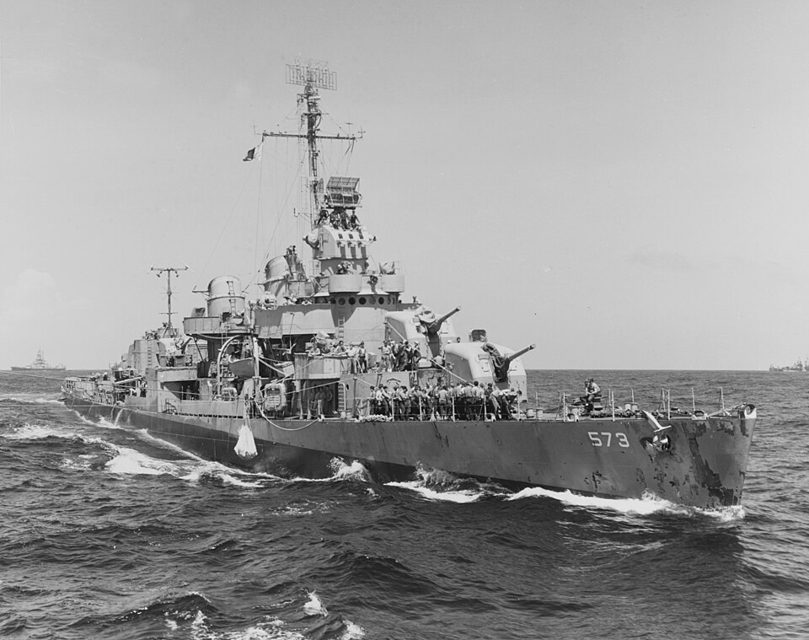
USS Harrison (DD-573) was a Fletcher-class destroyer in the United States Navy. Consolidated Steel Corporation launched her at Orange, Texas, on 4 May 1942, with Mrs. Harry B. Hird as sponsor. The Navy commissioned the ship on 25 January 1943. Carl Malcolm Dalton was captain from that day until 27 April 1944, when Walter Vincent Combs assumed command.
She trained in the Gulf of Mexico and in Caribbean waters, then escorted a merchant ship to the Panama Canal Zone and continued to New York. Harrison arrived on 6 April 1943 and reached Charleston two days afterward. From New York she sailed in a convoy to Casablanca, called at several Mediterranean ports, and was in Charleston again on 1 June. Beside the carrier Yorktown (CV-10) she practiced hunting submarines in the Caribbean, and she stayed on escort work in those waters through 22 July 1943.
In the middle of 1943 she was ordered to the Pacific Fleet. She left Norfolk, Virginia, on 22 July with the carrier Lexington (CV-16), entered Pearl Harbor on 9 August, and trained for the amphibious fighting ahead. Her duty was to guard the carriers while their aircraft worked over Japanese-held islands. On 22 August the group sailed for raids on Marcus, Wake, and Tarawa, with short replenishment stays at Pearl Harbor. Those preliminary blows done, she headed for the Solomons on 21 October, a theater already marked by hard fighting ashore and afloat. She reached Espiritu Santo, in the New Hebrides, on 4 November, sailed the next day, and on 7 November stood into Empress Augusta Bay at Bougainville to screen transports bringing reinforcements. Marines had landed on 1 November. On the night of 8–9 November, Japanese dive bombers and torpedo planes attacked, and her gunners were credited with at least one aircraft. She left on 14 November for the Gilberts and again screened transports as the first assault troops went ashore on 20 November. Harrison stayed off Tarawa until 29 November, patrolled off Makin, and on 7 December went to Funafuti for training. She anchored at Pearl Harbor on 1 January 1944 and spent most of January in Hawaiian waters rehearsing shore bombardment for the coming Marshall Islands landings.
On 22 January she sailed with the Southern Attack Force and arrived off Kwajalein on 31 January. While she screened the battleships New Mexico (BB-40) and Mississippi (BB-41) and those ships shelled positions ashore, gunfire from Harrison finished a small tanker trying to get out of the lagoon. Marines landed and pushed across the atoll's many islands. On 4 February the destroyer went into the lagoon to give close gunfire support, then for about four weeks patrolled offshore and anchored inside. She left on 1 March, reached Efate in the New Hebrides on 7 March, and after a brief pause screened a task group for the 20 March strike on Kavieng, New Ireland. She was back at Efate on 25 March and became one of roughly 200 ships gathered for the Hollandia occupation, the largest southwest Pacific effort yet tried. Off New Guinea from 1 April, she patrolled and escorted until 19 April, then moved to Humboldt Bay for the landing. Carriers under the screen of Harrison and other destroyers hit enemy airfields and covered the troops. On 11 May she arrived at Port Purvis, Florida Island, in the Solomons, for a month of local drills and patrols.
The Marianas came next on the Micronesia timetable. Harrison sailed on 4 June for the Marshalls, reached Kwajalein on 8 June, and carried out patrol and readiness duty there. On 17 June she set a course for Guam, arriving on 21 July to fire for Marines on shore and to patrol the transport anchorages. That Marianas thrust cut Japan's inner defensive ring, and at the Battle of the Philippine Sea Japanese naval air power was dealt a fatal blow. On 16 August she started back to Espiritu Santo by way of Eniwetok. She departed on 22 August for New Guinea, and on 15 September her guns covered the landing Rear Admiral Barbey put on Morotai Island, helping establish a useful air base. At Humboldt Bay she joined a larger task force and on 13 October sailed for the invasion of the Philippines. Off Leyte on 20 October she put well-aimed shells ashore in the opening of the assault, then escorted shipping in Leyte Gulf, already thick with vessels, and was back at Humboldt Bay on 23 October.
After many months in forward Pacific waters she started for the United States on 1 November 1944 and, calling at Pearl Harbor, entered the navy yard at Mare Island, California, on 24 November. She remained until 20 January 1945, then sailed again toward Pearl Harbor. Ulithi saw her on 7 February, and she joined Vice Admiral Marc Mitscher's fast carrier force, then Task Force 58 of the Fifth Fleet. Three days later, in company with Hornet (CV-12), Wasp (CV-18), and other carriers, she put to sea for the first carrier strike on the Japanese home islands since the Halsey-Doolittle raid of 1942. The approach was kept under the tightest secrecy. Off Japan on 16 February the carriers launched a heavy series of attacks in the Tokyo area, then moved south to cover the Iwo Jima landings set for the 19th. The force stayed east of the island, struck Tokyo again on 25 February, and refueled at sea, a clear show of how mobile those carrier groups had become. On 1 March the ships ran photographic missions at Okinawa, and Harrison with the rest of the force was back at Ulithi on 5 March 1945.
The task force left Ulithi again on 14 March to support the Okinawa operation, the last great island step toward Japan. In heavy strikes on 18 and 19 March the carriers did severe damage on Okinawa ahead of the invasion. Harrison survived the war. On 19 August 1970 the United States sold her to Mexico.